


Application of the Bifactor S - 1 Model to Multisource Ratings of ADHD/ODD Symptoms: an Appropriate Bifactor Model for Symptom Ratings
- PMID: 31834589
- PMCID: PMC8017439
- DOI: 10.1007/s10802-019-00608-4
Application of the Bifactor S - 1 Model to Multisource Ratings of ADHD/ODD Symptoms: an Appropriate Bifactor Model for Symptom Ratings
Abstract
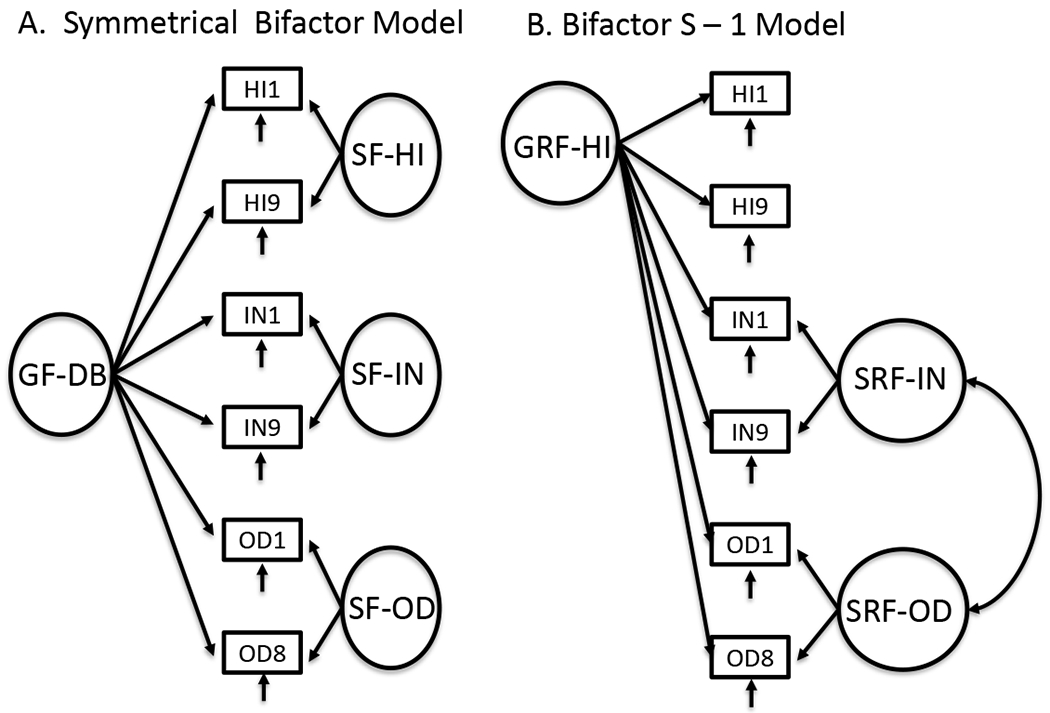
The symmetrical bifactor model is often applied to attention-deficit/hyperactivity disorder (ADHD)-hyperactive/impulsive (HI), ADHD-inattentive (IN), and oppositional defiant disorder (ODD) symptoms, but this model frequently yields anomalous or inadmissible results. An alternative model, the bifactor S - 1 model, is more appropriate for examining the hierarchical structure of ADHD/ODD symptoms. Both models were applied to ADHD-HI, ADHD-IN, and ODD symptom ratings by mothers, fathers, and teachers for 2142 Spanish children (49.49% girls; ages 8-13 years). The symmetrical bifactor model yielded the typical anomalous loadings, with a weakly defined ADHD-HI specific factor and difficult to interpret associations of general and specific factors with correlates. In contrast, the bifactor S - 1 model with ADHD-HI symptoms as general reference factor produced clearly interpretable results. For mothers and fathers, slightly more than 50% of true score variance in ADHD-IN and ODD symptoms represented specific residual variance not shared with the general ADHD-HI reference factor. For teachers, approximately 69% and 39% of true score variance in ADHD-IN and ODD symptoms, respectively, represented specific residual variance not shared with the general ADHD-HI reference factor. The general ADHD-HI reference factor and specific ADHD-IN and ODD residual factors showed convergent and discriminant validity across sources, along with unique associations with peer rejection, social impairment, and academic impairment factors. The bifactor S - 1 model also yielded results consistent with predictions from trait-impulsivity theory of ADHD/ODD development. Researchers should use the bifactor S - 1 model rather than the symmetrical bifactor model if hypotheses involve the latent hierarchical structure of ADHD/ODD symptoms.
Keywords: Attention-deficit/hyperactivity disorder; Bifactor S – 1 model; Bifactor model; Disruptive behavior disorders; Oppositional defiant disorder; P factor; Trait impulsivity theory.
Conflict of interest statement
Figures
Comment in
-
Multi-Faceted Constructs in Abnormal Psychology: Implications of the Bifactor S - 1 Model for Individual Clinical Assessment.J Abnorm Child Psychol. 2020 Jul;48(7):895-900. doi: 10.1007/s10802-020-00624-9. J Abnorm Child Psychol. 2020. PMID: 32086729 Free PMC article.
-
Commentary on Application of the Bifactor S-1 Model to Multisource Ratings of ADHD/ODD Symptoms: An Appropriate Bifactor Model for Symptom Ratings.J Abnorm Child Psychol. 2020 Jul;48(7):901-904. doi: 10.1007/s10802-020-00629-4. J Abnorm Child Psychol. 2020. PMID: 32125587
-
Applying the Bifactor S-1 Model to Ratings of ADHD/ODD Symptoms: A Commentary on Burns et al. (2019) and a Re-Analysis.J Abnorm Child Psychol. 2020 Jul;48(7):905-910. doi: 10.1007/s10802-020-00637-4. J Abnorm Child Psychol. 2020. PMID: 32236849
-
The Bifactor S-1 Model: a Psychometrically Sounder Alternative to Test the Structure of ADHD and ODD?J Abnorm Child Psychol. 2020 Jul;48(7):911-915. doi: 10.1007/s10802-020-00645-4. J Abnorm Child Psychol. 2020. PMID: 32285353
References
-
- Beauchaine TP (2015). Future directions in emotion dysregulation and youth psychopathology. Journal of Clinical Child and Adolescent Psychology, 44, 875–896. doi.org/10.1080/15374416.2015.1038827 - PubMed
-
- Beauchaine TP, & McNulty T (2013). Comorbidities and continuities as ontogenic processes: Toward a developmental spectrum model of externalizing psychopathology. Development and Psychopathology, 25, 1505–1528. doi.org/10.1017/S0954579413000746 - PMC - PubMed
Publication types
MeSH terms
Grants and funding
LinkOut - more resources
Full Text Sources
