


Review of Ginseng Anti-Diabetic Studies
- PMID: 31835292
- PMCID: PMC6943541
- DOI: 10.3390/molecules24244501
Review of Ginseng Anti-Diabetic Studies
Abstract
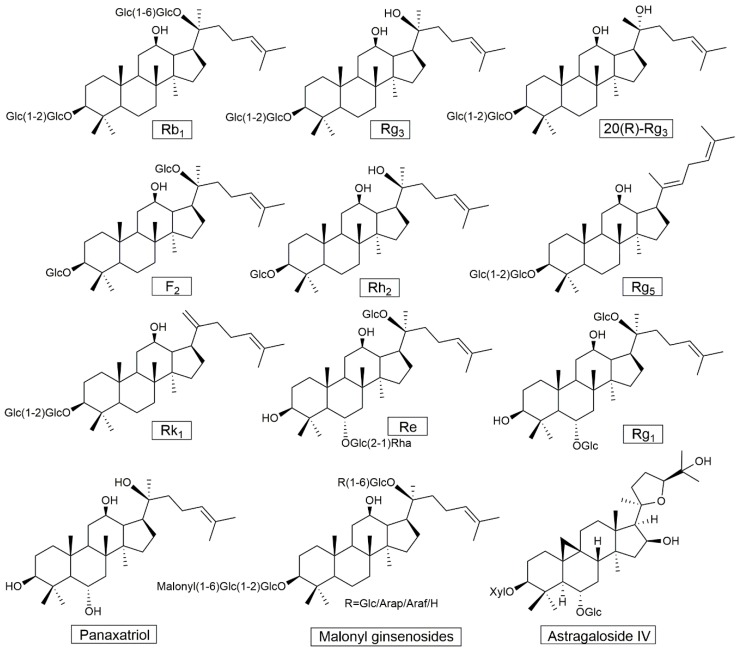
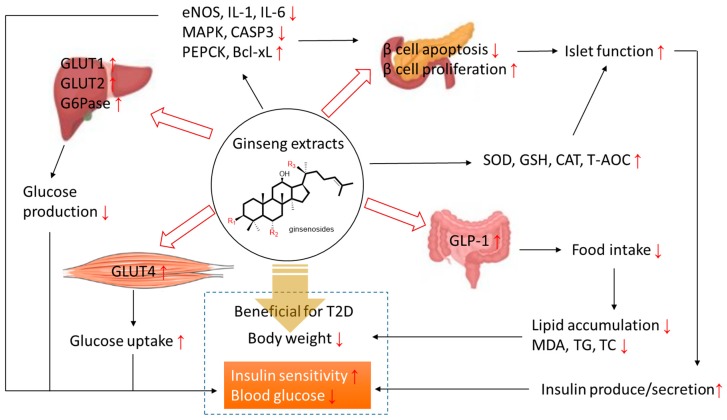
Ginseng is one of the most valuable and commonly used Chinese medicines not only in ancient China but also worldwide. Ginsenosides, also known as saponins or triterpenoids, are thought to be responsible for the beneficial effects of ginseng. In this review, we summarize recent publications on anti-diabetic studies of ginseng extracts and ginsenosides in cells, animals, and humans. It seems that the anti-diabetic effect of ginseng is positive for type 2 diabetic patients but has no significant impact on prediabetes or healthy adults. Regulation of insulin secretion, glucose uptake, anti-oxidative stress, and anti-inflammatory pathways may be the mechanisms involved with ginseng's anti-diabetic effects. Taken together, this summary provides evidence for the anti-diabetes effects of ginseng extracts and ginsenosides as well as the underlying mechanisms of their impact on diabetes.
Keywords: anti-diabetes; blood glucose; ginseng; ginsenosides; insulin.
Conflict of interest statement
The authors declare no conflict of interest.
Figures
References
-
- International Diabetes Federation . IDF Diabetes Atlas. 9th ed. IDF; Brussels, Belgium: 2019.
-
- Li Z., Jin H., Chen W., Sun Z., Jing L., Zhao X., Zhu S., Guo X., Study Group C.N. Influencing Factors of Knowledge, Attitude, and Practice regarding Medical Nutrition Therapy in Patients with Diabetes: A National Cross-Sectional Study in Urban China. J. Diabetes Res. 2017;2017:8948452. doi: 10.1155/2017/8948452. - DOI - PMC - PubMed
Publication types
MeSH terms
Substances
Grants and funding
LinkOut - more resources
Full Text Sources
Medical
