. 2019 Dec 9;24(24):4507.
doi: 10.3390/molecules24244507.

Chasing ChEs-MAO B Multi-Targeting 4-Aminomethyl-7-Benzyloxy-2 H-Chromen-2-ones

Affiliations

Chasing ChEs-MAO B Multi-Targeting 4-Aminomethyl-7-Benzyloxy-2 H-Chromen-2-ones

Mariagrazia Rullo et al. Molecules. .

Abstract

A series of 4-aminomethyl-7-benzyloxy-2H-chromen-2-ones was investigated with the aim of identifying multiple inhibitors of cholinesterases (acetyl- and butyryl-, AChE and BChE) and monoamine oxidase B (MAO B) as potential anti-Alzheimer molecules. Starting from a previously reported potent MAO B inhibitor (3), we studied single-point modifications at the benzyloxy or at the basic moiety. The in vitro screening highlighted triple-acting compounds (6, 8, 9, 16, 20) showing nanomolar and selective MAO B inhibition along with IC50 against ChEs at the low micromolar level. Enzyme kinetics analysis toward AChE and docking simulations on the target enzymes were run in order to get insight into the mechanism of action and plausible binding modes.

Keywords: acetylcholinesterase inhibitors; butyrylcholinesterase inhibitors; coumarin derivatives; docking simulations; monoamine oxidase B inhibitors; multi-target-directed ligands; structure–activity relationships.


Conflict of interest statement

The authors declare no conflict of interest.

Figures
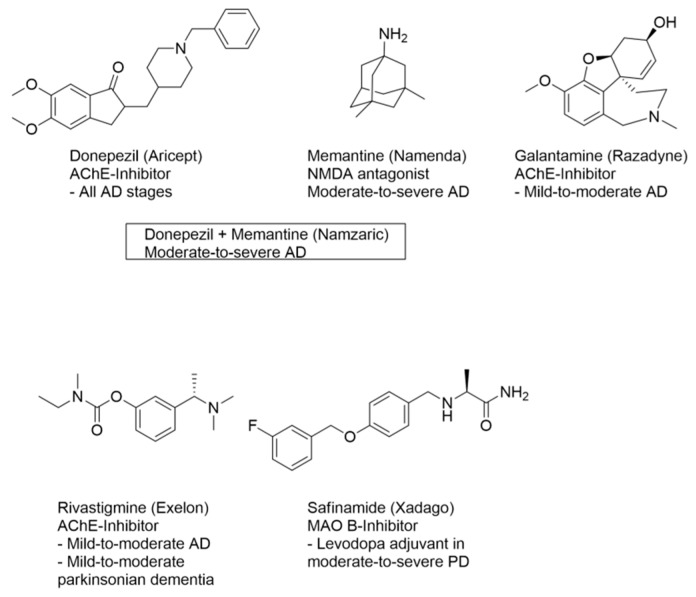
Figure 1
Figure 1
Drugs and combinations approved for the treatment of Alzheimer’s disease (AD).
Figure 2
Figure 2
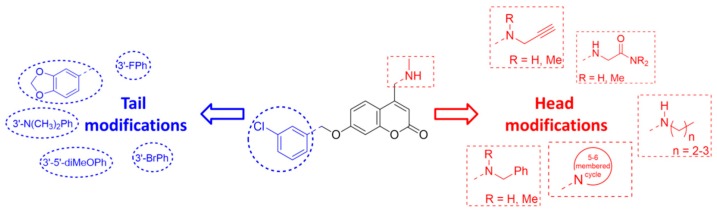
Structural modifications of starting hit NW-1772 (3).
Scheme 1
Scheme 1
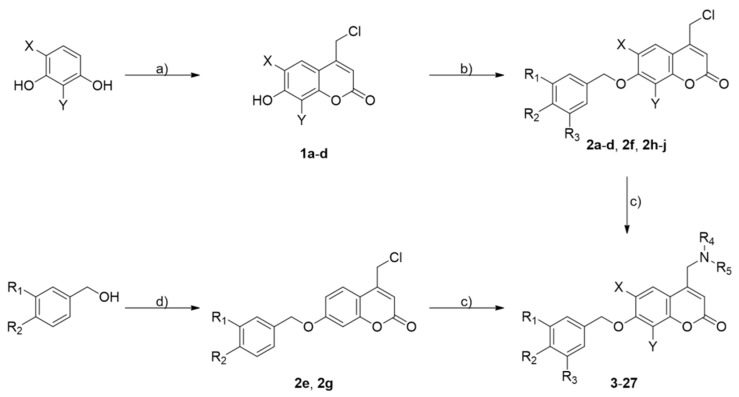
Reagents and conditions: a) ethyl 4-chloroacetoacetate, conc. H2SO4, 0 °C for 1–2 h (for 1a, 1c) or room temperature for 24 h (for 1b, 1d); b) suitable benzyl bromide, N,N-diisopropylethylamine (DIEA), ethanol, 1.5–5 h, Δ; c) appropriate amine, dry tetrahydrofuran (THF) or dimethylformamide (DMF), DIEA or K2CO3, 4–72 h, room temperature or 80 °C; d) 4-(chloromethyl)-7-hydroxy-2H-chromen-2-one (1a), diisopropyl azodicarboxylate (DIAD), PPh3, dry THF, 18 h, room temperature.
Figure 3
Figure 3
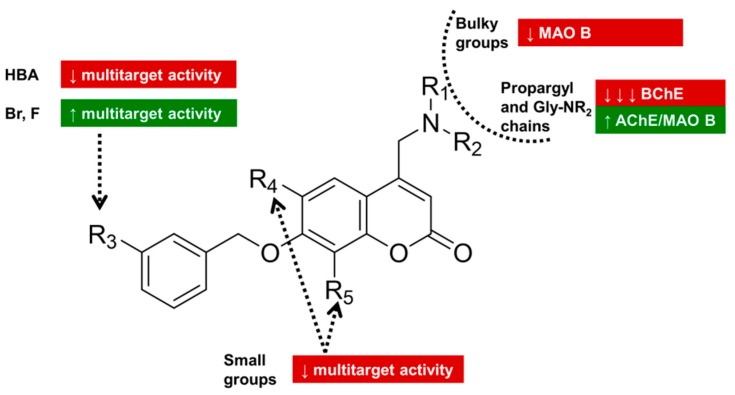
Pictorial representation of structure–activity relationships.
Figure 4
Figure 4
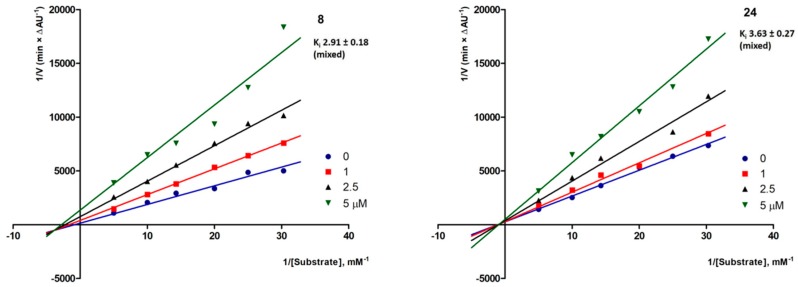
Electric eel AChE enzyme kinetics for compounds 8 (left) and 24 (right).
Figure 5
Figure 5
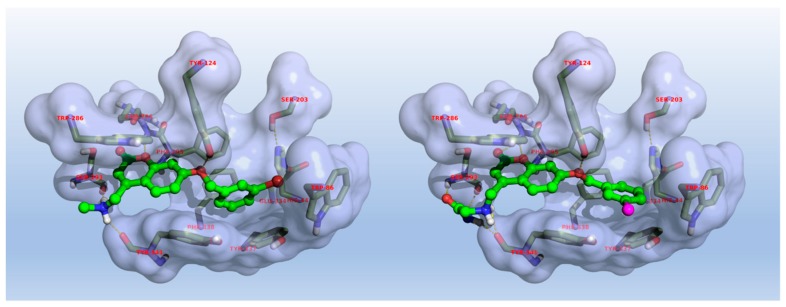
Predicted binding mode of compounds 8 (left) and 24 (right) within hAChE (PDB entry 6O4W). For a data summary, see Table S1.
Figure 6
Figure 6
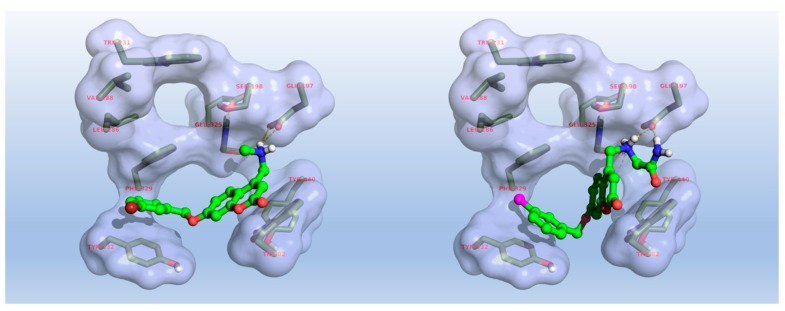
Predicted binding mode of compounds 8 (left) and 24 (right) within human BChE (PDB entry 6F7Q).

References

    1. Alzheimer’s Association 2017 Alzheimer’s disease facts and figures. Alzheimer’s Dement. 2017;13:325–373. doi: 10.1016/j.jalz.2017.02.001. - DOI - PubMed
    1. Prince M., Comas-Herrera A., Knapp M., Guerchet M., Karagiannidou M. World Alzheimer Report 2016: Improving Healthcare for People Living with Dementia. Alzheimer’s Disease International (ADI); London, UK: 2016. pp. 1–140.
    1. Querfurth H.W., LaFerla F.M. Alzheimer’s disease: Mechanism of disease. N. Engl. J. Med. 2010;362:329–344. doi: 10.1056/NEJMra0909142. - DOI - PubMed
    1. Scarpini E., Scheltens P., Feldman H. Treatment of Alzheimer’s disease: Current status and new perspectives. Lancet. Neurol. 2003;2:539–547. doi: 10.1016/S1474-4422(03)00502-7. - DOI - PubMed
    1. Kumar A., Singh A., Ekavali A review on Alzheimer’s disease pathophysiology and its management: An update. Pharm. Rep. 2015;67:195–203. doi: 10.1016/j.pharep.2014.09.004. - DOI - PubMed

MeSH terms

LinkOut - more resources