


Effects of the therapist's statements on the patient's outcome and the therapeutic alliance: A systematic review
- PMID: 31837282
- PMCID: PMC7187422
- DOI: 10.1002/cpp.2416
Effects of the therapist's statements on the patient's outcome and the therapeutic alliance: A systematic review
Abstract
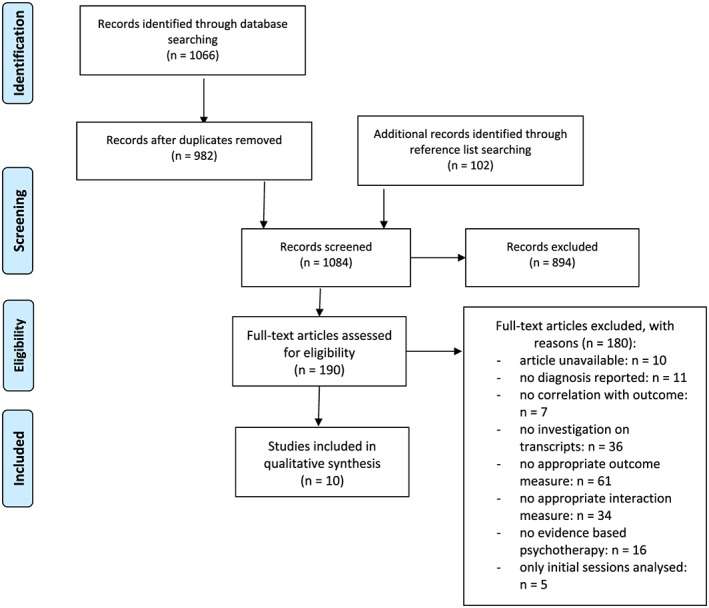
This systematic review summarizes articles that examined the effects of the psychotherapist's statements on the outcome of the patient and the therapeutic alliance. The databases PsychINFO, PSYNDEX, PubMed, and PsychARTICLES were searched, and English peer-reviewed articles were included. Participants should be adult patients with Diagnostic and Statistical Manual of Mental Disorders diagnosis who were receiving evidence-based psychotherapy in an individual setting. Studies with a standardized, observer-based measurement of the therapist's verbal utterances on the basis of verbatim transcripts of therapy sessions were included. Furthermore, there should be a standardized measurement of the symptom outcome or a measurement of the therapeutic alliance. The 10 included articles showed that supportive and exploratory statements and addressing aspects in the therapeutic relationship were perceived as positive regarding symptom outcome. Negative effects were particularly evident with controlling and challenging statements of the therapist. Regarding the therapeutic alliance, both positive and negative as well as nonsignificant results were obtained. The results of this review suggest that the question of which statements by therapists correlate positively or negatively with the outcome of therapy and the therapeutic alliance cannot be answered unequivocally and must be applied to more individual and specific situations.
Keywords: interaction; process; psychotherapy; systematic review; therapeutic alliance.
© 2019 The Authors. Clinical Psychology & Psychotherapy published by John Wiley & Sons Ltd.
Conflict of interest statement
No potential conflict of interest was reported by the authors.
Figures
References
-
- Ackerman, S. J. , & Hilsenroth, M. J. (2001). A review of therapist characteristics and techniques negatively impacting the therapeutic alliance. Psychotherapy: Theory, Research, Practice, Training, 38(2), 171–185. Retrieved from. 10.1037/0033-3204.38.2.171 - DOI
-
- American Psychiatric Association (2000). Diagnostic and statistical manual of mental disorders: DSM‐IV‐TR (4th ed., text revision). Washington, DC: American Psychiatric Association.
-
- Baldwin, S. A. , & Imel, Z. E. (2013). Therapist effects: Findings and methods In Lambert M. J. (Ed.), Bergin and Garfield's handbook of psychotherapy and behavior change (6th ed.). New York, NY: John Wiley & Sons.
-
- Baldwin, S. A. , Wampold, B. E. , & Imel, Z. E. (2007). Untangling the alliance‐outcome correlation exploring the relative importance of therapist and patient variability in the alliance. Journal of Consulting and Clinical Psychology, 75(6), 842 Retrieved from–852. http://content.apa.org/journals/ccp/75/6/842, 10.1037/0022-006X.75.6.842 - DOI - PubMed
Publication types
MeSH terms
LinkOut - more resources
Full Text Sources
Medical
