Review
. 2019 Dec 12;8(12):1625.
doi: 10.3390/cells8121625.

The Enigmatic Function of PARP1: From PARylation Activity to PAR Readers

Affiliations
Review

The Enigmatic Function of PARP1: From PARylation Activity to PAR Readers

Tatiana Kamaletdinova et al. Cells. .

Abstract

Poly(ADP-ribosyl)ation (PARylation) is catalysed by poly(ADP-ribose) polymerases (PARPs, also known as ARTDs) and then rapidly removed by degrading enzymes. Poly(ADP-ribose) (PAR) is produced from PARylation and provides a delicate and spatiotemporal interaction scaffold for numerous target proteins. The PARylation system, consisting of PAR synthesizers and erasers and PAR itself and readers, plays diverse roles in the DNA damage response (DDR), DNA repair, transcription, replication, chromatin remodeling, metabolism, and cell death. Despite great efforts by scientists in biochemistry, cell and molecular biology, genetics, and pharmacology over the last five decades, the biology of PARPs and PARylation remains enigmatic. In this review, we summarize the current understanding of the biological function of PARP1 (ARTD1), the founding member of the PARP family, focusing on the inter-dependent or -independent nature of different functional domains of the PARP1 protein. We also discuss the readers of PAR, whose function may transduce signals and coordinate the cellular processes, which has recently emerged as a new research avenue for PARP biology. We aim to provide some perspective on how future research might disentangle the biology of PARylation by dissecting the structural and functional relationship of PARP1, a major effector of the PARPs family.

Keywords: PAR; PAR binder; PAR-binding motif; PARP1; PARylation activity.


Conflict of interest statement

The authors declare no conflict of interest.

Figures
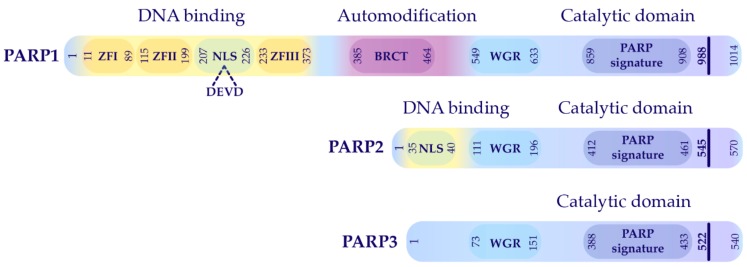
Figure 1
Figure 1
The scheme of PARP1, PARP2, and PARP3 structure and its functional domains. ZFI: zinc finger I, ZFII: zinc finger II, ZFIII: zinc finger III, NLS: nuclear localization signal, BRCT: BRCA1 C-terminal, DEVD: caspase cleavage site, and AAA: ankyrin repeat. The major domains and active catalytic sites are marked.
Figure 2
Figure 2
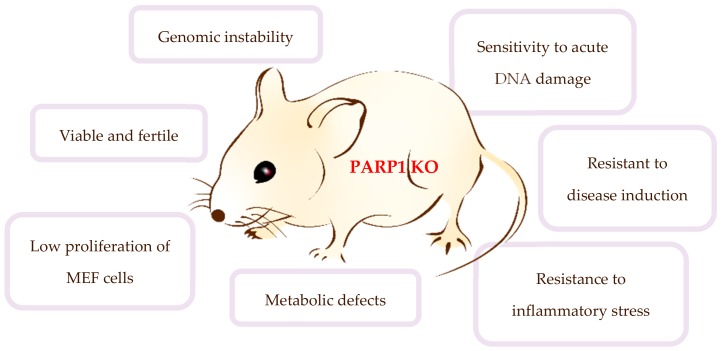
General characteristics of PARP1 knock-out (KO) mice. These mutant mice are surprisingly viable, fertile and have normal life, despite the genome being unstable. While these mice are extremely sensitive to alkylating agents and ionizing radiation, they are resistant to inflammatory stimuli, and ischemic and endotoxic treatment.
Figure 3
Figure 3
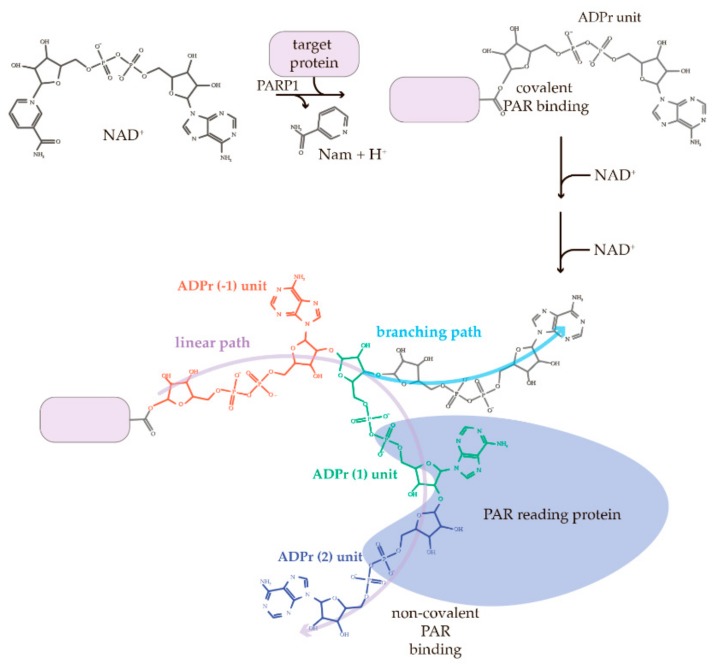
The scheme of PAR chain synthesis on the target protein. PARP1 cleaves the glycosidic bond between nicotinamide and ribose of NAD+, then provides the covalent attachment of ADP-ribose (ADPr) onto target proteins. Upcoming NAD+ molecules are used to further chain elongation via 2′,1′′-O-glycosidic bond. The branching point is 2′′,1′′′-O-glycosidic bond. PAR chains can be read by proteins containing specific and distinct PAR-binding motifs and bound non-covalently. The reading via the PBZ domain is illustrated in the picture.
Figure 4
Figure 4
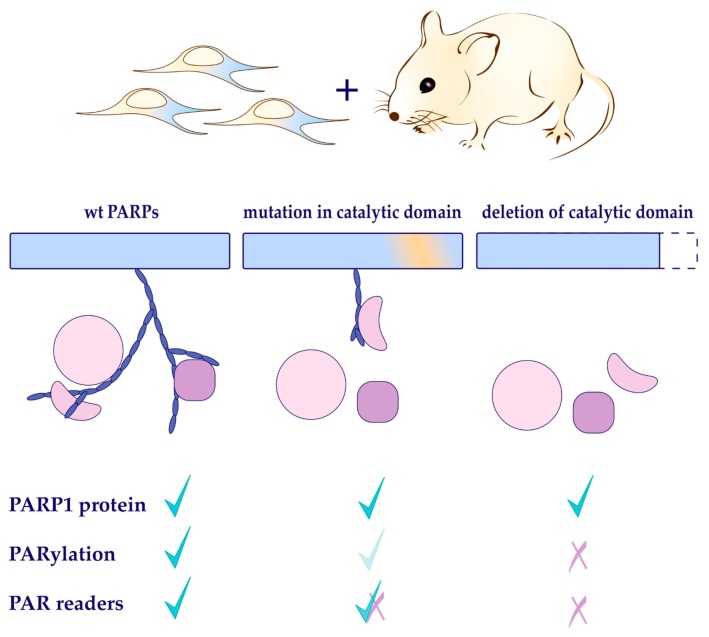
Genetic mutations of PARP1 in cells and mice have been used to study the function of PARP1 protein, PARylation activity, and PAR readers. While these studies have provided much insight into the function of PARP biology, it remains largely open as to how PARP1 protein, or its enzyme activity, or PAR readers are important in the cellular processes that dictate cell fate and pathological outcomes. Therefore, it calls for more defined and separation-of-function mutation studies.

References

    1. Liu C., Vyas A., Kassab M.A., Singh A.K., Yu X. The role of poly ADP-ribosylation in the first wave of DNA damage response. Nucleic Acids Res. 2017;45:8129–8141. doi: 10.1093/nar/gkx565. - DOI - PMC - PubMed
    1. Schuhwerk H., Atteya R., Siniuk K., Wang Z.Q. PARPing for balance in the homeostasis of poly(ADP-ribosyl)ation. Semin Cell Dev. Biol. 2017;63:81–91. doi: 10.1016/j.semcdb.2016.09.011. - DOI - PubMed
    1. Gupte R., Liu Z., Kraus W.L. PARPs and ADP-ribosylation: Recent advances linking molecular functions to biological outcomes. Genes Dev. 2017;31:101–126. doi: 10.1101/gad.291518.116. - DOI - PMC - PubMed
    1. Min W., Wang Z.-Q. Poly (ADP-ribose) glycohydrolase (PARG) and its therapeutic potential. Front. BioSci. 2009;14:1619–1626. doi: 10.2741/3329. - DOI - PubMed
    1. Slade D., Dunstan M.S., Barkauskaite E., Weston R., Lafite P., Dixon N., Ahel M., Leys D., Ahel I. The structure and catalytic mechanism of a poly(ADP-ribose) glycohydrolase. Nature. 2011;477:616–620. doi: 10.1038/nature10404. - DOI - PMC - PubMed

Publication types

Substances

LinkOut - more resources