


Health-related preferences of older patients with multimorbidity: an evidence map
- PMID: 31843855
- PMCID: PMC6924802
- DOI: 10.1136/bmjopen-2019-034485
Health-related preferences of older patients with multimorbidity: an evidence map
Abstract
Objectives: To systematically identify knowledge clusters and research gaps in the health-related preferences of older patients with multimorbidity by mapping current evidence.
Design: Evidence map (systematic review variant).
Data sources: MEDLINE, EMBASE, PsycINFO, PSYNDEX, CINAHL and Science Citation Index/Social Science Citation Index/-Expanded from inception to April 2018.
Study selection: Studies reporting primary research on health-related preferences of older patients (mean age ≥60 years) with multimorbidity (≥2 chronic/acute conditions).
Data extraction: Two independent reviewers assessed studies for eligibility, extracted data and clustered the studies using MAXQDA-18 content analysis software.
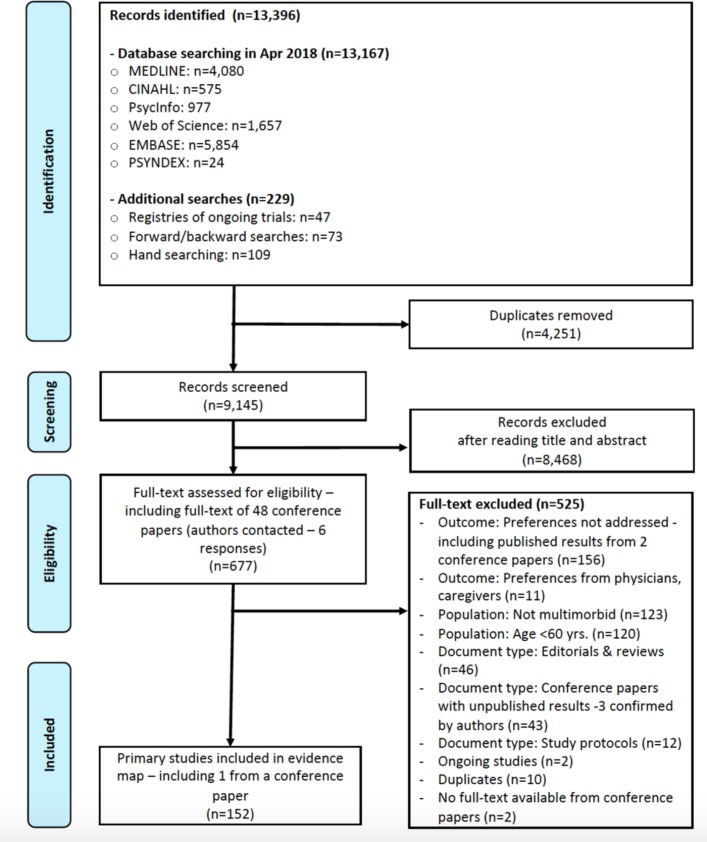
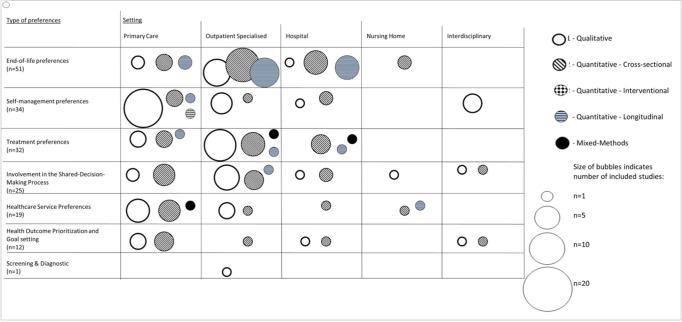
Results: The 152 included studies (62% from North America, 28% from Europe) comprised 57 093 patients overall (range 9-9105). All used an observational design except for one interventional study: 63 (41%) were qualitative (59 cross-sectional, 4 longitudinal), 85 (57%) quantitative (63 cross-sectional, 22 longitudinal) and 3 (2%) used mixed methods. The setting was specialised care in 85 (56%) and primary care in 54 (36%) studies. We identified seven clusters of studies on preferences: end-of-life care (n=51, 34%), self-management (n=34, 22%), treatment (n=32, 21%), involvement in shared decision making (n=25, 17%), health outcome prioritisation/goal setting (n=19, 13%), healthcare service (n=12, 8%) and screening/diagnostic testing (n=1, 1%). Terminology (eg, preferences, views and perspectives) and concepts (eg, trade-offs, decision regret, goal setting) used to describe health-related preferences varied substantially between studies.
Conclusion: Our study provides the first evidence map on the preferences of older patients with multimorbidity. Included studies were mostly conducted in developed countries and covered a broad range of issues. Evidence on patient preferences concerning decision-making on screening and diagnostic testing was scarce. Differences in employed terminology, decision-making components and concepts, as well as the sparsity of intervention studies, are challenges for future research into evidence-based decision support seeking to elicit the preferences of older patients with multimorbidity and help them construct preferences.
Trial registration number: Open Science Framework (OSF): DOI 10.17605/OSF.IO/MCRWQ.
Keywords: general medicine (see internal medicine); geriatric medicine; internal medicine.
© Author(s) (or their employer(s)) 2019. Re-use permitted under CC BY-NC. No commercial re-use. See rights and permissions. Published by BMJ.
Conflict of interest statement
Competing interests: None declared.
Figures
References
-
- van den Akker M, Buntinx F, Knottnerus JA. Comorbidity or multimorbidity: what’s in a name? A review of literature. Eur J Gen Pract 1996;2:65–70.
Publication types
MeSH terms
LinkOut - more resources
Full Text Sources
Medical
Miscellaneous
