. 2019 Dec 26;116(52):26798-26807.
doi: 10.1073/pnas.1915608116. Epub 2019 Dec 16.

Characterization of splice-altering mutations in inherited predisposition to cancer

Affiliations

Characterization of splice-altering mutations in inherited predisposition to cancer

Silvia Casadei et al. Proc Natl Acad Sci U S A. .

Abstract

Mutations responsible for inherited disease may act by disrupting normal transcriptional splicing. Such mutations can be difficult to detect, and their effects difficult to characterize, because many lie deep within exons or introns where they may alter splice enhancers or silencers or introduce new splice acceptors or donors. Multiple mutation-specific and genome-wide approaches have been developed to evaluate these classes of mutations. We introduce a complementary experimental approach, cBROCA, which yields qualitative and quantitative assessments of the effects of genomic mutations on transcriptional splicing of tumor suppressor genes. cBROCA analysis is undertaken by deriving complementary DNA (cDNA) from puromycin-treated patient lymphoblasts, hybridizing the cDNA to the BROCA panel of tumor suppressor genes, and then multiplex sequencing to very high coverage. At each splice junction suggested by split sequencing reads, read depths of test and control samples are compared. Significant Z scores indicate altered transcripts, over and above naturally occurring minor transcripts, and comparisons of read depths indicate relative abundances of mutant and normal transcripts. BROCA analysis of genomic DNA suggested 120 rare mutations from 150 families with cancers of the breast, ovary, uterus, or colon, in >600 informative genotyped relatives. cBROCA analysis of their transcripts revealed a wide variety of consequences of abnormal splicing in tumor suppressor genes, including whole or partial exon skipping, exonification of intronic sequence, loss or gain of exonic and intronic splicing enhancers and silencers, complete intron retention, hypomorphic alleles, and combinations of these alterations. Combined with pedigree analysis, cBROCA sequencing contributes to understanding the clinical consequences of rare inherited mutations.

Keywords: cancer; mutation; splicing.


Conflict of interest statement

Competing interest statement: R.O. is an employee of Color Genomics. Z.T. is an employee of Color Genomics. T.W. consults for Color Genomics.

Figures
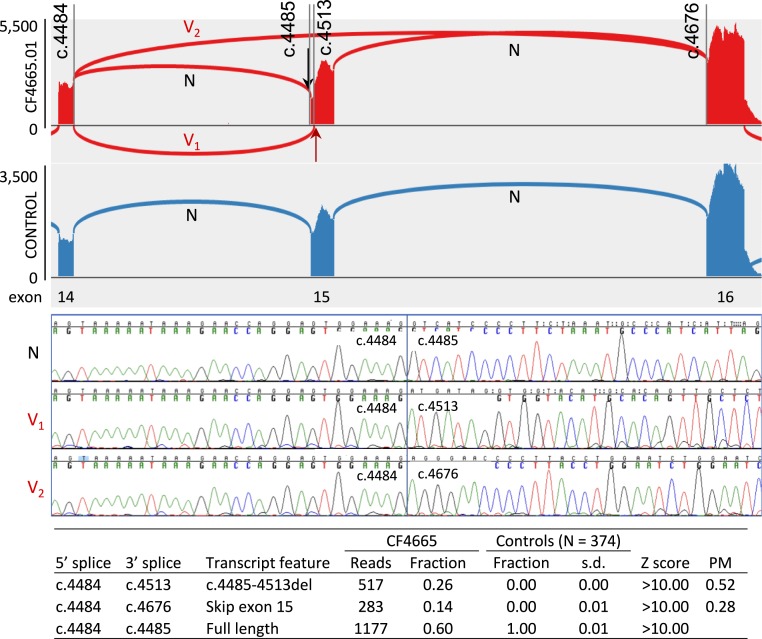
Fig. 1.
Fig. 1.
An example of analysis of BRCA1 by cBROCA. At BRCA1 exons 14 to 16, BRCA1 c.4485-1G>A (black arrow) of patient CF4665.01 produces 2 mutant transcripts (V1 and V2) and normal transcript (N) (red graph). Wild-type BRCA1 of controls produces only the normal transcript (blue graph). Mutant transcript V1 introduces a frameshift by splicing from c.4484 of exon 14 to a cryptic acceptor at c.4513 of exon 15, yielding a premature stop at codon 1496. This transcript is supported by 26% of reads (517/1,977). Mutant transcript V2 skips BRCA1 exon 15 by splicing from c.4484 to c.4676 of exon 16, yielding a premature stop of codon 1509. This transcript is supported by 14% of reads (283/1,977). Sanger sequencing validated these splice effects. Estimates of proportions of transcripts from the mutant allele (PM) are therefore 52% V1, 28% V2, and 20% wild-type.
Fig. 2.
Fig. 2.
Analysis by cBROCA of mutations in BARD1 and ATM leading to multiple abnormal transcripts. (A) In family CF5058, BARD1 c.159-1C>T occurs in the proband, who was diagnosed with ovarian cancer (Ov) at age 58, her son who was diagnosed with prostate cancer (Pr) at age 52, and two other female relatives who underwent risk-reducing bilateral salpingo-oophorectomy (BSO) and remain cancer-free. Heterozygosity for the variant allele is indicated by VN and homozygosity for the nonmutant allele by NN. (B) In family CF1395, ATM c.5674+1G>T occurs in relatives who developed cancers of the breast (Br, including bilateral breast cancer [Bil Br]), ovary (Ov), prostate (Pr), pancreas (Pa), and cholangiocarcinoma/bile duct (Chlnc); and acute lymphocytic leukemia (ALL), leukemia (Leuk), non-Hodgkin lymphoma (NHL), and Hodgkin Disease (HD). Heterozygosity for the variant allele is indicated by VN and homozygosity for the nonmutant allele by NN. (C) In family CF5058, BARD1 c.159-1C>T (black arrow) yields two abnormal transcripts: V1, which skips exon 2, including critical residues Cys53, Cys66, His68, and Cys71 of the BARD1 RING domain, and V2, which skips exons 2 and 3 with an immediate stop at codon 53. Neither of these mutant transcripts appears in controls. (D) In family CF1395, ATM c.5674+1G>T yields multiple abnormal transcripts, nearly all of which (V1 cluster) extend into ATM intron 36 where they are subject to decay. Evidence of these transcripts was detected by cBROCA in RNA from cells treated with puromycin to inhibit nonsense-mediated decay. Other abnormal transcripts skip exons 37 and 38 (V2) or exon 37 (V3), both leading to premature stops.
Fig. 3.
Fig. 3.
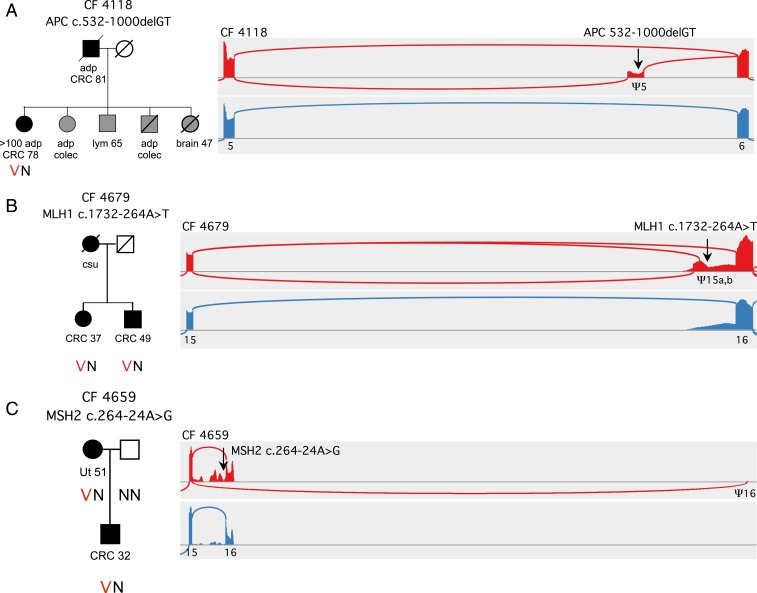
Analysis by cBROCA of intronic mutations leading to exonification. (A) In family CF4118, APC c.532-1000delGT (black arrow) leads to exonification of 165 bp in APC intron 5 and an in-frame stop. Exonification is very likely due to disruption of a silencing enhancer at chr5:112,115,485-112,115,492, and thereby activation of a splice acceptor at chr5:112,115,380 and of a splice donor at chr5:112,115,548. This exon does not appear in transcripts of controls. (B) In family CF4679, MLH1 c.1732-264A>T creates 2 exons that do not appear in normal MHL1 transcripts: one, with an insertion of 141 bp in the message and a stop at codon 587; and the other, with an insertion of 85 bp in the message and a stop at codon 581. The mechanism of exonification is likely creation of a donor splice at c.1732-264, activating previously silent acceptor sites at c.1732-406 and at c.1732-350. (C) In family CF4659, MSH2 c.2635-24A>G destroys a splicing branch-point, activating multiple cryptic splice sites in MSH1 intron 15, leading to multiple unstable transcripts. The mutation also activates a cryptic acceptor splice more than 30 kb downstream, at MSH2 c.2634+31432, creating transcripts that skip exon 16 and the 3′UTR, with a stop after 922 codons. Abbreviations are adenomatous polyps (adp), prophylactic colectomy (colec), colorectal cancer (CRC), lymphoma (lym), uterine cancer (Ut), cancer of unknown primary site (csu).
Fig. 4.
Fig. 4.
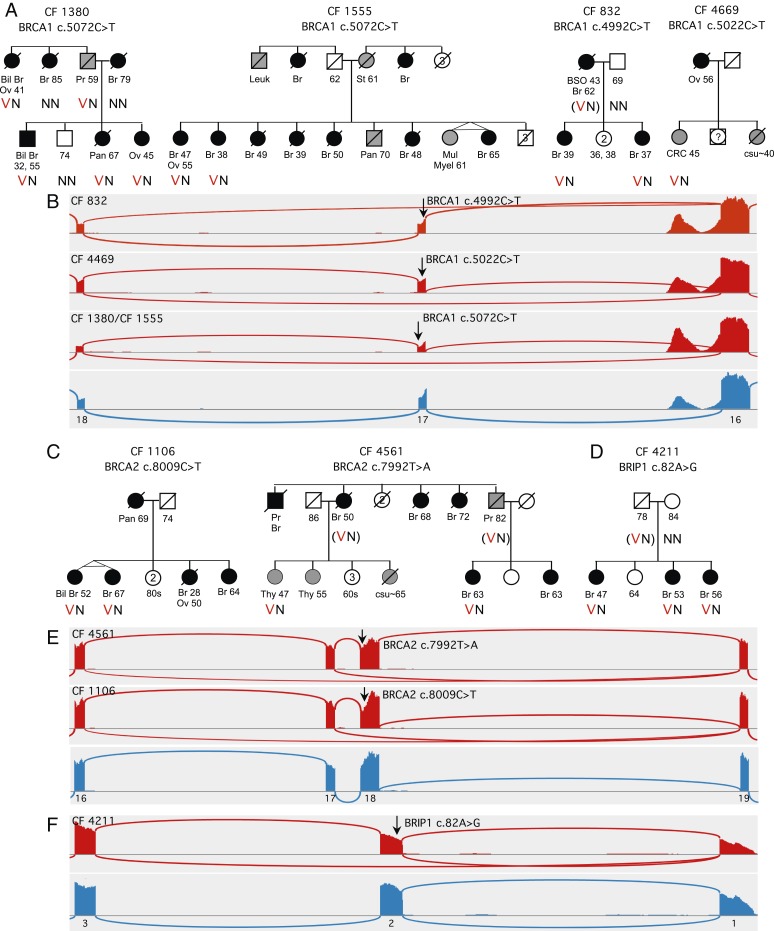
cBROCA analysis of exonic mutations in splicing enhancers and silencers. (A) Abnormal splicing of BRCA1 exon 17 in families CF1380, CF1555, CF832, and CF4469. (B) In family CF832, BRCA1 c.4992C>T deletes a splice enhancer in exon 17, leading to exon skipping in 26% of transcripts from the mutant allele. In family CF4469, BRCA1 c.5022C>T deletes a more 3′ splice enhancer of exon 17, leading to exon skipping in 32% of transcripts from the mutant allele. In families CF1380 and CF1555, BRCA1 c.5072C>T deletes a still more 3′ splice enhancer in exon 17, leading to exon skipping in 61% of transcripts from the mutant allele. In all families, proportions of mutant transcripts are significantly above background (P < 0.0000003 for each comparison). (C) Abnormal splicing of BRCA2 exon 18 in families CF1106 and CF4561. (D) Abnormal splicing of BRIP1 exon 2 in family CF4211. (E) BRCA2 c.7992T>A in family CF4561 and BRCA2 c.8009C>T in family CF1106 both lead to skipping exon 18 and a stop at codon 2702 in 43% and 51% of transcripts, and to skipping exons 17 and 18 and a stop at codon 2645 in 6% and 8% of transcripts, respectively, from the mutant alleles. (F) In family CF4211, BRIP1 c.82A>G leads to skipping exon 2, including the ATG translation start, in 43% of transcripts from the mutant allele. The next in-frame ATG in the mutant transcript is at codon 101 in exon 4, so the mutant protein is predicted to lack residues 1 to 100, including most of the DNA binding domain. Abbreviations are cancers of the breast (Br, including bilateral breast cancer [Bil Br]), ovary (Ov), pancreas (Pan), prostate (Pr), stomach (St), thyroid (Thy), unknown primary site (csu), and colorectal cancer (CRC); multiple myeloma (Mult Mye); and bilateral salpingooophorectomy (BSO). Heterozygosity for a variant allele is indicated by VN and homozygosity for the nonmutant allele by NN.
Fig. 5.
Fig. 5.
cBROCA analysis of effects of genomic copy number variants on transcription. (A) Genomic triplication of BRCA2 exons 14 to 24 in 4 families leads to greater read depth at splice junctions in cBROCA sequence of mutation carriers compared to unrelated controls (n = 87). Read depth >1.5-fold specifically at exons 14 to 24 suggests the triplication is in tandem. (B) De novo genomic deletion of BRCA2 noncoding exon 1 in family CF4727 leads to lower read depths across all BRCA2 splice junctions for the mutation carrier compared to controls (n = 17). The ratio of BRCA2 reads for CF4727 versus controls was 0.53, suggesting no BRCA2 transcription from the mutant allele. Bil, bilateral; Br, breast cancer; Pan (Panc), pancreatic cancer.

References

    1. Farber-Katz S., et al. , Quantitative analysis of BRCA1 and BRCA2 germline splicing variants using a novel RNA-massively parallel sequencing assay. Front. Oncol. 8, 286 (2018). - PMC - PubMed
    1. Fontes A., Cloning technologies. Methods Mol. Biol. 997, 253–261 (2013). - PubMed
    1. Gaildrat P., et al. , Multiple sequence variants of BRCA2 exon 7 alter splicing regulation. J. Med. Genet. 49, 609–617 (2012). - PubMed
    1. Trapnell C., Pachter L., Salzberg S. L., TopHat: Discovering splice junctions with RNA-Seq. Bioinformatics 25, 1105–1111 (2009). - PMC - PubMed
    1. Trapnell C., et al. , Differential gene and transcript expression analysis of RNA-seq experiments with TopHat and Cufflinks. Nat. Protoc. 7, 562–578 (2012). - PMC - PubMed

LinkOut - more resources