


Recommendations for good practice in ultrasound: oocyte pick up†
- PMID: 31844683
- PMCID: PMC6903452
- DOI: 10.1093/hropen/hoz025
Recommendations for good practice in ultrasound: oocyte pick up†
Abstract
Study question: What is good practice in ultrasound (US), and more specifically during the different stages of transvaginal oocyte retrieval, based on evidence in the literature and expert opinion on US practice in ART?
Summary answer: This document provides good practice recommendations covering technical aspects of US-guided transvaginal oocyte retrieval (oocyte pick up: OPU) formulated by a group of experts after considering the published data, and including the preparatory stage of OPU, the actual procedure and post-procedure care.
What is known already: US-guided transvaginal OPU is a widely performed procedure, but standards for best practice are not available.
Study design size duration: A working group (WG) collaborated on writing recommendations on the practical aspects of transvaginal OPU. A literature search for evidence of the key aspects of the procedure was carried out. Selected papers (n = 190) relevant to the topic were analyzed by the WG.
Participants/materials setting methods: The WG members considered the following key points in the papers: whether US practice standards were explained; to what extent the OPU technique was described and whether complications or incidents and how to prevent such events were reported. In the end, only 108 papers could be used to support the recommendations in this document, which focused on transvaginal OPU. Laparoscopic OPU, transabdominal OPU and OPU for IVM were outside the scope of the study.
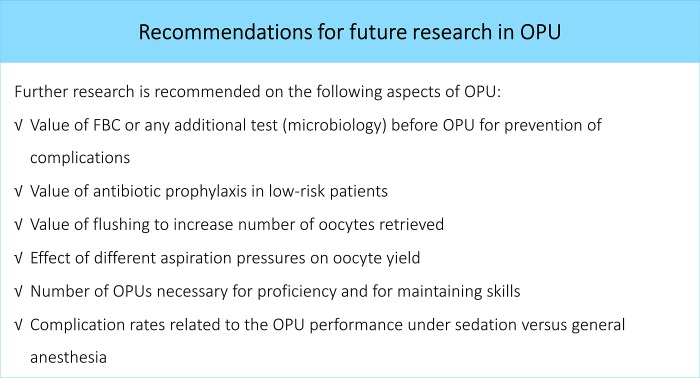
Main results and the role of chance: There was a scarcity of studies on the actual procedural OPU technique. The document presents general recommendations for transvaginal OPU, and specific recommendations for its different stages, including prior to, during and after the procedure. Most evidence focussed on comparing different equipment (needles) and on complications and risks, including the risk of infection. For these topics, the recommendations were largely based on the results of the studies. Recommendations are provided on equipment and materials, possible risks and complications, audit and training. One of the major research gaps was training and competence. This paper has also outlined a list of research priorities (including clarification on the value or full blood count, antibiotic prophylaxis and flushing, and the need for training and proficiency).
Limitations reasons for caution: The recommendations of this paper were mostly based on clinical expertise, as at present, only a few clinical trials have focused on the oocyte retrieval techniques, and almost all available data are observational. In addition, studies focusing on OPU were heterogeneous with significant difference in techniques used, which made drafting conclusions and recommendations based on these studies even more challenging.
Wider implications of the findings: These recommendations complement previous guidelines on the management of good laboratory practice in ART. Some useful troubleshooting/checklist recommendations are given for easy implementation in clinical practice. These recommendations aim to contribute to the standardization of a rather common procedure that is still performed with great heterogeneity.
Study funding/competing interests: The meetings of the WG were funded by ESHRE. The other authors declare that they have no conflict of interest.
Trial registration number: NA.ESHRE Pages content is not externally peer reviewed. The manuscript has been approved by the Executive Committee of ESHRE.
Keywords: ART; competence; good practice; guideline; needle; oocyte pick up; oocyte retrieval; quality; recommendations; ultrasound.
© The Author(s) 2019. Published by Oxford University Press on behalf of the European Society of Human Reproduction and Embryology. All rights reserved. For Permissions, please email: journals.permissions@oup.com.
Figures
References
-
- Acharya U, Elkington N, Manning L, Thorp-Jones D, Tavener G. Recommendations for good practice for sedation in assisted conception. Hum Fertil 2019;1–9. - PubMed
-
- Almog B, Rimon E, Yovel I, Bar-Am A, Amit A, Azem F. Vertebral osteomyelitis: a rare complication of transvaginal ultrasound-guided oocyte retrieval. Fertil Steril 2000;73:1250–1252. - PubMed
-
- American Institute of Ultrasound in Medicine AIUM Practice Parameter for Ultrasound Examinations in Reproductive Medicine and Infertility, 2017.
-
- Amso NN. Potential health hazards of assisted reproduction. Problems facing the clinician. Hum Reprod 1995;10:1628–1630. - PubMed
-
- Annamraju H, Ganapathy R, Webb B. Pelvic tuberculosis reactivated by in vitro fertilization egg collection? Fertil Steril 2003;2008:e2001–e2003. - PubMed
LinkOut - more resources
Full Text Sources
Research Materials