


How to detect a positive response to a fluid bolus when cardiac output is not measured?
- PMID: 31845003
- PMCID: PMC6915177
- DOI: 10.1186/s13613-019-0612-x
How to detect a positive response to a fluid bolus when cardiac output is not measured?
Abstract
Background: Volume expansion is aimed at increasing cardiac output (CO), but this variable is not always directly measured. We assessed the ability of changes in arterial pressure, pulse pressure variation (PPV) and heart rate (HR) or of a combination of them to detect a positive response of cardiac output (CO) to fluid administration.
Methods: We retrospectively included 491 patients with circulatory failure. Before and after a 500-mL normal saline infusion, we measured CO (PiCCO device), HR, systolic (SAP), diastolic (DAP), mean (MAP) and pulse (PP) arterial pressure, PPV, shock index (HR/SAP) and the PP/HR ratio.
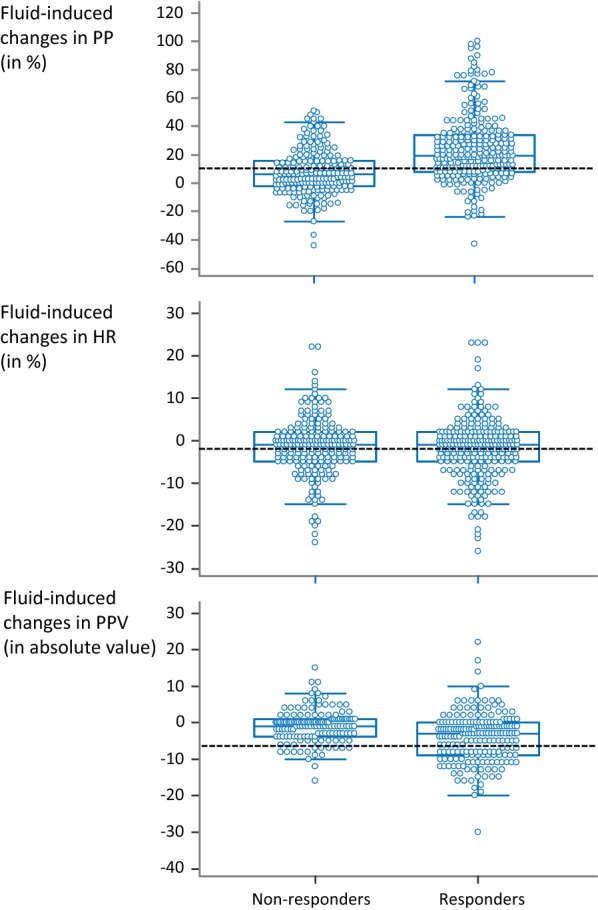
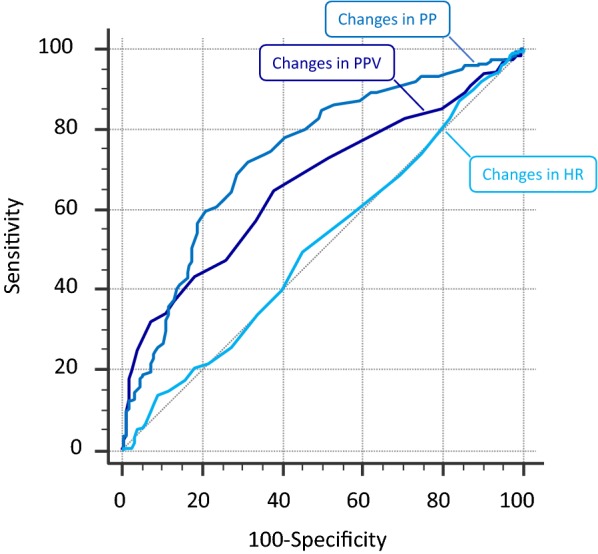
Results: The fluid-induced changes in HR were not correlated with the fluid-induced changes in CO. The area under the receiver operating characteristic curve (AUROC) for changes in HR as detectors of a positive fluid response (CO increase ≥ 15%) was not different from 0.5. The fluid-induced changes in SAP, MAP, PP, PPV, shock index (HR/SAP) and the PP/HR ratio were correlated with the fluid-induced changes in CO, but with r < 0.4. The best detection was provided by increases in PP, but it was rough (AUROC = 0.719 ± 0.023, best threshold: increase ≥ 10%, sensitivity = 72 [66-77]%, specificity = 64 [57-70]%). Neither the decrease in shock index nor the changes in other indices combining changes in HR, shock index, PPV and PP provided a better detection of a positive fluid response than changes in PP.
Conclusion: A positive response to fluid was roughly detected by changes in PP and not detected by changes in HR. Changes in combined indices including the shock index and the PP/HR ratio did not provide a better diagnostic accuracy.
Keywords: Fluid challenge; Heart rate; Pulse pressure; Pulse pressure variation; Shock index; Volume expansion.
Conflict of interest statement
J-L Teboul and X. Monnet are members of the Medical Advisory Board of Pulsion Medical Systems. J-L Teboul and X Monnet gave lectures for Masimo. The other authors have no competing interests to declare. No financial support.
Figures
References
-
- Monnet X, Letierce A, Hamzaoui O, Chemla D, Anguel N, Osman D, et al. Arterial pressure allows monitoring the changes in cardiac output induced by volume expansion but not by norepinephrine. Crit Care Med. 2011;39(6):1394–1399. - PubMed
-
- Le Manach Y, Hofer CK, Lehot J-J, Vallet B, Goarin J-P, Tavernier B, et al. Can changes in arterial pressure be used to detect changes in cardiac output during volume expansion in the perioperative period? Anesthesiology. 2012;117(6):1165–1174. - PubMed
LinkOut - more resources
Full Text Sources
Miscellaneous
