Review
. 2019 Dec 17;11(1):82.
doi: 10.1186/s13073-019-0704-0.

Genomics of circadian rhythms in health and disease

Affiliations
Review

Genomics of circadian rhythms in health and disease

Filipa Rijo-Ferreira et al. Genome Med. .

Abstract

Circadian clocks are endogenous oscillators that control 24-h physiological and behavioral processes. The central circadian clock exerts control over myriad aspects of mammalian physiology, including the regulation of sleep, metabolism, and the immune system. Here, we review advances in understanding the genetic regulation of sleep through the circadian system, as well as the impact of dysregulated gene expression on metabolic function. We also review recent studies that have begun to unravel the circadian clock's role in controlling the cardiovascular and nervous systems, gut microbiota, cancer, and aging. Such circadian control of these systems relies, in part, on transcriptional regulation, with recent evidence for genome-wide regulation of the clock through circadian chromosome organization. These novel insights into the genomic regulation of human physiology provide opportunities for the discovery of improved treatment strategies and new understanding of the biological underpinnings of human disease.


Conflict of interest statement

The authors declare that they have no competing interests.

Figures
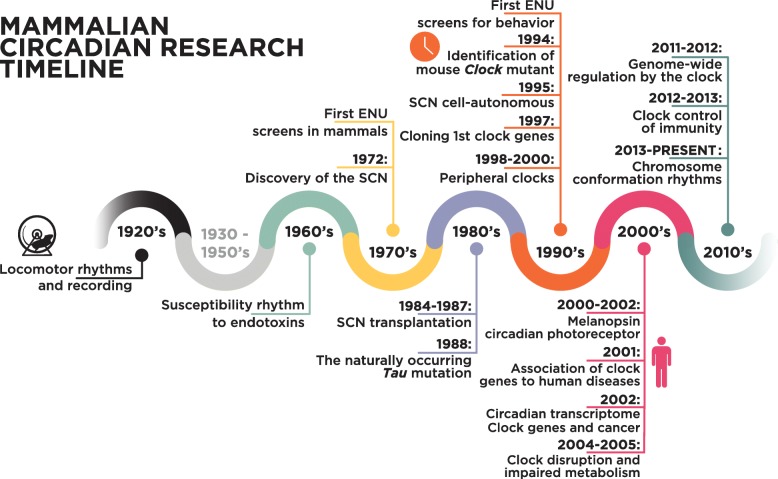
Fig. 1
Fig. 1
Timeline of major findings in mammalian circadian clock research. 1920s: first long-term recordings of locomotor rhythms in rats (reviewed in [12]). 1960: Cold Spring Harbor Symposium on Biological Clocks. First observations that time of day determines susceptibility to endotoxins [13]. 1972: lesion studies show that the suprachiasmatic nucleus (SCN) of the hypothalamus regulates adrenal corticosterone and drinking behavior rhythms [14, 15]. Late 1970s and 1980s: first ENU screens for novel gene identification were performed in mammals [16]. 1984–1990: identification of the SCN as a master regulator through transplantation experiments [17, 18]. 1988: a naturally occurring circadian Tau mutation was identified in hamsters [19]. 1990s: first mammalian ENU screens for behavior, leading to the identification of the first mammalian clock gene, Clock [2]. 1995: circadian rhythms were shown to be cell-autonomous in mammals, being retained in isolated SCN neurons [20]. 1997: cloning of the Clock gene, which was shown to belong to the bHLH–PAS family of transcription factors. In the same year, the mammalian Per1 gene was also cloned, both providing entry points for identifying the mechanism of circadian rhythmicity in mammals [3, 8]. 1998–2000: Discovery of BMAL1/MOP3 as the partner of CLOCK [5, 11], repression by CRY [10] and the Per1/2-Cry1/2 feedback loop on CLOCK:BMAL1 [21]. First descriptions of circadian clocks in the periphery [22, 23]. The cloning of the hamster Tau mutant identified CK1ε as an important kinase regulating the core circadian clock [24]. 2000s: melanopsin was identified as the circadian photoreceptor in the retina [–27]. 2001: first mutation in a clock gene associated with human disease [28]. 2002: first circadian transcriptomes revealed a significant subset of genes that have cyclic gene expression with a 24-h period [–31]. 2004–2005: association of mutations in clock genes with impaired metabolism [32, 33]. 2011: peroxiredoxin cycles reported to be independent of transcription [34]. 2011–2012: detailed descriptions of genome-wide regulation by the clock [–38]. 2012–2013: major advances in our understanding of the clock control of immunity [–42]. Present day: a new layer in our understanding of genome-wide regulation by the clock through circadian chromosome organization is emerging [–45]. ENU, N-ethyl-N-nitrosourea
Fig. 2
Fig. 2
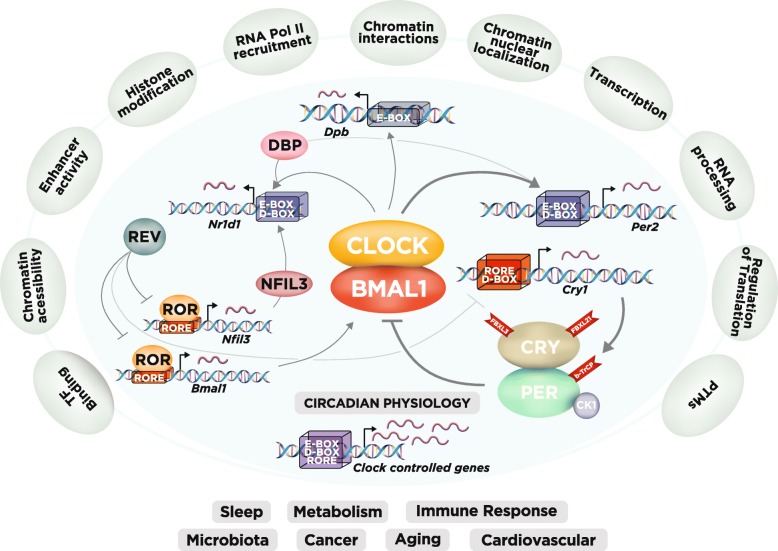
The circadian gene network and layers of genome-wide regulation in mammals. At the core of the network, the transcription factors CLOCK and BMAL1 activate the Per1, Per2, Cry1, and Cry2 genes (here we show Per2 and Cry1 as examples), whose protein products (PER and CRY) repress their own transcription. The PER and CRY proteins are post-translationally regulated by parallel E3 ubiquitin ligase pathways (FBXL3 and FBXL21 for CRY and β-TrCP for PER), with PER levels being also regulated by CK1. CLOCK and BMAL1 also regulate the expression of the Nr1d1/2 genes, which encode the nuclear receptors REV-ERBα/β, respectively. These nuclear receptors rhythmically repress the transcription of Bmal1 and Nfil3, two genes that are activated by retinoic acid-related orphan receptor-α/β (RORα/β). In turn, NFIL3 together with D-box binding protein (DBP), as well as CLOCK and BMAL1, regulate a rhythm in the REV-ERBα/β nuclear receptors. These three interlocked transcriptional feedback loops regulate the majority of cycling genes, leading to rhythms in various different physiological systems, from sleep to metabolism and aging (bottom of figure). Note that the E- and D-boxes and the RORE-binding regions are in cis upstream at the promoter; however, they are represented here as a stacked box for simplicity. Recent work has identified additional levels of regulation of circadian gene expression (outer layer of regulation in the figure), including rhythmic histone modifications, RNA polymerase II (Pol II) recruitment, circadian chromosomal conformation interactions and post-translational modifications (PTMs). Please refer to Table S1 for many of the studies that allowed the external regulatory layers to be added to the comprehensive view of the clock
Fig. 3
Fig. 3
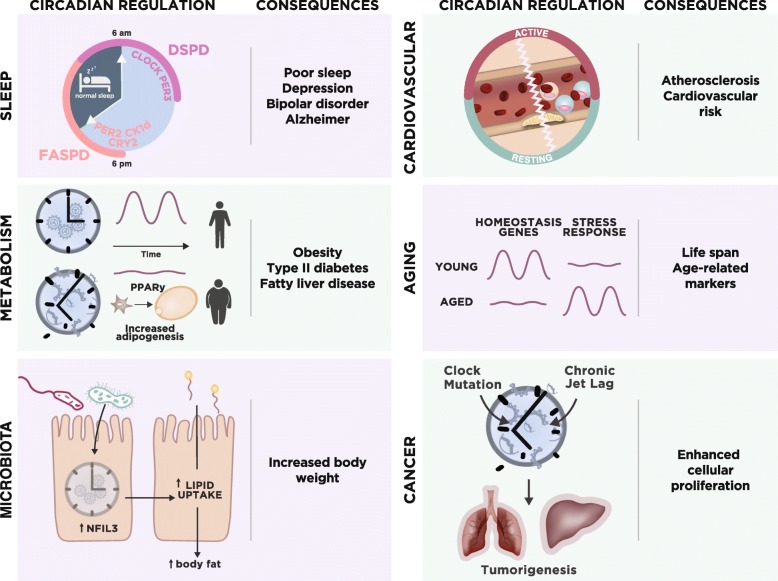
Highlights of circadian regulation across different physiological systems. Sleep: overview of circadian disruptions that directly modulate the timing and quality of sleep in humans [28, 47, 48, 76, 77] and the consequences of poor rhythms [–80]. The outer layers represent the time at which individuals who have either familial advanced sleep phase disorder (FASPD) or delayed sleep phase disorder (DSPD) usually sleep. Metabolism: the integration of corticosterone rhythmic signaling by PPARγ in adipogenesis [81] and the metabolic consequences of disrupted rhythms [32, 33]. Cardiovascular system: neutrophils and monocytes adhere to atherosclerotic plaques (represented as the yellow mass in the inner side of the blood vessel) during the transition from the active to the resting period [57]. Clock disruption also impacts the vascular system [82]. Aging: reprogramming of circadian gene expression in stem cells in aging [83] and the consequences of poor rhythms [84]. Microbiota: gut microbiota upregulate NFIL3 levels, which modulate lipid uptake and body fat [85]. Cancer: disruption of the circadian clock leads to enhanced cell proliferation and tumorigenesis [49, 50]

References

    1. Konopka RJ, Benzer S. Clock mutants of Drosophila melanogaster. Proc Natl Acad Sci U S A. 1971;68:2112–2116. doi: 10.1073/pnas.68.9.2112. - DOI - PMC - PubMed
    1. Vitaterna MH, King DP, Chang AM, Kornhauser JM, Lowrey PL, McDonald JD, et al. Mutagenesis and mapping of a mouse gene, clock, essential for circadian behavior. Science. 1994;264:719–725. doi: 10.1126/science.8171325. - DOI - PMC - PubMed
    1. King DP, Zhao Y, Sangoram AM, Wilsbacher LD, Tanaka M, Antoch MP, et al. Positional cloning of the mouse circadian clock gene. Cell. 1997;89:641–653. doi: 10.1016/S0092-8674(00)80245-7. - DOI - PMC - PubMed
    1. van der Horst GT, Muijtjens M, Kobayashi K, Takano R, Kanno S, Takao M, et al. Mammalian Cry1 and Cry2 are essential for maintenance of circadian rhythms. Nature. 1999;398:627–630. doi: 10.1038/19323. - DOI - PubMed
    1. Bunger MK, Wilsbacher LD, Moran SM, Clendenin C, Radcliffe LA, Hogenesch JB, et al. Mop3 is an essential component of the master circadian pacemaker in mammals. Cell. 2000;103:1009–1017. doi: 10.1016/S0092-8674(00)00205-1. - DOI - PMC - PubMed

Publication types

MeSH terms