


The structural basis of T-cell receptor (TCR) activation: An enduring enigma
- PMID: 31848223
- PMCID: PMC6983839
- DOI: 10.1074/jbc.REV119.009411
The structural basis of T-cell receptor (TCR) activation: An enduring enigma
Abstract
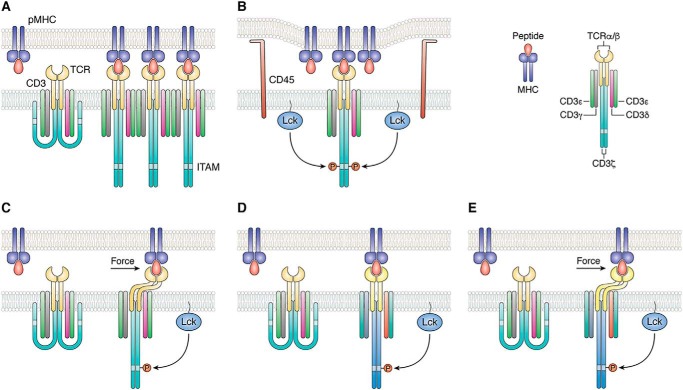
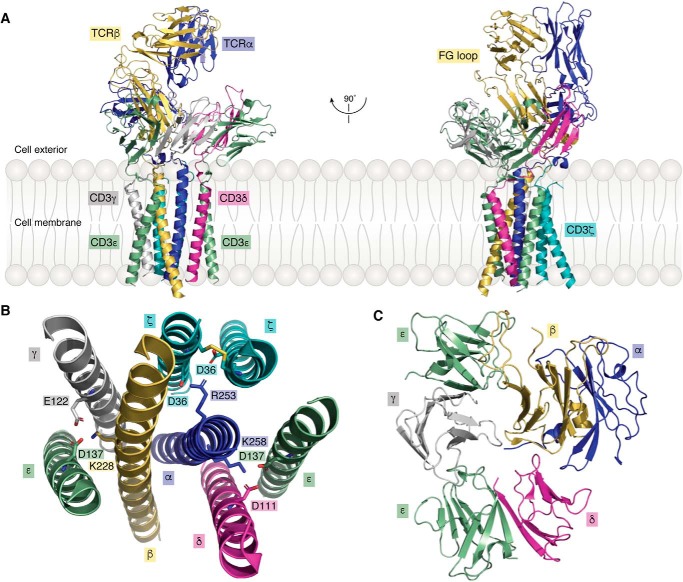
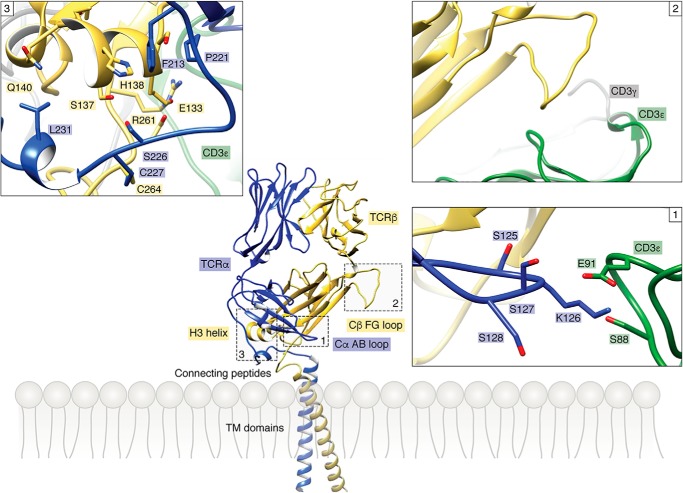
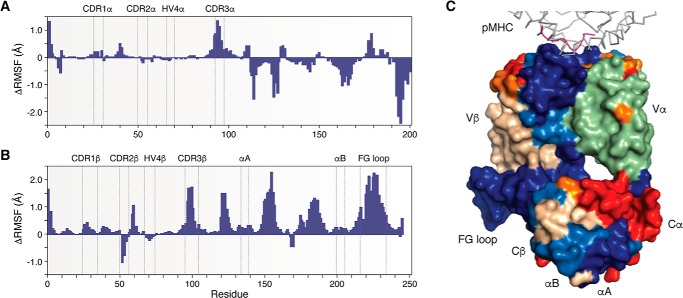
T cells are critical for protective immune responses to pathogens and tumors. The T-cell receptor (TCR)-CD3 complex is composed of a diverse αβ TCR heterodimer noncovalently associated with the invariant CD3 dimers CD3ϵγ, CD3ϵδ, and CD3ζζ. The TCR mediates recognition of antigenic peptides bound to MHC molecules (pMHC), whereas the CD3 molecules transduce activation signals to the T cell. Whereas much is known about downstream T-cell signaling pathways, the mechanism whereby TCR engagement by pMHC is first communicated to the CD3 signaling apparatus, a process termed early T-cell activation, remains largely a mystery. In this review, we examine the molecular basis for TCR activation in light of the recently determined cryoEM structure of a complete TCR-CD3 complex. This structure provides an unprecedented opportunity to assess various signaling models that have been proposed for the TCR. We review evidence from single-molecule and structural studies for force-induced conformational changes in the TCR-CD3 complex, for dynamically-driven TCR allostery, and for pMHC-induced structural changes in the transmembrane and cytoplasmic regions of CD3 subunits. We identify major knowledge gaps that must be filled in order to arrive at a comprehensive model of TCR activation that explains, at the molecular level, how pMHC-specific information is transmitted across the T-cell membrane to initiate intracellular signaling. An in-depth understanding of this process will accelerate the rational design of immunotherapeutic agents targeting the TCR-CD3 complex.
Keywords: T-cell receptor (TCR); allosteric regulation; cryo-electron microscopy; major histocompatibility complex (MHC); mechanotransduction; molecular dynamics; nuclear magnetic resonance (NMR); signal transduction.
© 2020 Mariuzza et al.
Conflict of interest statement
The authors declare that they have no conflicts of interest with the contents of this article
Figures
References
Publication types
MeSH terms
Substances
Associated data
- Actions
- Actions
- Actions
- Actions
Grants and funding
LinkOut - more resources
Full Text Sources
Other Literature Sources
Research Materials
Miscellaneous
