. 2019 Dec 17;10(6):e02788-19.
doi: 10.1128/mBio.02788-19.

Diversity in Natural Transformation Frequencies and Regulation across Vibrio Species

Affiliations

Diversity in Natural Transformation Frequencies and Regulation across Vibrio Species

Chelsea A Simpson et al. mBio. .

Abstract

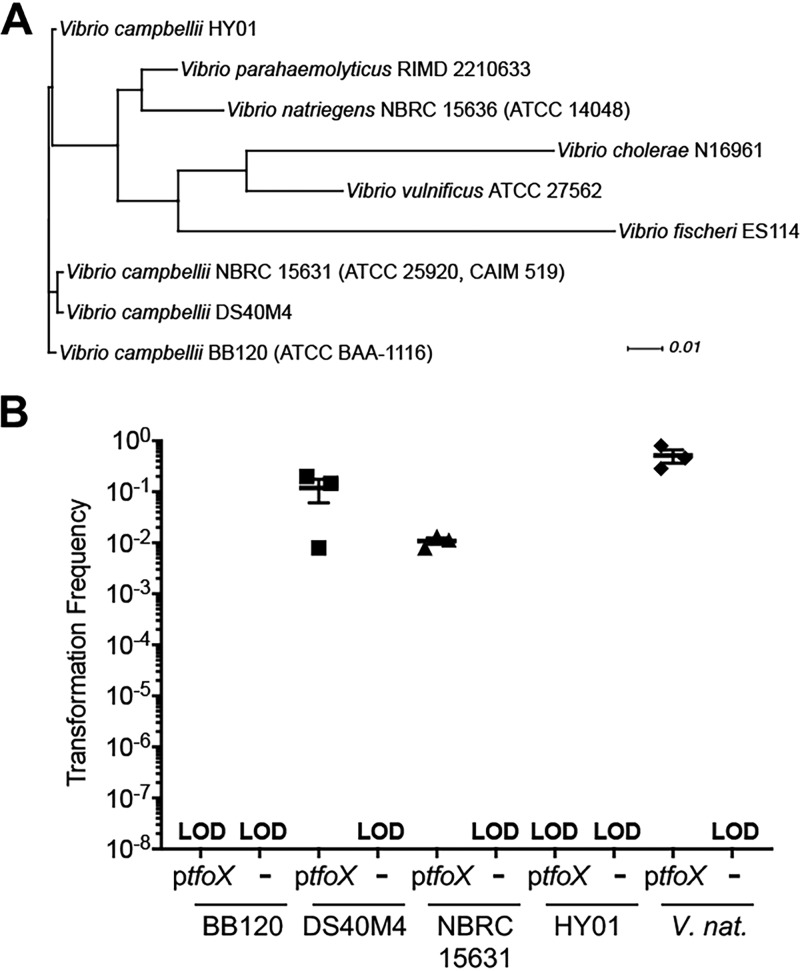
In Vibrio species, chitin-induced natural transformation enables bacteria to take up DNA from the external environment and integrate it into their genome. Expression of the master competence regulator TfoX bypasses the need for chitin induction and drives expression of the genes required for competence in several Vibrio species. Here, we show that TfoX expression in Vibrio campbellii strains DS40M4 and NBRC 15631 enables high natural transformation frequencies. Conversely, transformation was not achieved in the model quorum-sensing strain V. campbellii BB120 (previously classified as Vibrio harveyi). Surprisingly, we find that quorum sensing is not required for transformation in V. campbellii DS40M4 or Vibrio parahaemolyticus in contrast to the established regulatory pathway in Vibrio cholerae in which quorum sensing is required to activate the competence regulator QstR. Similar to V. cholerae, expression of both QstR and TfoX is necessary for transformation in DS40M4. There is a wide disparity in transformation frequencies among even closely related Vibrio strains, with V. vulnificus having the lowest functional transformation frequency. Ectopic expression of both TfoX and QstR is sufficient to produce a significant increase in transformation frequency in Vibrio vulnificus To explore differences in competence regulation, we used previously studied V. cholerae competence genes to inform a comparative genomics analysis coupled with transcriptomics. We find that transformation capability cannot necessarily be predicted by the level of gene conservation but rather correlates with competence gene expression following TfoX induction. Thus, we have uncovered notable species- and strain-level variations in the competence gene regulation pathway across the Vibrio genus.IMPORTANCE Naturally transformable, or competent, bacteria are able to take up DNA from their environment, a key method of horizontal gene transfer for acquisition of new DNA sequences. Our research shows that Vibrio species that inhabit marine environments exhibit a wide diversity in natural transformation capability ranging from nontransformability to high transformation rates in which 10% of cells measurably incorporate new DNA. We show that the role of regulatory systems controlling the expression of competence genes (e.g., quorum sensing) differs throughout both the species and strain levels. We explore natural transformation capabilities of Vibrio campbellii species which have been thus far uncharacterized and find novel regulation of competence. Expression of two key transcription factors, TfoX and QstR, is necessary to stimulate high levels of transformation in Vibrio campbellii and recover low rates of transformation in Vibrio vulnificus.

Keywords: competence; natural transformation; quorum sensing; vibrio.


Figures

FIG 1
FIG 1
Natural transformation of V. campbellii strains via tfoX expression. (A) Phylogenetic tree of Vibrio strains based on comparison of amino acid sequences of 79 core conserved genes in the genomes shown. (B) Chitin-independent transformation of V. campbellii strains BB120, DS40M4, NBRC 15631, and HY01 compared to V. natriegens. Strains contained either a plasmid expressing tfoX (pMMB67EH-tfoX-kanR) or an empty vector control (pMMB67EH-kanR for V. campbellii strains or pMMB67EH-carbR for V. natriegens). Strains were transformed with 300 ng of linear luxR::Specr tDNA (for V. campbellii) or dns::Specr tDNA (for V. natriegens). LOD, limit of detection.
FIG 2
FIG 2
V. campbellii DS40M4 and NBRC 15631 encode functional LuxR and LuxO proteins. (A to C) The PluxCDABE-gfp reporter plasmid pCS019 was introduced into wild-type, ΔluxR, and ΔluxO strains of V. campbellii BB120 (A), DS40M4 (B), and NBRC 15631 (C), and the GFP fluorescence divided by OD600 was determined (GFP expression per cell). Different letters indicate significant differences (one-way analysis of variance [ANOVA] on log-transformed data, followed by Tukey’s multiple-comparison test, P < 0.0001). (D to F) GFP expression per cell was determined as described above using the pCS019 reporter in BB120 ΔluxM ΔluxS ΔcqsA (CAS270) (D), DS40M4 ΔluxS ΔcqsA (CAS254) (E), and NBRC 15631 wild-type (F) strains in the presence or absence of supernatants (sup) from BB120-derived synthase mutant strains as indicated (TL184, AI-1; TL185, AI-2; TL16, CAI-1; JMH363, CAI-1, AI-2; KM816, CAI-1, AI-1; TL203, AI-1, AI-2; BB120, AI-1, AI-2, CAI-1). Different letters indicate significant differences (D and E, one-way analysis of variance [ANOVA] on log-transformed data, followed by Tukey’s multiple-comparison test, P < 0.05; F, unpaired t test; P < 0.05).
FIG 3
FIG 3
Natural transformation of V. campbellii DS40M4 does not require LuxR. (A and B) Transformation frequencies using chitin-independent transformation of a ΔluxB::Tmr substrate (300 ng) into wild-type, ΔluxR, and ΔluxO strains of DS40M4 (A) and NBCR 15631 (B). LOD, limit of detection. (C) Transformation frequencies using chitin-independent transformation of a Δvc1807::Tmr substrate (300 ng) into wild-type, ΔhapR, and ΔluxO strains of V. cholerae. LOD, limit of detection. In panel A, there are no significant differences (ANOVA on log-transformed data; P = 0.1054). In panels B and C, different letters indicate significant differences (ANOVA on log-transformed data, followed by Tukey’s multiple-comparison test; P < 0.01).
FIG 4
FIG 4
Comparative genomics and transcriptomics analyses of BB120 and DS40M4 competence genes. Genes required for DNA uptake and integration previously determined in V. cholerae were identified in BB120 and DS40M4 using reciprocal BLAST analyses. Genes are organized based on function. The locus tags correspond to V. cholerae genes; corresponding locus tags for BB120 and DS40M4 are in Table S4. (A) The chart indicates the amino acid identity shared between V. cholerae, BB120, and DS40M4, which is shown in each bar and by the color scale. (B) The chart indicates the RPKM values derived from RNA-seq data comparing either BB120 or DS40M4 transcript levels in the presence or absence of tfoX induction (strains contain plasmid pMMB67EH-tfoX-kanR).
FIG 5
FIG 5
Endogenous QstR expression and ectopic TfoX overexpression are necessary for natural transformation. (A) Transformation frequencies using chitin-independent transformation of a ΔluxB::Specr substrate (300 ng) into wild-type, ΔluxR, ΔqstR, and ΔluxR ΔqstR strains of DS40M4, all containing pMMB67EH-tfoX-kanR. LOD, limit of detection. Different letters indicate significant differences (Kruskal-Wallis test; P < 0.01). (B) Transformation frequencies using chitin-independent transformation of a ΔluxB::Tmr substrate (300 ng) into wild-type and ΔluxR strains of DS40M4, either with the pMMB67EH-tfoX-kanR plasmid (ptfoX), the pCS39 plasmid (pqstR), or the pCS32 plasmid (ptfoX-qstR). Different letters indicate significant differences (Kruskal-Wallis test; P < 0.01).
FIG 6
FIG 6
Natural transformation frequencies vary in Vibrio species. (A) Genes required for DNA uptake and integration previously determined in V. cholerae were identified in each Vibrio strain. Genes are organized based on function. The chart indicates the amino acid identity shared with V. cholerae proteins and indicated by the color scale. (B) Chitin-independent transformations in each of the listed Vibrio species using Specr linear tDNAs (300 ng) targeting the luxR homolog in each strain in the presence of a plasmid expressing either tfoX alone (pMMB67EH-tfoX-kanR) or both tfoX and qstR (pCS32). Asterisks indicate P < 0.0001 (ANOVA on log-transformed data followed by Tukey’s multiple-comparison test) for all strains except V. parahaemolyticus (Kruskal-Wallis test, P < 0.01). ns, not significant. LOD, limit of detection. ND, not determined. (C and D) Transformation frequencies using chitin-independent transformation of a ΔpomB::Tmr substrate (300 ng) into wild-type and ΔsmcR V. vulnificus strains expressing tfoX (pMMB67EH-tfoX-kanR) (C) or wild-type and ΔopaR V. parahaemolyticus strains expressing tfoX (pMMB67EH-tfoX-kanR) (D). LOD, limit of detection. For both panels A and B, asterisks indicate significant differences (unpaired t test; P < 0.05).
FIG 7
FIG 7
Model for regulation of natural transformation in Vibrio species. In some Vibrio strains, both chitin-sensing and quorum-sensing systems are required to activate TfoX and LuxR-type proteins, respectively. Conversely, some Vibrio strains do not require LuxR proteins, and the influence of quorum sensing on natural transformation is minimal at most. We propose that all Vibrio strains utilize TfoX and QstR to drive expression of genes required for competence, but the signaling systems used to regulate QstR differ.

References

    1. Meibom KL, Blokesch M, Dolganov NA, Wu CY, Schoolnik GK. 2005. Chitin induces natural competence in Vibrio cholerae. Science 310:1824–1827. doi:10.1126/science.1120096. - DOI - PubMed
    1. Sun Y, Bernardy EE, Hammer BK, Miyashiro T. 2013. Competence and natural transformation in vibrios. Mol Microbiol 89:583–595. doi:10.1111/mmi.12307. - DOI - PMC - PubMed
    1. Hayes CA, Dalia TN, Dalia AB. 2017. Systematic genetic dissection of chitin degradation and uptake in Vibrio cholerae. Environ Microbiol 19:4154–4163. doi:10.1111/1462-2920.13866. - DOI - PMC - PubMed
    1. Yamamoto S, Izumiya H, Mitobe J, Morita M, Arakawa E, Ohnishi M, Watanabe H. 2011. Identification of a chitin-induced small RNA that regulates translation of the tfoX gene, encoding a positive regulator of natural competence in Vibrio cholerae. J Bacteriol 193:1953–1965. doi:10.1128/JB.01340-10. - DOI - PMC - PubMed
    1. Rutherford ST, Bassler BL. 2012. Bacterial quorum sensing: its role in virulence and possibilities for its control. Cold Spring Harb Perspect Med 2:a012427. doi:10.1101/cshperspect.a012427. - DOI - PMC - PubMed

Publication types