


Design, Conduct, and Use of Patient Preference Studies in the Medical Product Life Cycle: A Multi-Method Study
- PMID: 31849657
- PMCID: PMC6902285
- DOI: 10.3389/fphar.2019.01395
Design, Conduct, and Use of Patient Preference Studies in the Medical Product Life Cycle: A Multi-Method Study
Abstract
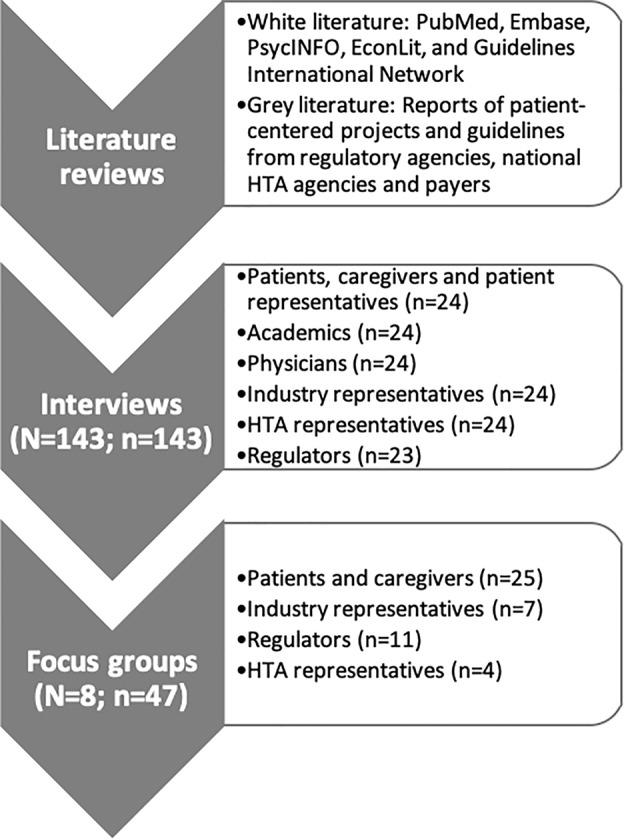
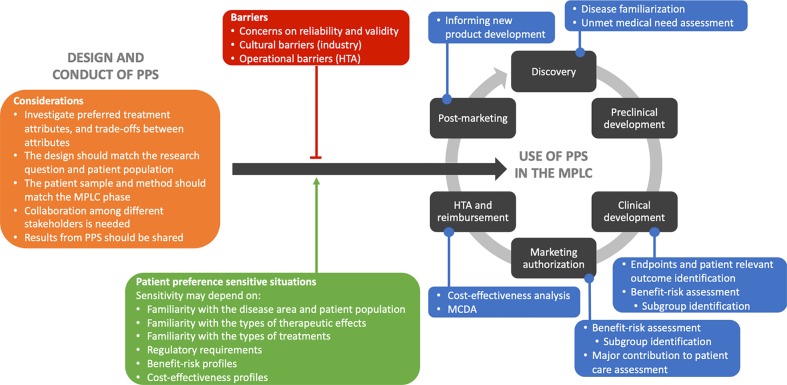
Objectives: To investigate stakeholder perspectives on how patient preference studies (PPS) should be designed and conducted to allow for inclusion of patient preferences in decision-making along the medical product life cycle (MPLC), and how patient preferences can be used in such decision-making. Methods: Two literature reviews and semi-structured interviews (n = 143) with healthcare stakeholders in Europe and the US were conducted; results of these informed the design of focus group guides. Eight focus groups were conducted with European patients, industry representatives and regulators, and with US regulators and European/Canadian health technology assessment (HTA) representatives. Focus groups were analyzed thematically using NVivo. Results: Stakeholder perspectives on how PPS should be designed and conducted were as follows: 1) study design should be informed by the research questions and patient population; 2) preferred treatment attributes and levels, as well as trade-offs among attributes and levels should be investigated; 3) the patient sample and method should match the MPLC phase; 4) different stakeholders should collaborate; and 5) results from PPS should be shared with relevant stakeholders. The value of patient preferences in decision-making was found to increase with the level of patient preference sensitivity of decisions on medical products. Stakeholders mentioned that patient preferences are hardly used in current decision-making. Potential applications for patient preferences across industry, regulatory and HTA processes were identified. Four applications seemed most promising for systematic integration of patient preferences: 1) benefit-risk assessment by industry and regulators at the marketing-authorization phase; 2) assessment of major contribution to patient care by European regulators; 3) cost-effectiveness analysis; and 4) multi criteria decision analysis in HTA. Conclusions: The value of patient preferences for decision-making depends on the level of collaboration across stakeholders; the match between the research question, MPLC phase, sample, and preference method used in PPS; and the sensitivity of the decision regarding a medical product to patient preferences. Promising applications for patient preferences should be further explored with stakeholders to optimize their inclusion in decision-making.
Keywords: decision-making; health technology assessment; marketing authorization; medical products; patient preferences.
Copyright © 2019 van Overbeeke, Janssens, Whichello, Schölin Bywall, Sharpe, Nikolenko, Phillips, Guiddi, Pravettoni, Vergani, Marton, Cleemput, Simoens, Kübler, Juhaeri, Levitan, de Bekker-Grob, Veldwijk and Huys.
Figures
References
-
- Barrow J. M., Toney-Butler T. J. (2019). Change Management. StatPearls. Treasure Island (FL): StatPearls Publishing LLC. - PubMed
-
- Bloom D., Beetsch J., Harker M., Hesterlee S., Moreira P., Patrick-Lake B., et al. (2018). The Rules of Engagement: CTTI Recommendations for Successful Collaborations Between Sponsors and Patient Groups Around Clinical Trials. Ther. Innovation Regul. Sci. 52 (2), 206–213. 10.1177/2168479017720247 - DOI - PMC - PubMed
-
- Committee for Orphan Medicinal Products (COMP) (2010). Recommendation on elements required to support the medical plausibility and the assumption of significant benefit for an orphan designation. EMA/COMP/15893/2009 Final (European Medicines Agency). www.ema.europa.eu/en/documents/regulatory-procedural-guideline/recommend...: European Medicines Agency (EMA).
LinkOut - more resources
Full Text Sources
