Review
. 2020 Apr 8;120(7):3328-3380.
doi: 10.1021/acs.chemrev.9b00440. Epub 2019 Dec 18.

Ultraviolet Photodissociation Mass Spectrometry for Analysis of Biological Molecules

Affiliations
Review

Ultraviolet Photodissociation Mass Spectrometry for Analysis of Biological Molecules

Jennifer S Brodbelt et al. Chem Rev. .

Abstract

The development of new ion-activation/dissociation methods continues to be one of the most active areas of mass spectrometry owing to the broad applications of tandem mass spectrometry in the identification and structural characterization of molecules. This Review will showcase the impact of ultraviolet photodissociation (UVPD) as a frontier strategy for generating informative fragmentation patterns of ions, especially for biological molecules whose complicated structures, subtle modifications, and large sizes often impede molecular characterization. UVPD energizes ions via absorption of high-energy photons, which allows access to new dissociation pathways relative to more conventional ion-activation methods. Applications of UVPD for the analysis of peptides, proteins, lipids, and other classes of biologically relevant molecules are emphasized in this Review.


Conflict of interest statement

The authors declare no competing financial interest.

Figures

Figure 1.
Figure 1.
UVPD has been used to characterize numerous classes of biological molecules.
Figure 2.
Figure 2.
Implementation of UVPD on (a) an Orbitrap Lumos mass spectrometer and (b) Synapt Q-TOF mass spectrometer. Adapted with permission from refs and . Copyright 2016 and 2018 American Chemical Society, respectively.
Figure 3.
Figure 3.
Fragmentation nomenclature for peptides and proteins: a/x, b/y, and c/z ions according to cleavage of backbone bonds. The subscript indicates the number of residues contained in the product, as illustrated for a tetrapeptide.
Figure 4.
Figure 4.
Production of a + 1/a and x + 1/x ions from UVPD of a protonated peptide. Adapted with permission from ref . Copyright 2005 Elsevier.
Figure 5.
Figure 5.
Distribution of 193 nm UVPD and HCD fragment ions for different proteases (GluC, LysC, trypsin, and chymotrypsin) used for Halobacterium cell lysate. The abundances of the various fragment ion types were compiled for the 25 most confidently identified peptides (based on XCorr scores) from each digest. Reproduced with permission from ref . Copyright 2015 American Chemical Society.
Figure 6.
Figure 6.
(A) HCD (3+), (B) 193 nm UVPD (3+), and (C) 193 nm UVPD (2−) spectra of tryptic peptide LNDGHFMPVLGFGTYAPPEVPR showing complementary information from each technique. Combining all methods yields 70% coverage by a- and b-type ions and 70% coverage by x- and y-type ions. Reproduced with permission from ref . Copyright 2018 American Chemical Society.
Figure 7.
Figure 7.
UVPD (193 nm) mass spectra of GEEVTAEVADGPQSVIFDQAENR from H. salinarum: (A) unmodified peptide (2−) and (B) carbamylated peptide (2−). # indicates the loss of water; Δ represents carbamylation. Combined number of unique (C) peptide and (D) protein identifications from LC/UVPD-MS analyses of carbamylated and unmodified tryptic peptides from H. salinarum in the negative mode in triplicate. Reproduced with permission from ref . Copyright 2014 American Chemical Society.
Figure 8.
Figure 8.
Comparison of (A) HCD and (B) 193 nm UVPD for analysis of phosphopeptide APPDNLPSPGGSR. The modification losses are encoded as (1) H3PO4 + H2O, (2) H3PO4, and (3) full modification or HPO3. The insets show the contribution of neutral losses of phosphomodifications (red pie segments) to the total ion current. (C) Percentage of neutral losses of phosphorylation modifications caused by HCD (red bars) versus UVPD (blue bars) for mono-, bi-, and triphosphorylated peptides, expressed as a percentage of total ion current. Reproduced with permission from ref . Copyright 2016 American Chemical Society.
Figure 9.
Figure 9.
Phosphorylations identified in Drosophila melanogaster C-terminal domain (CTD) of RNA polymerase II following treatment with Erk2 using LC-UVPD-MS. (A) Sites of phosphorylation in Drosophila melanogaster CTD, where confirmed sites are highlighted in green. One peptide (repeat 28) shows a single phosphorylation, but the position of the phosphate could not be distinguished among three sites (shown in gold). Regions of the protein in gray were not detected in the Erk2-treated or control CTD samples. The phosphorylation map is the composite of sites identified using positive-mode and negative-mode LC-UVPD-MS. Representative 193 nm UVPD mass spectra from positive-mode (B) and negative-mode (C) analyses are shown for the chymotryptic peptide SPTpSPVYSPTVQF, which covers heptads 11 and 12. In both polarities, the doubly charged ions of m/z 745.3 (for positive mode) and m/z 743.3 (for negative mode) were activated using 2 laser pulses at 2 mJ. Ions that are detected following phosphate neutral loss are denoted by “-P”. (D) Graphical schematic of the rule book for CTD phosphorylation by Erk2 derived from the UVPD mass spectra for numerous phosphopeptides. SP motifs are recognized with the strict requirement for proline (blue) following serine/threonine (orange and red). Modification of Ser5 (S, red) is favored over Ser2 (S, orange) during phosphorylation by Erk2. Thr4 (T) and Ser7 (S) shown in dashed font had little impact on the phosphorylation outcome. An aromatic residue such as tyrosine (Y) or phenylalanine (F) is required (colored green) for phosphorylation. Reproduced with permission from ref . Copyright 2017 American Chemical Society.
Figure 10.
Figure 10.
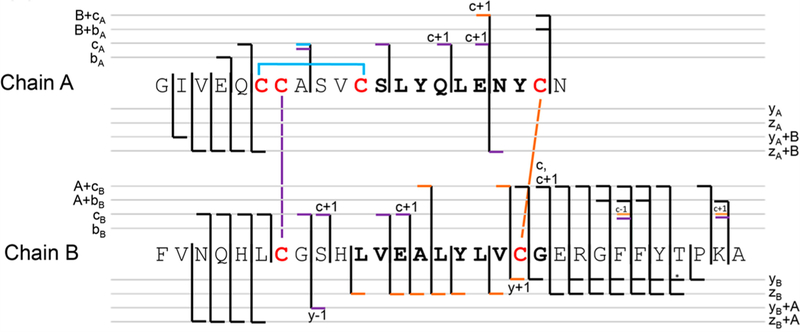
Deconvoluted 193 nm UVPD spectrum of partially reduced peptide pair from lysozyme digest (4+). For this segment of the protein, the disulfide bond linking Cys76 and Cys94 (shown with blue stars) was reduced and alkylated, whereas the disulfide bond between Cys64 and Cys80 (connecting the red and blue chains) remained intact prior to UVPD. Fragment ions denoted with a blue dot contain the intact mass of the B-chain. Fragment ions denoted with a red dot contain the intact mass of the A-chain. Spectrum magnified 5×. Reproduced with permission from ref . Copyright 2018 American Chemical Society.
Figure 11.
Figure 11.
Precursor-ejection UVPD (PE-UVPD). (A) Schematic representation of a sequence of events to relieve space charge effects beginning with ion accumulation, then 193 nm UVPD, followed by resonance ejection applied to the remaining undissociated precursor. UVPD mass spectra (1 pulse, 2 mJ) of angiotensin (3+) obtained using an AGC target of 3 × 10⁴ (B) without PE-UVPD and (C) with PE-UVPD. Expansions of the m/z 125–350 range are also shown without and with PE-UVPD, illustrating the mass shifts in the fragment ion assignments. (D) Mass error (ppm) of fragment ions ranging from m/z 130–1030 using AGC target 5 × 10⁴ without PE-UVPD (light red line) and with PE-UVPD (red dashed line), as well as 3 × 10⁴ without PE-UVPD (light blue line) and with PE-UVPD (blue dashed line). The m/z value of the precursor ion is indicated by a solid black vertical line. The zero ppm error value is shown with a horizontal gray line. Reproduced with permission from ref . Copyright 2017 American Chemical Society.
Figure 12.
Figure 12.
Radical-directed dissociation (RDD) entails derivatization of peptides with 4-iodobenzoic acid to install a C–I bond that is selectively cleaved by 266 nm UVPD. Collisional activation of the resulting product yields fragmentation patterns that reflect the antioxidant properties of the peptides. MS/MS spectra are shown for two peptides derived from β-lactoglobulin. (a) CID of IPAVFK4IB radical (1+). (b) CID of VYVEELK4IBPTPEGDLEILLQK radical (3+). Fragments derived from radical-initiated pathways are labeled in red; fragments from proton-driven pathways are labeled in green. The radical sequestering score (RSS) shown on each spectrum represents the ratio of summed fragment ion abundances originating from b/y-type ions (labeled in green font) to those originating from radical-directed fragmentation (labeled in red font). Peptides exhibiting antioxidant behavior have RSS scores greater than 1.4, indicating that the radical is sequestered. Reproduced with permission from ref . Copyright 2015 Royal Society of Chemistry.
Figure 13.
Figure 13.
UV photodissociation of two epimeric peptides: (a) [IQTGLDATHAER + H]+ and (b) [IQTGLDATHAER + 2H]2+. The d-form shows abundant −56 Da loss from Leu for both charge states. The downward arrow indicates the selected precursor ion. Reproduced with permission from ref . Copyright 2012 American Chemical Society.
Figure 14.
Figure 14.
Percent aspartic acid isomerization of water-soluble (WS, upper bars) αA sheep crystallin proteins versus water-insoluble (WI, lower bars) αA sheep crystallin proteins determined from RDD mass spectra using 266 nm photons and CID. The color-coded bars correspond to three structural regions: orange, disordered N-terminus; blue, structured α-crystallin domain; purple, disordered C-terminus. Three separate digests were performed; error bars represent standard deviations. Number ranges above the bars represent peptide sequences. Peptide 164–173 does not contain error bars because it only appeared baseline-resolved in one digest. The full protein sequence is given below the plot, with aspartic acid residues in bolded/black and serine residues in underlined/black. Asp105 and Asp106 are in bold red text in the amino acid sequence and are shown explicitly in the crystal structure (PDB 3L1F) to highlight an important region of isomerization. Stars indicate isomerized regions where isomerization was identified but quantitation was not possible due to incomplete chromatographic separation. Reproduced with permission from ref . Copyright 2017 American Chemical Society.
Figure 15.
Figure 15.
(a) Photoelectron-transfer dissociation (PETD) mass spectrum for ubiquitin (5+) and (b) its corresponding c/z fragmentation map. CO2 losses are marked by an asterisk. Reproduced with permission from ref . Copyright 2017 American Chemical Society.
Figure 16.
Figure 16.
(a) Electrospray ionization (ESI) mass spectrum of a tryptic peptide CAQCHTVEK containing two benzeneselenol tags, (b) 266 nm UVPD mass spectrum of C*AQC*HTVEK (2+), and (c) UVPDnLossCID spectrum. The asterisks represent incorporation of benzeneselenol tag. Reproduced with permission from ref . Copyright 2016 American Chemical Society.
Figure 17.
Figure 17.
UVPD (351 nm) (3 mJ/pulse, 15 pulses) mass spectrum of elongation factor G peptide V[AMCA]YSGVVNSGDTVLNSVK[carbamyl]AAR (2+) from a tryptic digest of E. coli lysate. AMCA (7-amino-4-methylcoumarin-3-acetic acid) is the chromogenic tag appended to the peptide at the N-terminus. The lysine residue is carbamylated. The precursor is labeled with an asterisk. The inset shows the number and overlap of spectra that were identified correctly from an E. coli data set using the UVnovo algorithm. UVnovo identifications from the paired CID + UVPD, CID-only, and UVPD-only mass spectra are shown. Adapted with permission from refs and . Copyright 2016 and 2017 American Chemical Society, respectively.
Figure 18.
Figure 18.
(a) Setup used for dual-spray-initiated bioconjugation of a peptide cation with an FBDSA anion for enhanced ultraviolet photodissociation. (b) Comparison of 193 nm UVPD efficiencies before and after Schiff base modification of KLVANNTRL (1+): (1) MS2 UVPD mass spectrum for unlabeled peptide and (2) MS3 UVPD mass spectrum following online derivatization using the dual-spray reactor. Reproduced with permission from ref . Copyright 2015 American Chemical Society.
Figure 19.
Figure 19.
Comparison of H/D scrambling in the regioselective deuterium-labeled peptide HHHHHHIIHIIK following 213 nm UVPD, ETD, or CID using mild ion source conditions. The degree of H/D scrambling was quantitated for all fragment ion types present at suitable ion abundance. Experiments were done in at least three replicates, and the error bars indicate single standard deviations. Reproduced with permission from ref . Copyright 2018 American Chemical Society.
Figure 20.
Figure 20.
Comparison of 193 nm UVPD, HCD, and ETD for middle-down analysis of Lys-C digested Trastuzumab in terms of (a) overlap in identified peptide populations and (b) average peptide mass and sequence coverage obtained by each activation method. (c) Relative E-scores for the 29 overlapping peptides identified by all three activation methods and (d) ion-cleavage maps obtained for an 8.2 kDa CDR-H1 and CDR-H2-containing peptide. The hypervariable regions are shaded in gray. Reproduced with permission from ref . Copyright 2017 American Chemical Society.
Figure 21.
Figure 21.
MS1 spectrum of the Fc/2 subunit of trastuzumab showing mass shifts consistent with glycoform microheterogeneity (top). The inset demonstrates consecutive saccharide additions to the core N-linked glycan structure. The expanded region of the deconvoluted 193 nm UVPD mass spectrum (middle) of the G0F glycoform (25+) shows a mass shift consistent with the intact glycan between consecutive a ions (a60 and a61). An abrupt stop in matched N-terminally derived ions allows unambiguous glycan site localization at a single Asn (N61) residue in the sequence map (bottom). Reproduced with permission from ref . Copyright 2016 American Chemical Society.
Figure 22.
Figure 22.
Comparison of deconvoluted (A) ETD and (B) 193 nm UVPD mass spectra of the N-terminal tail of H3K4me1K9me2K14acK18-acK23acK27acK36me3 (50 residues, 8+ charge state) showing fragment ion maps, P-score, sequence coverage, and labeled PTM site-localizing ions. Residues are shaded to indicate modifications: red indicates acetylation, blue indicates dimethylation, green indicates methylation, and purple indicates trimethylation. Reproduced with permission from ref . Copyright 2018 American Chemical Society.
Figure 23.
Figure 23.
Sequence maps of the H4 proteoform acNacK16me2K20 showing coverage and scoring metrics by (a) HCD, (b) EThcD, and (c) 193 nm UVPD. Reproduced with permission from ref . Copyright 2018 American Chemical Society.
Figure 24.
Figure 24.
Fractional abundance per charge state of the a and x ions of ubiquitin for 5+ (a, b), 6+, (c, d), 7+ (e, f), and 8+ (g, h). (i) Charge sites of ubiquitin elucidated based on the a/x ions from UVPD are highlighted in bold red font for the 5+, 6+, 7+, and 8+ charge states. The arrows are shown to highlight the changes in protonation sites as a function of increasing charge state. (j) The secondary and tertiary structures of ubiquitin (5+ and 8+) are represented with salt bridges denoted by hashed lines. The amino acids that are protonated for the 5+ and 8+ charge states are highlighted in red font. Reprinted with permission from ref . Copyright 2016 Royal Society of Chemistry.
Figure 25.
Figure 25.
Portion of MS/MS spectra for ubiquitin acquired using three UVPD methods: (A) 193 nm UVPD (one 2.5 mJ laser pulse) of ubiquitin (12+), (B) ET/UVPD (8 ms ETD in LIT) of ubiquitin (13+) followed by one 1.8 mJ laser pulse of ubiquitin (12+·) (MS3), (C) ET/broadband UVPD (15 ms ETD) of ubiquitin (13+) in HCD cell followed by one 2.5 mJ laser pulse of all product ions. All spectra are shown on the same scale. (D) Segmented bar graph showing percentages of ion-type pairs identified by UVPD, ETD, and ET/UVPD for ubiquitin with all activation events performed in the HCD cell (UVPD, one 2.5 mJ laser pulse; ETD, 15 ms; ET/UVPD, 4 ms ETD, and one 1.0 mJ laser pulse). Reproduced with permission from ref . Copyright 2014 American Chemical Society.
Figure 26.
Figure 26.
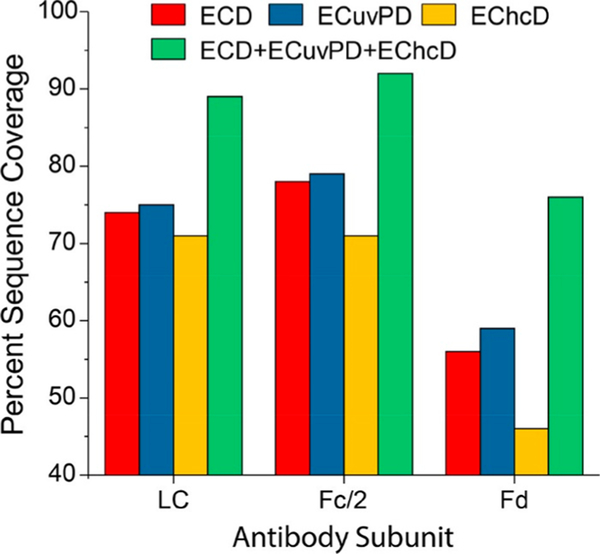
Sequence coverages obtained from a single LC/MS/MS experiment using ECD, ECuvPD (1 pulse at 0.5 mJ, 193 nm), EChcD (CE = 12 eV), and combined coverage for the LC, Fc/2, and Fd subunits of SigmaMAB (MSQC4). The reported sequence coverage for the Fc/2 subunit is for the G0F glycoform. Analyses were performed for the 20+, 25+, and 24+ charge states of the LC, Fc/2, and Fd subunits, respectively. Reproduced with permission from ref . Copyright 2018 American Chemical Society.
Figure 27.
Figure 27.
(A) Concept of UVPD with fragment ion protection (FIP) showing resonant excitation to move fragment ions away from the laser beam. (B) Sequence coverage map of UVPD of ubiquitin (12+) using eight 0.25 mJ pulses and expansions of ion profiles and signal-to-noise levels for four large fragment ions without FIP (upper profiles) and with FIP (lower profiles), including y5810+ (m/z 654), a7010+(m/z 787), z639+ (m/z 788), and a7110+ (m/z 798). Results represent the average of three spectra (each consisting of 6 μscans) generated by Thermo Xcalibur Qual Browser v2.2. Reproduced with permission from ref . Copyright 2018 American Chemical Society.
Figure 28.
Figure 28.
Cleavage pattern of insulin by 266 nm UV-activation/ECD showing three disulfide bonds cleaved (blue, purple, and gold). Fragment ions are color-coded according to the corresponding cleaved disulfide bonds. Reprinted with permission from ref . Copyright 2015 Elsevier.
Figure 29.
Figure 29.
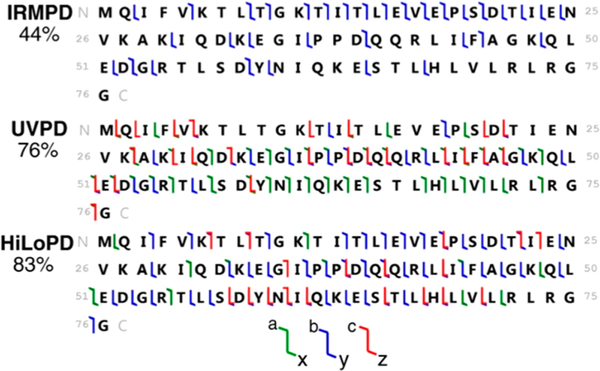
Number of fragment ions (without PTM loss) detected in IRMPD (using a 50 W cw CO2 laser, 50–200 ms), UVPD (using 1–2 pulses from a 213 nm Nd:YAG laser), and HiLoPD (using simultaneous IR and UV irradiation) mass spectra of (a) the +3 charge state precursor ion (m/z 665.3544) of FFKNIVTPRT(H2PO4)-PPPSQGK peptide and (b) the +3 charge state precursor ion (m/z 556.9529) of EAISPPDAAS(GalNAc)AAPLR peptide. Reprinted with permission from ref . Copyright 2018 Springer.
Figure 30.
Figure 30.
Sequence coverage of the +13 charge state precursor ion (m/z = 659.8249) of ubiquitin observed by IRMPD, UVPD (four pulses, 1 mJ/pulse of 213 nm from a Nd:YAG laser), and HiLoPD (simultaneous introduction of UV and IR lasers using 1 s IR irradiation and four pulses, 1 mJ/pulse of 213 nm from a Nd:YAG laser). Reprinted with permission from ref . Copyright 2016 Springer.
Figure 31.
Figure 31.
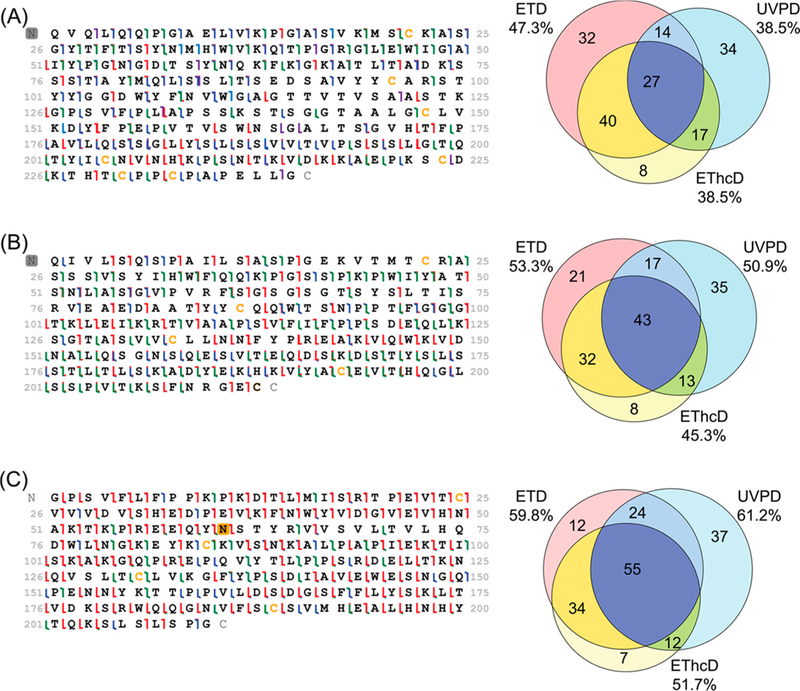
LC–MS characterization of the three ~25 kDa subunits generated from IdeS proteolysis of rituximab. The left sides of panels A–C show the fragmentation maps of Fd, Lc, and Fc/2, respectively, obtained by summing data from three ETD runs, two 213 nm UVPD runs, and one EThcD run (total of six LC–MS2 runs). The presence of the N-linked glycan, mapped using diagnostic fragment ions that include the mass of the sugar chains G0F, G1F, and G2F, is highlighted by an orange rectangle. For each panel, the right side shows the corresponding Venn diagram of shared/unique matched fragment ions for each of the three ion fragmentation techniques. Reproduced with permission from ref . Copyright 2018 American Chemical Society.
Figure 32.
Figure 32.
(A) Absolute SETA probe-incorporation values (n = 3) of PARP-C per lysine for the native (0% acetonitrile (ACN)), 25% ACN, and 50% ACN solution conditions based on 193 nm UVPD data. K324 was not quantified in the 50% ACN solution due to lack of sequence coverage beyond K324. K305 and K320 were not observed. K347 and K349 were averaged together. (B) PARP-C with color-coded lysine residues that represent their SETA incorporation trend as a function of acetonitrile solution composition with two views rotated by 180°. Pink = increasing SETA incorporation, blue = decreasing SETA incorporation, light brown = no change in SETA incorporation, and orange = variable SETA incorporation. NMR structure PDB ID 2JVN, state 1 shown. Reproduced with permission from ref . Copyright 2014 American Chemical Society.
Figure 33.
Figure 33.
Color-coded residues that had an enhanced (positive) or suppressed (negative) change in 193 nm UVPD fragmentation upon comparison of apo-dihydrofolate reductase (DHFR) and (a) DHFR·NADPH, (b) DHFR·MTX, and (c) DHFR·MTX·NADPH as well as comparison of (d) DHFR·NADPH to DHFR·MTX·NADPH are highlighted according to the colored ranges. In each case, the increase (enhancement: yellow, orange, and red) or decrease (suppression: turquoise, royal blue, and purple) in UVPD fragmentation yield is shown as a percentage representing the change in ion abundance (based on total ion current) and superimposed on the crystal structures. Crystal structures 1RX1, 1RG7, and 1RX3 were used to represent the DHFR·NADPH (a), DHFR·MTX (b), and DHFR·MTX·NADPH (c, d) complexes, respectively. Two 45° rotations are shown for each complex. MTX is methotrexate. Reproduced with permission from ref . Copyright 2015 American Chemical Society.
Figure 34.
Figure 34.
Plot of backbone-cleavage sites with the respect to ion types (a/x, b/y, and c/z) obtained via electron-induced dissociation (EID) with in-source decay (ISD) or via UVPD. (A) ISD (120 V)-EID of human carbonic anhydrase I (HCA-I) with a/x, b/y, and c/z ions plotted separately; (B) 193 nm UVPD of HCA-I; (C) EID of apo-WT superoxide dismutase (SOD1) dimer; (D) UVPD of apo-WT SOD1 dimer (each spectrum was acquired from 200 scans). Reproduced with permission from ref . Copyright 2017 American Chemical Society.
Figure 35.
Figure 35.
Localization of the tannin (B2 3′OG) binding site on IB5. Patterns of the fragments linked to B2 3′OG for [IB5a·B2 3′OG + 7H]7+ after 16 eV dissociative photoionization. The binding site of B2 3′OG is highlighted by the dashed rectangle. Reprinted with permission from ref . Copyright 2013 Wiley.
Figure 36.
Figure 36.
UVPD (193 nm) of tetrameric streptavidin (13+) using a single (a) 1.0 mJ or (b) 3.0 mJ laser pulse. Reproduced with permission from ref . Copyright 2016 American Chemical Society.
Figure 37.
Figure 37.
HCD and 193 nm UVPD mass spectra of the 12+ charge state monomer of (A) WT and (B) T186R BCAT2 observed after in-source trapping (IST). Expanded views (insets) in panel (A) show selected fragment ions labeled. Holo fragment ions that contain the pyridoxal phosphate (PLP) cofactor are denoted by a diamond. The precursors are indicated with a filled star in the MS/MS spectra. The unfilled star denotes the charge-reduced precursor (11+) as the PLP cofactor is ejected during HCD. Sequence coverage maps for (1) HCD and (2) UVPD of (A) WT and (B) T186R BCAT2 are shown beneath the spectra, with cleavages leading to a/x ions colored in green, b/y ions in blue, and c/z ions in red. The UVPD sequence maps represent the combined coverage for identified apo and holo fragment ions for the spectra collected using 1 and 3 mJ per pulse. Sequence coverages were 13 and 18% from HCD and 45 and 37% from UVPD for WT and T186R BCAT2, respectively. The Thr residue mutated to an Arg is shaded in gold in panel (B). Reproduced with permission from ref . Copyright 2018 American Chemical Society.
Figure 38.
Figure 38.
Drift-time selected 266 nm UVPD of melittin (5+) with an irradiation time of 2 s (20 laser shots). (a) UVPD of the compact conformer C produces cleavage between seven residues producing b and y fragments while (b) UVPD of the more extended conformer E yields more extensive fragmentation with cleavage between 17 residues. The black trace represents the trapped-only spectrum without laser irradiation; the red dotted trace represents laser on. The main fragments produced or enhanced by UVPD are labeled on the spectra. The insets show the arrival-time distributions (ATD) of the two separated conformers (shaded in blue as C and E, which corresponds with the UVPD spectra). Reproduced with permission from ref . Copyright 2016 American Chemical Society.
Figure 39.
Figure 39.
Photodissociation (266 nm) mass spectra of monounsaturated isomers [fatty acid 4-iodobenzyl esters (18:1) + Na]+ derivatized from (a) fatty acid (11Z-18:1), (b) fatty acid (9Z-18:1), and (c) fatty acid (6Z-18:1). The asterisk indicates the diagnostic product ion formed selectively from each double-bond positional isomer, thus allowing differentiation of double-bond positional isomers. Reprinted with permission from ref . Copyright 2013 Wiley.
Figure 40.
Figure 40.
(a) HCD (NCE 25) and (b) 193 nm UVPD (10 pulses, 6 mJ) spectra of protonated phosphatidylcholine (PC) 18:1(9Z)/18:1(9Z) ([M + H]+, m/z 786.60). (c) HCD (NCE 25) and (d) UVPD (10 pulses, 6 mJ) spectra of protonated PC 18:1(6Z)/18:1(6Z) ([M + H]+, m/z 786.60). Reproduced with permission from ref . Copyright 2017 American Chemical Society.
Figure 41.
Figure 41.
HCD/UVPD spectra of two sodium-cationized sn-regioisomeric phosphatidylcholines (PC): (A) PC 16:0/18:1(n-9) and (B) PC 18:1(n-9)/16:0. These spectra were obtained by isolating the headgroup loss ions (m/z 599.5) generated by HCD and subjecting them to 10 laser pulses (193 nm) with 4 mJ per pulse. Reproduced with permission from ref . Copyright 2017 American Chemical Society.
Figure 42.
Figure 42.
(a) Negative-mode LC-MS base peak chromatogram and m/z 1136 extracted ion chromatogram of m/z 1136 from M. bovis lipid extract; representative (b) HCD and (c) 213 nm UVPD mass spectra of m/z 1136; and (d) fragment ion map. Reproduced with permission from ref . Copyright 2019 American Chemical Society.
Figure 43.
Figure 43.
Optical images of the H&E stained (a) mouse brain tissue section, (e) human brain tissue section, and (i) lymph node tissue section with thyroid cancer metastasis. (b) DESI-MS ion image of m/z 798, (c) DESI-UVPD ratio image of the ratio of the summed intensities of the 193 nm UVPD double-bond diagnostic ions (Im/z 660 + 684)/(Im/z 688 + 712), (d) expanded region of UVPD mass spectra of the white and gray matter, (f) DESI-MS ion image of m/z 798, (g) DESI ratio image of the ratio of the summed intensities of the UVPD double-bond diagnostic ions (Im/z 660 + 684)/(Im/z 688 + 712), (h) expanded region of UVPD mass spectra of the white and gray matter, (j) DESI-MS ion image of m/z 798, (k) DESI ratio image of the intensity m/z 684 divided by the intensity m/z 712, and (l) expanded regions of UVPD mass spectra of cancerous and normal parts of tissue. Representative spectra were taken from areas of tissue marked with a white arrow. Reproduced with permission from ref . Copyright 2018 American Chemical Society.
Figure 44.
Figure 44.
(a) CID–CID (NCE 18–NCE 30), (b) CID–HCD (NCE 18–NCE 35), and (c) CID–UVPD (NCE 18–5 pulses, 2 mJ) of the core oligosaccharide substructure of tetra-acylated S. enterica Rb containing a pyrophosphoethanolamine modification (m/z 851.81, charge state 2−). (d) CID–CID (NCE 18–NCE 30), (e) CID–HCD (NCE 18–NCE 35), and (f) CID–UVPD (NCE 18–5 pulses, 2 mJ) of the lipid A substructure of S. enterica Rb containing a pyrophosphoethanolamine modification (m/z 679.41, charges state 2−). A yellow star is used to denote the precursor ion. Only select neutral losses are labeled on the spectra to avoid congestion: ▼ = loss of pyrophosphethanolamine; Δ = loss of phosphoethanolamine; ■ = loss of HPO3; □ = loss of H2PO4 and indicates that both of the indicated cleavages occur to generate a particular fragment ion. The acyl chains are numbered, and the loss of a particular acyl chain is denoted as M – N, where M represents the LPS and N represents the acyl chain that is lost. Reproduced with permission from ref . Copyright 2016 American Chemical Society.
Figure 45.
Figure 45.
Fragmentation nomenclature for nucleic acids.
Figure 46.
Figure 46.
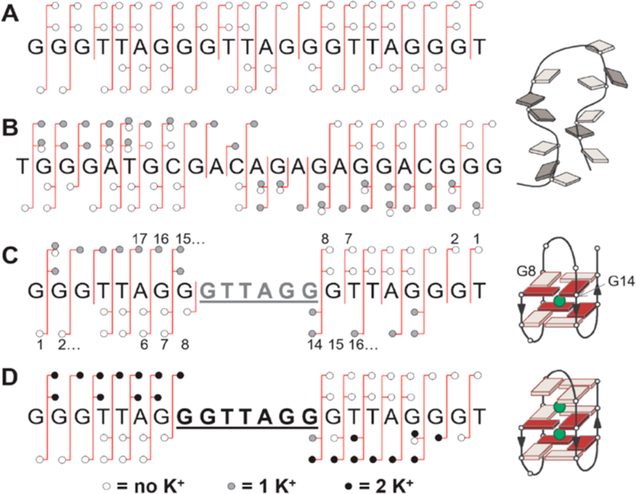
(A) EPD analysis of 22GT without potassium ion bound (M6−). (B) EPD of the nonspecific MK6− complex of a control strand not forming G-quadruplex. EPD of 22GT G-quadruplex with one (C) potassium (MK6−) or with (D) two potassium ions bound (MK26−). Reprinted with permission from ref . Copyright 2019 Royal Society of Chemistry.
Figure 47.
Figure 47.
Fragmentation nomenclature for carbohydrates.
Figure 48.
Figure 48.
(a) a-EPD (UVPD (4 mJ per pulse and 5 pulses) of m/z 855.70 (3−) followed by CID (15 NCE) of m/z 1283.53 (2−)) of E. coli R1 tridecasaccharide. The precursor is labeled with a star. The red asterisk denotes neutral phosphate loss from the precursor ion. a-EPD reveals diagnostic product ions differentiating the branching pattern and substitution of a glucosamine residue for a glucose or galactose. (b) The identified product ions are mapped onto the structure of E. coli R1 tridecasaccharide. (c) a-EPD (UVPD (4 mJ per pulse and 5 pulses) of m/z 855.36 (3−) followed by CID (15 NCE) of m/z 1283.04 (2−)) of E. coli R3 tridecasaccharide. (d) The identified product ions are mapped onto the structure of E. coli R3 tridecasaccharide. Reproduced with permission from ref . Copyright 2019 American Chemical Society.
Figure 49.
Figure 49.
VUV-photoactivation spectrum of a porphyran using 18 eV photons from a synchrotron radiation source. The precursor ion of the L6S-G-LA-G-L6S-G oligoporphyran with one methyl group was isolated as the [M + 3Na − 2H]+ species (m/z 1213.4, positive mode). Two isomers ((1) L6S-G6Me-LA-G-L6S-G6 and (2) L6S-G-LA-G6Me-L6S-G6) could be unequivocally differentiated from the spectrum. Masses marked with ▼ showed a complete shift upon 18O-labeling, while masses marked with ▽ contain two fragments, one of which shifted and one of which did not shift upon 18O-labeling. Several ions, indicated with ⧧, correspond to doubly charged fragments. Ions indicated with ★ correspond to an internal rearrangement. Reproduced with permission from ref . Copyright 2015 American Chemical Society.
Figure 50.
Figure 50.
Radical fragmentation spectra afforded by UVPD and RDD. The dot indicates radical products; the dagger indicates that the product forms a double bond. The [4IB M + Na]+ precursors of m/z 842 during UVPD and the −I radical precursors (m/z 715) during RDD are indicated with arrows. Reproduced with permission from ref . Copyright 2018 American Chemical Society.
Figure 51.
Figure 51.
LED-HCD cell with housing and trapping rods removed. Red lines represent the axis of fixed alignment of each LED. The inset shows the cell assembled with planar trapping rods and the cover installed. Reprinted with permission from ref . Copyright 2016 Wiley.

References

    1. Zhang Y; Fonslow BR; Shan B; Baek MC; Yates JR 3rd Protein analysis by shotgun/bottom-up proteomics. Chem. Rev 2013, 113, 2343–2394. - PMC - PubMed
    1. Banoub JH; Newton RP; Esmans E; Ewing DF; Mackenzie G Recent development in mass spectrometry for the characterization of nucleosides, nucleotides, oligonucleotides, and nucleic acids. Chem. Rev 2005, 105, 1869–1915. - PubMed
    1. Fabris D A role for the MS analysis of nucleic acids in the post-genomics age. J. Am. Soc. Mass Spectrom 2010, 21, 1–13. - PubMed
    1. Schürch S Characterization of nucleic acids by tandem mass spectrometry - The second decade (2004–2013): From DNA to RNA and modified sequences. Mass Spectrom. Rev 2016, 35, 483–523. - PubMed
    1. Beck JL; Colgrave MO; Ralph SF; Sheil MM Electrospray ionization mass spectrometry of oligonucleotide complexes with drugs, metals, and proteins. Mass Spectrom. Rev 2001, 20, 61–87. - PubMed

Publication types

MeSH terms