


Causes of inferior relative survival after testicular germ cell tumor diagnosed 1953-2015: A population-based prospective cohort study
- PMID: 31851716
- PMCID: PMC6919610
- DOI: 10.1371/journal.pone.0225942
Causes of inferior relative survival after testicular germ cell tumor diagnosed 1953-2015: A population-based prospective cohort study
Abstract
Background: Testicular germ cell tumor (TGCT) patients and survivors have excess mortality compared to the general male population, but relative survival (RS) has been scarcely studied. We investigated causes of excess mortality and their impact on RS among men diagnosed with TGCT in Norway, 1953-2015.
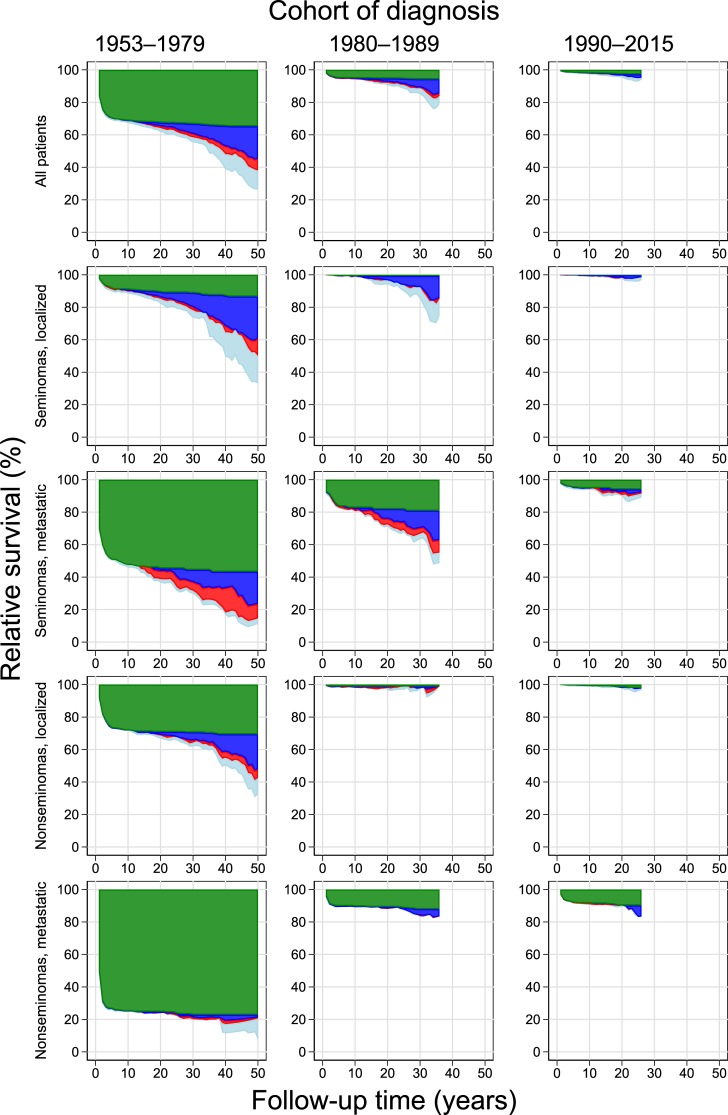
Methods and findings: Using registry data (n = 9541), standardized mortality ratios (SMRs) and RS were calculated. By December 31st, 2015, 816 testicular cancer (TC) and 1508 non-TC deaths had occurred (non-TC SMR: 1.36). Within five years of TGCT diagnosis, 80% were TC deaths. Non-TC second cancer (SC) caused 65% of excess non-TC deaths, of which 34% from gastric, pancreatic or bladder cancer. SC SMRs remained elevated ≥26 years of follow-up. In localized TGCT diagnosed >1979, SC SMRs were only elevated after seminoma. Cardiovascular disease caused 9% and other causes 26% of excess non-TC deaths, of which 58% from gastrointestinal and genitourinary disorders. RS continuously declined with follow-up. TGCT patients diagnosed >1989 had superior five-year TC-specific RS (98.3%), lower non-TC SMR (1.21), but elevated SMRs for several SCs, infections, Alzheimer's disease, genitourinary disease and suicide. A limitation was lack of individual treatment data.
Conclusions: RS declines mainly from TC deaths <5 years after TGCT diagnosis. Later, excess SC mortality becomes particularly important, reducing RS even ≥26 years. Radiotherapy; standard adjuvant seminoma treatment 1980-2007, is likely an important contributor, as are chemotherapy and possibly innate susceptibilities. Vigilant long-term follow-up, including psychosocial aspects, is important. Further research should focus on identifying survivor risk groups and optimizing treatment.
Conflict of interest statement
The authors have declared that no competing interests exist.
Figures
References
Publication types
MeSH terms
Supplementary concepts
LinkOut - more resources
Full Text Sources
Medical
