. 2020 Feb;40(2):323-334.
doi: 10.1161/ATVBAHA.119.313137. Epub 2019 Dec 19.

IL (Interleukin)-6 Contributes to Deep Vein Thrombosis and Is Negatively Regulated by miR-338-5p

Affiliations

IL (Interleukin)-6 Contributes to Deep Vein Thrombosis and Is Negatively Regulated by miR-338-5p

Yunhong Zhang et al. Arterioscler Thromb Vasc Biol. 2020 Feb.

Abstract

Objective: Deep venous thrombosis (DVT), one of the most common venous thromboembolic disorders, is closely linked with pulmonary embolism and post-thrombotic syndrome, both of which have a high mortality. However, the factors that trigger DVT formation are still largely unknown. Elevated expression of IL (interleukin)-6-an important inflammatory cytokine-has been linked with DVT formation. However, the molecular mechanisms leading to the elevated IL-6 in DVT remain unclear. Here, we proposed that epigenetic modification of IL-6 at the post-transcriptional level may be a crucial trigger for IL-6 upregulation in DVT. Approach and Results: To explore the association between microRNAs and IL-6 in DVT, we performed microRNA microarray analysis and experiments both in vitro and in vivo. Microarray and quantitative real-time polymerase chain reaction results showed that IL-6 expression was increased while miR-338-5p level was decreased substantially in peripheral blood mononuclear cells of patients with DVT, and there was significant negative correlation between miR-338-5p and IL-6. Experiments in vitro showed that overexpressed miR-338-5p reduced IL-6 expression, while miR-338-5p knockdown increased IL-6 expression. Moreover, our in vivo study found that mice with anti-IL-6 antibody or agomiR-338-5p delivery resulted in decreased IL-6 expression and alleviated DVT formation, whereas antagomiR-338-5p acted inversely. Most of miR-338-5p was found located in cytoplasm by fluorescence in situ hybridization. Dual-luciferase reporter assay identified direct binding between miR-338-5p and IL-6.

Conclusions: Our results suggest that decreased miR-338-5p promotes DVT formation by increasing IL-6 expression.

Keywords: cytoplasm; fluorescence; inflammation; interleukin-6; venous thrombosis.


Figures
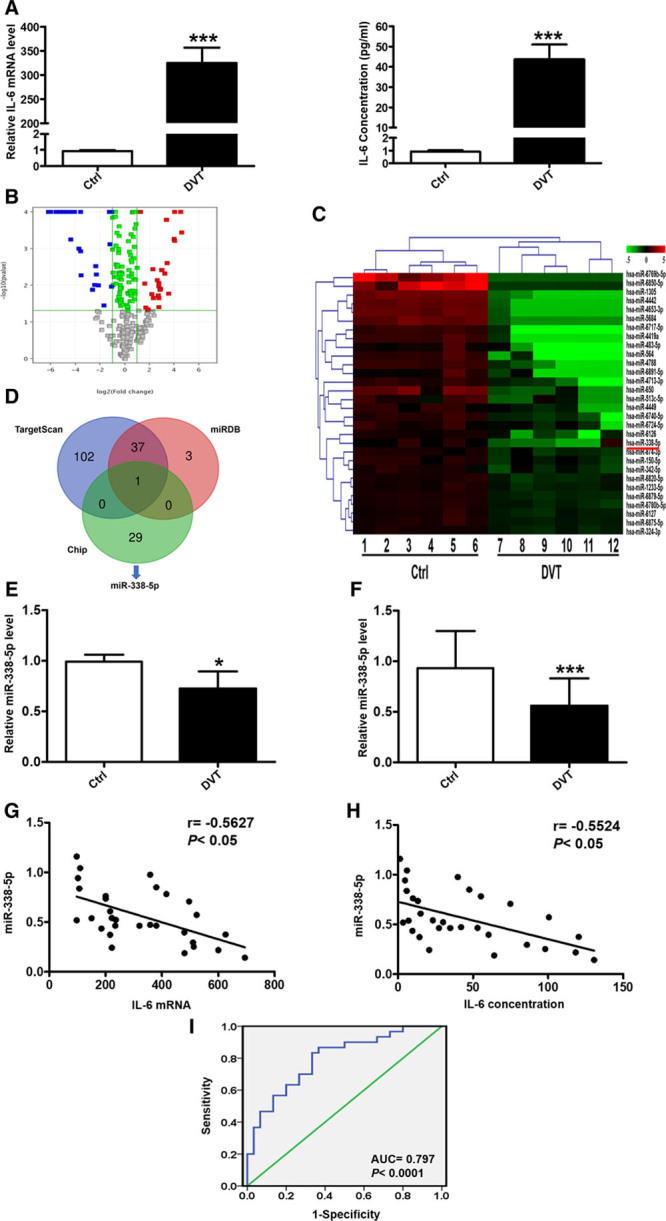
Figure 1.
Figure 1.
The expression of IL (interleukin)-6 and miR-338-5p in patients with deep venous thrombosis (DVT) and healthy controls (Ctrls). A, Relative expression levels of IL-6 mRNA in the peripheral blood mononuclear cells (PBMCs) and IL-6 protein in the plasma from 30 DVT patients and 30 Ctrls were determined by quantitative real-time polymerase chain reaction (qRT-PCR) and ELISA. B, The volcano plot was constructed using fold-change values and P. The vertical lines correspond to 2-fold up and down, respectively, and the horizontal line represents a P of 0.05. The red point in the plot represents the significantly upregulated and the blue point represents the significantly downregulated microRNAs (miRNAs). C, Heat map showing the profiling data of downregulated miRNAs in the blood of 6 DVT patients compared with that of 6 Ctrls determined by microarray analysis. Red indicates increased relative expression, while green indicates decreased relative expression. D, The Venn diagram shows miR-338-5p predicted by Targetscan, miRDB, and Chip. E and F, Levels of miR-338-5p in PBMCs from 6 patients and 6 Ctrls by microarray return samples and DVT patients (n=30) compared with Ctrls subjects (n=30) were measured by qRT-PCR. G and H, The correlation between miR-338-5p and IL-6 was analyzed using Pearson correlation analysis (n=30). I, Diagnostic value of miR-338-5p for DVT was evaluated by receiver operating characteristic curve. AUC indicates area under the curve. *P<0.05, ***P<0.001.
Figure 2.
Figure 2.
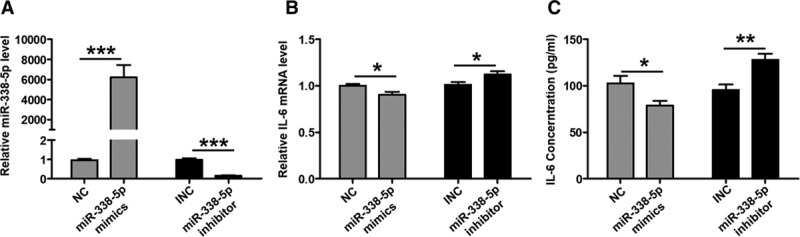
miR-338-5p negatively regulates IL (interleukin)-6 expression in human umbilical vein endothelial cells. A, The expression level of miR-338-5p after negative control (NC), miR-338-5p mimics, inhibitor NC (INC), and miR-338-5p inhibitor transfection as detected by quantitative real-time polymerase chain reaction (qRT-PCR). B, The expression level of IL-6 mRNA after NC, miR-338-5p mimics, INC, and miR-338-5p inhibitor transfection as detected by qRT-PCR. C, The expression level of IL-6 protein was detected by ELISA. *P<0.05, **P<0.01, ***P<0.001.
Figure 3.
Figure 3.
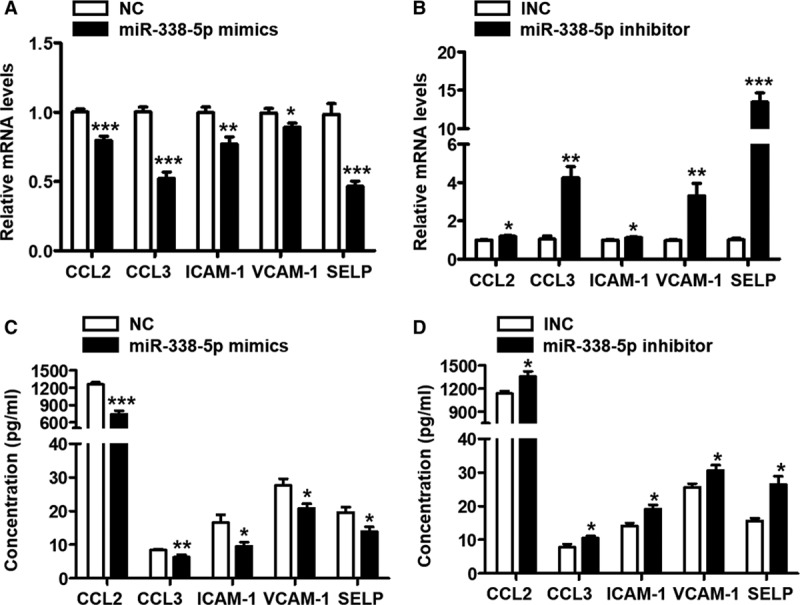
miR-338-5p is correlated with vascular markers of endothelial function. A and B, CCL (C-C motif chemokine ligand) 2, CCL3, ICAM-1 (intercellular cell adhesion molecule-1), VCAM-1 (vascular cell adhesion molecule-1), and SELP (p-selectin) mRNA expression in HUVECs from each treatment group was determined via quantitative real-time polymerase chain reaction analysis. C and D, CCL2, CCL3, ICAM-1, VCAM-1, and SELP protein expression in HUVECs from each treatment group was determined by ELISA. INC indicates inhibitor negative control; and NC, negative control. *P<0.05, **P<0.01, ***P<0.001.
Figure 4.
Figure 4.
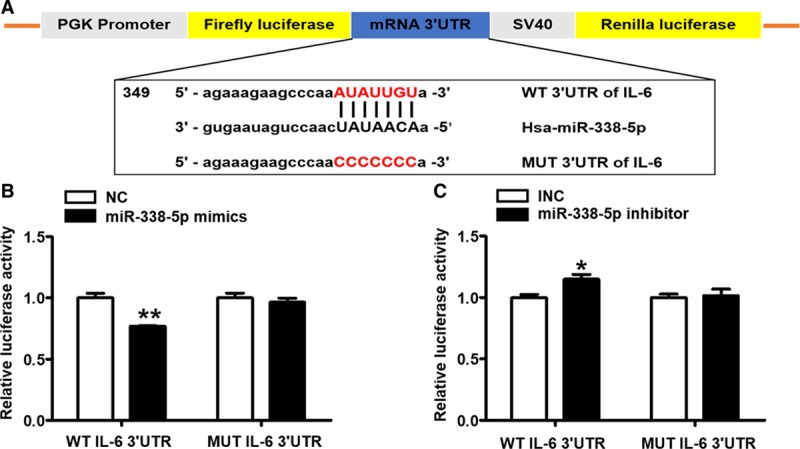
miR-338-5p targets IL (interleukin)-6 mRNA 3′ untranslated region (3′UTR) directly. A, Schematic representation of IL-6 mRNA 3′UTR demonstrating putative microRNA target site, luciferase activities of WT (wild-type) and MUT (mutant) constructs. B and C, The luciferase activity was determined by cotransfecting the vectors (IL-6 3′UTR-WT and MUT) combined with negative control (NC), miR-338-5p mimics, inhibitor negative control (INC), or miR-338-5p inhibitor into 293T cells. *P<0.05, **P<0.01.
Figure 5.
Figure 5.
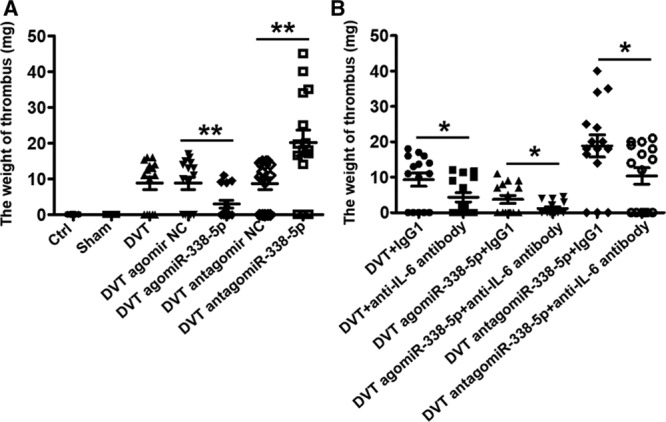
The role of miR-338-5p in deep venous thrombosis (DVT) formation by targeting IL (interleukin)-6 in vivo. A, Thrombus weights at 48 h post-operation were measured in the different treatment groups (n=15). B, Effect of anti–IL-6 antibody on thrombosis in different treatment groups (n=15). Ctrl indicates control; INC, inhibitor negative control; and NC, negative control. *P<0.05, **P<0.01.

References

    1. Strijkers RH, Cate-Hoek AJ, Bukkems SF, Wittens CH. Management of deep vein thrombosis and prevention of post-thrombotic syndrome. BMJ. 2011;343:d5916. doi: 10.1136/bmj.d5916. - PubMed
    1. Feng Y, Lei B, Zhang F, Niu L, Zhang H, Zhang M. Anti-inflammatory effects of simvastatin during the resolution phase of experimentally formed venous thrombi. J Investig Med. 2017;65:999–1007. doi: 10.1136/jim-2017-000442. - PubMed
    1. Fu Y, Wang D. Emergency care and prevention of thromboembolic disease. Chinese Journal for Clinicians. 2006;34:51–53.
    1. Giordano NJ, Jansson PS, Young MN, Hagan KA, Kabrhel C. Epidemiology, pathophysiology, stratification, and natural history of pulmonary embolism. Tech Vasc Interv Radiol. 2017;20:135–140. doi: 10.1053/j.tvir.2017.07.002. - PubMed
    1. Appelen D, van Loo E, Prins MH, Neumann MH, Kolbach DN. Compression therapy for prevention of post-thrombotic syndrome. Cochrane Database Syst Rev. 2017;9:CD004174. doi: 10.1002/14651858.CD004174.pub3. - PMC - PubMed

Publication types

MeSH terms