. 2019 Dec 18;10(1):62.
doi: 10.1186/s13293-019-0279-x.

Novel human sex-typing strategies based on the autism candidate gene NLGN4X and its male-specific gametologue NLGN4Y

Affiliations

Novel human sex-typing strategies based on the autism candidate gene NLGN4X and its male-specific gametologue NLGN4Y

Stephan Maxeiner et al. Biol Sex Differ. .

Abstract

Background: Since the early days of PCR techniques, sex identification, "sex-typing," of genomic DNA samples has been a fundamental part of human forensic analysis but also in animal genetics aiming at strategic livestock breeding. Most analyses are employing the AMELX/AMELY gene loci on the X and Y chromosomes present in most mammals. We hypothesize that sex-typing in humans is also possible based on the genes NLGN4X and NLGN4Y, which represent X and Y chromosome-specific copies of a common ancestral neuroligin-4 orthologue.

Methods: Genomic DNA was isolated from human blood and buccal cell samples (total n = 111) and submitted to two different strategies: (a) a traditional two-primer PCR approach detecting an insertion/deletion (indel) polymorphism immediately upstream of the translational start on exon 1 and (b) detection of a single nucleotide polymorphism, SNP, on the translational stop carrying exon 7. The SNP detection was based on a quantitative PCR approach (rhAMP genotyping) employing DNA/RNA hybrid oligonucleotides that were blocked and which could only be activated upon perfect annealing to the target DNA sequence.

Results: All indel PCR-tested human DNA samples showed two bands for males representing X- and Y-specific copies of NLGN4 and a single band for female samples, i.e., homozygosity of NLGN4X and absence of NLGN4Y, in accordance with the self-reported sex of the donors. These results were in perfect agreement with the results of the rhAMP-based SNP-detection method: all males were consequently positive for both alleles, representing either SNP variant, and females were interpreted as homozygous regarding the SNP variant found in NLGN4X. Both methods have shown reliable and consistent results that enabled us to infer the sex of donor DNA samples across different ethnicities.

Conclusions: These results indicate that the detection of human NLGN4X/Y is a suitable alternative to previously reported methods employing gene loci such as AMELX/Y. Furthermore, this is the first report applying successfully the rhAMP-genotyping strategy as a means for SNP-based sex-typing, which consequently will be applicable to other gene loci or different species as well.

Keywords: Amelogenin; Chromosomes; Neuroligin-4; rhAMP genotyping; sex-typing.


Conflict of interest statement

The authors declare that they have no competing interests.

Figures

Fig. 1
Fig. 1
NLGN4X/Y gene overview and assay location. a Schematic encompassing the pseudoautosomal region, PAR (green boxed area), as well as the X-specific region on the X chromosome and the male-specific region on the Y chromosome. CD99 is the most proximal, first gene located in the PAR common to both sex chromosomes. The SRY gene (unique to the Y chromosome) is immediately located at the pseudoautosomal boundary within the male-specific region. Gametologous copies of the NLGN4X/Y, AMELX/Y, and ZFX/Y genes are depicted according to their relative positions on the X-specific and male-specific region. b Enlargement of the respective NLGN4X (magenta) and NLGN4Y genes (blue). For immediate comparison, only the protein coding exons are depicted. Both genes share an identical structure except for the size of the untranslated region on exon 1 (grey boxes). All exons are drawn to scale, whereas dashed lines between two neighboring exons reflect varying intron sizes with the respective sizes labeled on top. Exons are numbered according to the general assignment of exons of the neuroligin family [22]; generally, NLGN4 genes formally lack exon 2. Arrows flanking the 5-prime untranslated region on exon 1 represent relative primer localization to identify the indel variation allowing the discrimination of both genes. Grey arrowheads point to the relative position of three potential single nucleotide polymorphisms, SNPs. c Relative position of all three SNPs (A–C) within the coding region. SNP_A and SNP_B are synonymous changes; SNP_C is a non-synonymous change resulting in amino acid differences between NLGN4X and NLGN4Y proteins. d Sequence alignment of NLGN4X/Y PCR amplicons. Priming oligonucleotides are highlighted in grey with the start codon in blue. Identical bases are shown in red, mismatches in black
Fig. 2
Fig. 2
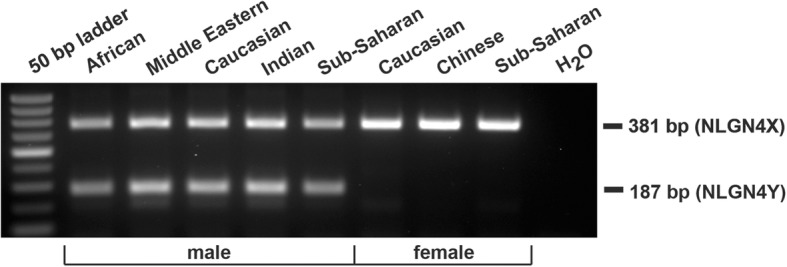
PCR-based NLGN4X/Y sex-typing strategy. Representative picture showing PCR results separated on an agarose gel testing for an indel polymorphism between both NLGN4 gametologues. Male donor DNA of different ethnicities resulted consistently in two bands indicated by the presence of NLGN4X (381 bp) and NLGN4Y (187 bp). Female donor DNA resulted only in a single band (NLGN4X)
Fig. 3
Fig. 3
Sex-typing strategies based on NLGN4X/Y gene polymorphisms. a Allelic discrimination patterns based on rhAMP-SNP-detection strategies using SNP assays A (squares), B (triangles), and C (circles). Results for male donor DNA are depicted in blue, for females in magenta. Each assay was run on the identical set of male and female donor DNA samples (N = 5 each). Detection values of the respective “alleles,” i.e., NLGN4X/Y gametologues, are displayed in relative fluorescent units (RFU) calculated by the thermo cycler software. The performance result of assay C is the only one out-grouping male donors from female donors. b A total of N = 111 male and female donor DNA samples were subjected to rhAMP-analysis using the SNP_C assay. Results for male (blue) and female (magenta) donor DNA separated consistently (100%) and matched with self-reported sex identification of donors

References

    1. Gubbay J, Collignon J, Koopman P, Capel B, Economou A, Münsterberg A, et al. A gene mapping to the sex-determining region of the mouse Y chromosome is a member of a novel family of embryonically expressed genes. Nature. 1990;346(6281):245–250. doi: 10.1038/346245a0. - DOI - PubMed
    1. Sinclair AH, Berta P, Palmer MS, Hawkins JR, Griffiths BL, Smith MJ, et al. A gene from the human sex-determining region encodes a protein with homology to a conserved DNA-binding motif. Nature. 1990;346(6281):240–244. doi: 10.1038/346240a0. - DOI - PubMed
    1. Stévant I, Papaioannou MD, Nef S. A brief history of sex determination. Mol Cell Endocrinol. 2018;468:3–10. doi: 10.1016/j.mce.2018.04.004. - DOI - PubMed
    1. Nakahori Y, Takenaka O, Nakagome Y. A human X-Y homologous region encodes "amelogenin". Genomics. 1991;9(2):264–269. doi: 10.1016/0888-7543(91)90251-9. - DOI - PubMed
    1. Graves JA. Evolution of vertebrate sex chromosomes and dosage compensation. Nat Rev Genet. 2016;17(1):33–46. doi: 10.1038/nrg.2015.2. - DOI - PubMed

Publication types

Substances

LinkOut - more resources