


Novel coumarins active against Trypanosoma cruzi and toxicity assessment using the animal model Caenorhabditis elegans
- PMID: 31852548
- PMCID: PMC6921407
- DOI: 10.1186/s40360-019-0357-z
Novel coumarins active against Trypanosoma cruzi and toxicity assessment using the animal model Caenorhabditis elegans
Abstract
Background: Chagas disease (CD) is a tropical parasitic disease. Although the number of people infected is very high, the only drugs available to treat CD, nifurtimox (Nfx) and benznidazole, are highly toxic, particularly in the chronic stage of the disease. Coumarins are a large class of compounds that display a wide range of interesting biological properties, such as antiparasitic. Hence, the aim of this work is to find a good antitrypanosomal drug with less toxicity. The use of simple organism models has become increasingly attractive for planning and simplifying efficient drug discovery. Within these models, Caenorhabditis elegans has emerged as a convenient and versatile tool with significant advantages for the toxicological potential identification for new compounds.
Methods: Trypanocidal activity: Forty-two 4-methylamino-coumarins were assayed against the epimastigote form of Trypanosoma cruzi (Tulahuen 2 strain) by inhibitory concentration 50% (IC50). Toxicity assays: Lethal dose 50% (LD50) and Body Area were determined by Caenorhabditis elegans N2 strain (wild type) after acute exposure. Structure-activity relationship: A classificatory model was built using 3D descriptors.
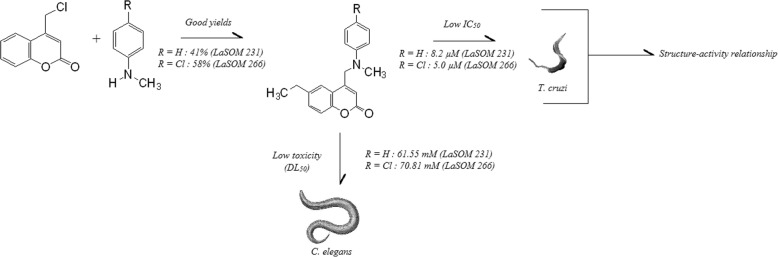
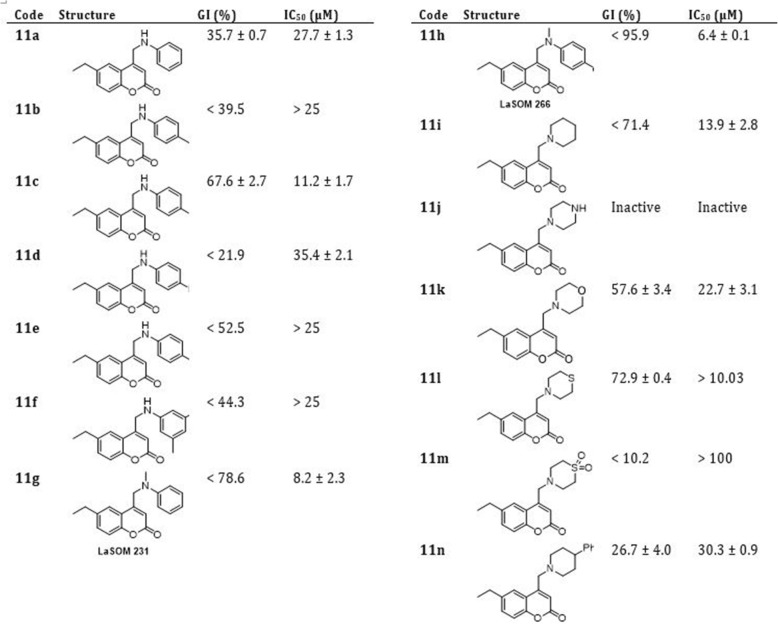
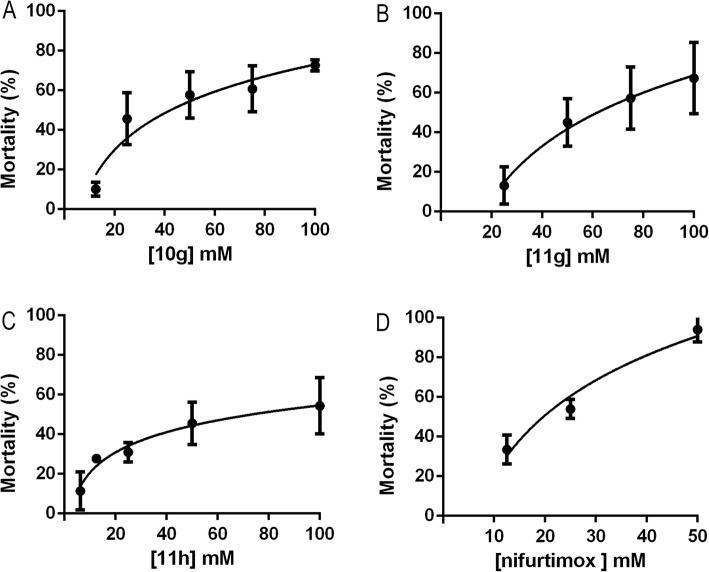
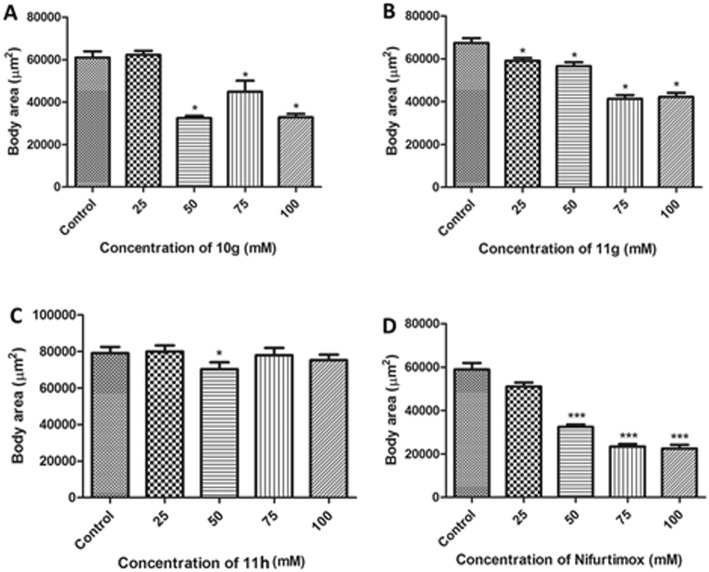
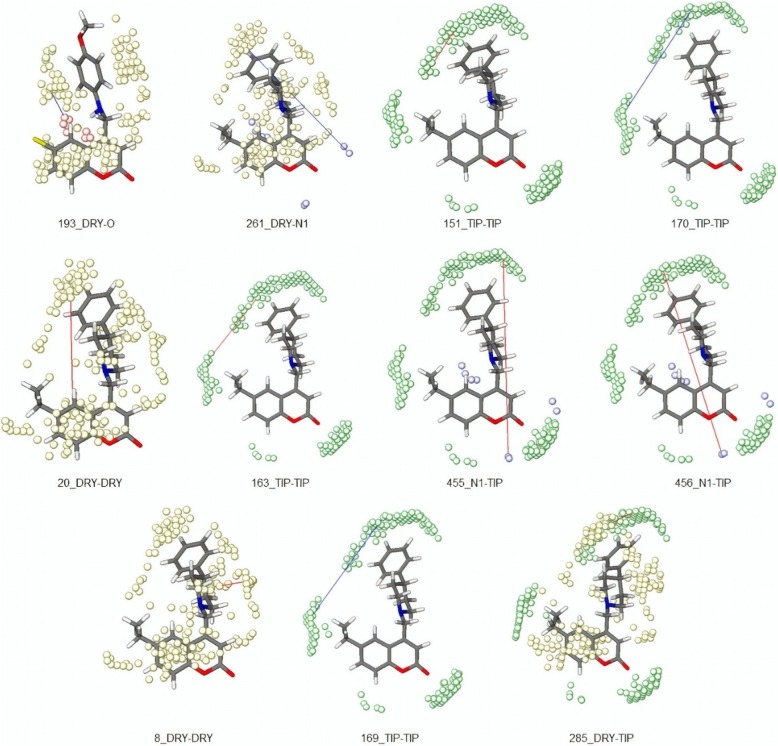
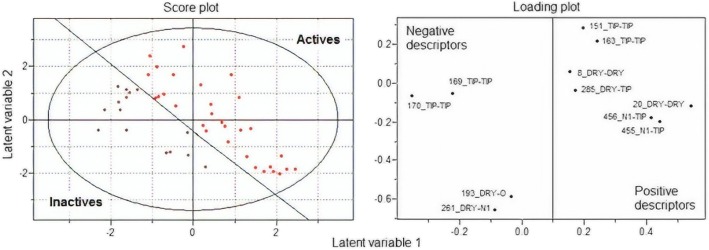
Results: Two of these coumarins demonstrated near equipotency to Nifurtimox (IC50 = 5.0 ± 1 μM), with values of: 11 h (LaSOM 266), (IC50 = 6.4 ± 1 μM) and 11 g (LaSOM 231), (IC50 = 8.2 ± 2.3 μM). In C. elegans it was possible to observe that Nfx showed greater toxicity in both the LD50 assay and the evaluation of the development of worms. It is possible to observe that the efficacy between Nfx and the synthesized compounds (11 h and 11 g) are similar. On the other hand, the toxicity of Nfx is approximately three times higher than that of the compounds. Results from the QSAR-3D study indicate that the volume and hydrophobicity of the substituents have a significant impact on the trypanocidal activities for derivatives that cause more than 50% of inhibition. These results show that the C. elegans model is efficient for screening potentially toxic compounds.
Conclusion: Two coumarins (11 h and 11 g) showed activity against T. cruzi epimastigote similar to Nifurtimox, however with lower toxicity in both LD50 and development of C. elegans assays. These two compounds may be a feasible starting point for the development of new trypanocidal drugs.
Keywords: Caenorhabditis elegans; Chagas disease; Coumarins; Structure-activity relationship; Trypanosoma cruzi.
Conflict of interest statement
The authors declare that they have no competing interests.
Figures
References
-
- Organization WH . Chagas disease (American trypanosomiasis) 2017.
-
- Urbina JA, Payares G, Sanoja C, Molina J, Lira R, Brener Z, Romanha AJ. Parasitological cure of acute and chronic experimental Chagas disease using the long-acting experimental triazole TAK-187. Activity against drug-resistant Trypanosoma cruzi strains. Int J Antimicrob Agents. 2003;21(1):39–48. doi: 10.1016/S0924-8579(02)00274-1. - DOI - PubMed
-
- Arias AR. Situación de la enfermidad de Chagas en el Continente Americano, in Enfermidad de Chagas: Estrategias em la búsqueda de nuevos medicamentos. Mexico,DF: RIDIMEDCHAG-CYTED; 2012.
-
- Graebin C, Uchoa F, Bernardes L, Campo V, Carvalho I, Eifler-Lima V. Antiprotozoal Agents: An Overview. AntiInfect Agents Med Chem. 2009;8(4):345–366. doi: 10.2174/187152109789760199. - DOI
Publication types
MeSH terms
Substances
LinkOut - more resources
Full Text Sources
Research Materials
