. 2020 Mar 15;26(6):1309-1317.
doi: 10.1158/1078-0432.CCR-19-2829. Epub 2019 Dec 18.

5-Hydroxymethylcytosine Profiles in Circulating Cell-Free DNA Associate with Disease Burden in Children with Neuroblastoma

Affiliations

5-Hydroxymethylcytosine Profiles in Circulating Cell-Free DNA Associate with Disease Burden in Children with Neuroblastoma

Mark A Applebaum et al. Clin Cancer Res. .

Abstract

Purpose: 5-Hydroxymethylcytosine (5-hmC) is an epigenetic marker of open chromatin and active gene expression. We profiled 5-hmC with Nano-hmC-Seal technology using 10 ng of plasma-derived cell-free DNA (cfDNA) in blood samples from patients with neuroblastoma to determine its utility as a biomarker.

Experimental design: For the Discovery cohort, 100 5-hmC profiles were generated from 34 well children and 32 patients (27 high-risk, 2 intermediate-risk, and 3 low-risk) at various time points during the course of their disease. An independent Validation cohort encompassed 5-hmC cfDNA profiles (n = 29) generated from 21 patients (20 high-risk and 1 intermediate-risk). Metastatic burden was classified as high, moderate, low, or none per Curie metaiodobenzylguanidine scores and percentage of tumor cells in bone marrow. Genes with differential 5-hmC levels between samples according to metastatic burden were identified using DESeq2.

Results: Hierarchical clustering using 5-hmC levels of 347 genes identified from the Discovery cohort defined four clusters of samples that were confirmed in the Validation cohort and corresponded to high, high-moderate, moderate, and low/no metastatic burden. Samples from patients with increased metastatic burden had increased 5-hmC deposition on genes in neuronal stem cell maintenance and epigenetic regulatory pathways. Further, 5-hmC cfDNA profiles generated with 1,242 neuronal pathway genes were associated with subsequent relapse in the cluster of patients with predominantly low or no metastatic burden (sensitivity 65%, specificity 75.6%).

Conclusions: cfDNA 5-hmC profiles in children with neuroblastoma correlate with metastatic burden and warrants development as a biomarker of treatment response and outcome.


Conflict of interest statement

Conflict of Interests Statement

CH and WZ are shareholders of Shanghai Epican Genetech Co. Ltd. that licensed 5-hmC-Seal from the University of Chicago. CH is a scientific founder and scientific advisory board member of Accent Therapeutics, Inc.

Figures
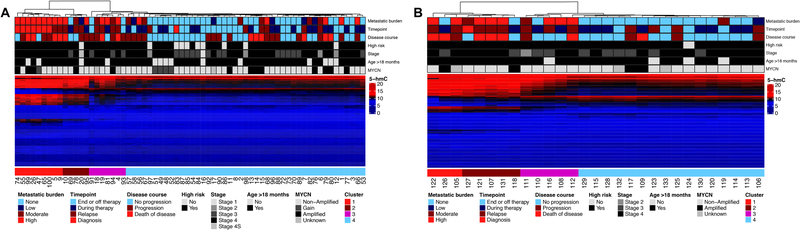
Figure 1:
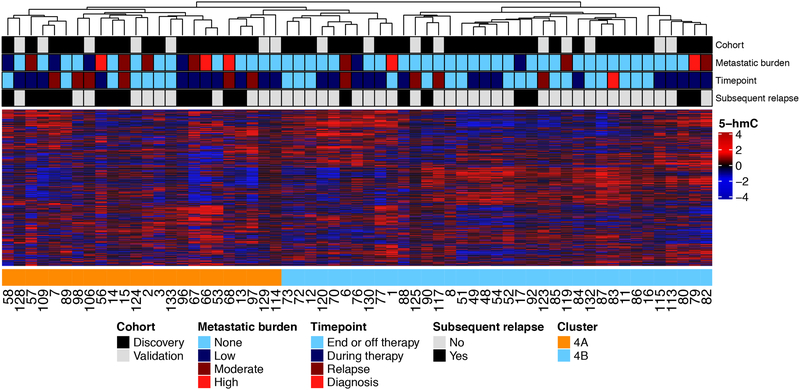
Figure 1:. cfDNA 5-hmC profiles are associated with disease burden and disease status in both the Discovery and Validation cohorts.
A) Hierarchical clustering of the Discovery cohort using 347 genes identified in the Discovery cohort with differential 5-hmC between samples from those with or without active disease. B) Hierarchical clustering of the Validation cohort using the same gene set and clustering parameters. Cluster 1 is enriched for patients with high metastatic disease burden. Clusters 2 and 3 are enriched for patients with moderate to high metastatic disease burden. Cluster 4 is enriched for patients with low or no metastatic disease burden.
Figure 2:
Figure 2:. Cluster 4 samples are subdivided into those with minimal disease burden and those without.
1,242 genes from the GO pathway of neuronal systems processes distinguishes Cluster 4 patients with some metastatic disease burden (Cluster 4A) from those without (Cluster 4B). The sensitivity and specificity for identifying patients who subsequently relapsed was 65% (95% CI: 40.8–84.6%) and 75.6% (95% CI: 59.7–87.3%), respectively.
Figure 3:
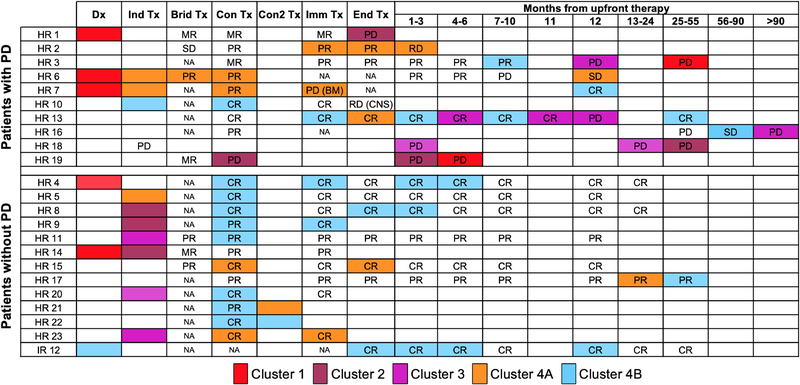
Figure 3:. 5-hmC profiling matches clinical response by INRC.
Each patient with two or more samples in the Discovery and Validation cohorts are shown. 5-hmC Cluster assignments are highlighted in the box and the INRC response classification at that time point is written. All cfDNA was collected at the beginning of the timepoint. Clinical response was determined using the 2017 INRC comparing each timepoint to diagnosis or prior assessment for relapsed patients. Abbreviations: Tx; Therapy, Dx; Diagnosis, Ind; Induction, Brid; Bridge therapy per ANBL1221, Con; first consolidative transplant, Con2; second consolidative transplant Imm; Immunotherapy, Fu; follow up, SD; Stable Disease, MR; Minor Response, PR; Partial Response, CR: Complete Response, PD; Progressive Disease, HR; high-risk, IR; intermediate-risk, NA; Not applicable.
Figure 4:
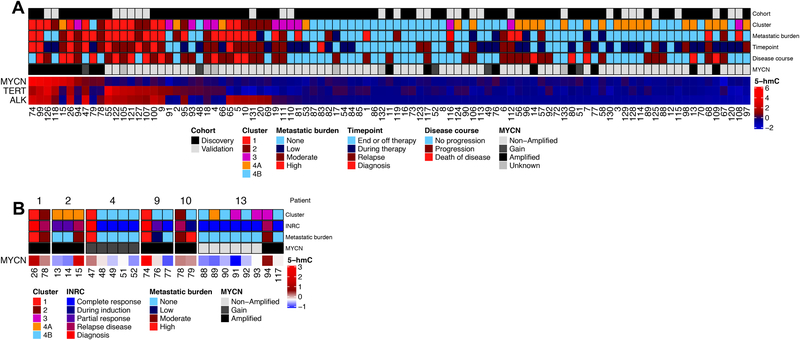
Figure 4:. Candidate gene analysis of 5-hmC on MYCN, TERT, and ALK.
A) Ranking of 95 samples according to normalized 5-hmC levels of these three genes. B) Normalized 5-hmC for MYCN over time for 5 patients with tumors having MYCN-amplification or gain and more than one sample collected.
Figure 5:
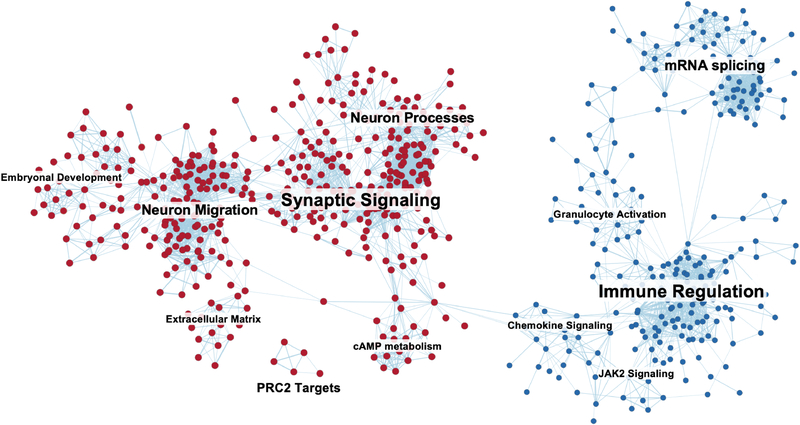
Figure 5:. Pathway clusters with significant enrichment of genes with differential 5-hmC in blood from patients with active disease compared to those without.
Each node represents an MSigDB pathway with FDR < 0.01. Pathways enriched in patients with clinically detectable disease are shown in red and those from those without detectable disease in blue. Edge similarity cutoff of 0.375.

References

    1. Li W, Zhang X, Lu X, You L, Song Y, Luo Z, et al. 5-Hydroxymethylcytosine signatures in circulating cell-free DNA as diagnostic biomarkers for human cancers. Cell Res 2017;27(10):1243–57. - PMC - PubMed
    1. Han D, Lu X, Shih AH, Nie J, You Q, Xu MM, et al. A Highly Sensitive and Robust Method for Genome-wide 5hmC Profiling of Rare Cell Populations. Molecular cell 2016;63(4):711–9. - PMC - PubMed
    1. Applebaum MA, Barr EK, Karpus J, Nie J, Zhang Z, Armstrong AE, et al. 5-Hydroxymethylcytosine Profiles Are Prognostic of Outcome in Neuroblastoma and Reveal Transcriptional Networks That Correlate With Tumor Phenotype. JCO Precision Oncology 2019(3):1–12. - PMC - PubMed
    1. Tian X, Sun B, Chen C, Gao C, Zhang J, Lu X, et al. Circulating tumor DNA 5-hydroxymethylcytosine as a novel diagnostic biomarker for esophageal cancer. Cell Res 2018;28(5):597–600. - PMC - PubMed
    1. Cai J, Chen L, Zhang Z, Zhang X, Lu X, Liu W, et al. Genome-wide mapping of 5-hydroxymethylcytosines in circulating cell-free DNA as a non-invasive approach for early detection of hepatocellular carcinoma. Gut 2019. - PMC - PubMed

Publication types

MeSH terms