. 2019 Dec 18;9(1):19358.
doi: 10.1038/s41598-019-55903-3.

Improvement of Commercially Valuable Traits of Industrial Crops by Application of Carbon-based Nanomaterials

Affiliations

Improvement of Commercially Valuable Traits of Industrial Crops by Application of Carbon-based Nanomaterials

Kamal Pandey et al. Sci Rep. .

Abstract

Carbon-based nanomaterials (CBNs) have great potential as a powerful tool to improve plant productivity. Here, we investigated the biological effects of graphene and carbon nanotubes (CNTs) on fiber-producing species (cotton, Gossypium hirsutum) and ornamental species (vinca, Catharanthus roseus). The exposure of seeds to CNTs or graphene led to the activation of early seed germination in Catharanthus and overall higher germination in cotton and Catharanthus seeds. The application of CBNs resulted in higher root and shoot growth of young seedlings of both tested species. Cultivation of Catharanthus plants in soil supplemented with CBNs resulted in the stimulation of plant reproductive system by inducing early flower development along with higher flower production. Catharanthus plants cultivated in CNTs or graphene supplemented soil accelerated total flower production by 37 and 58%, respectively. Additionally, CBNs reduced the toxic effects caused by NaCl. Long-term application of CBNs to crops cultivated under salt stress conditions improved the desired phenotypical traits of Catharanthus (higher flower number and leaf number) and cotton (increased fiber biomass) compared to untreated plants of both species cultivated at the same stress condition. The drought stress experiments revealed that introduction of CBNs to matured Catharanthus plant increased the plant survival with no symptoms of leaf wilting as compared to untreated Catharanthus growing in water deficit conditions.


Conflict of interest statement

The authors declare no competing interests.

Figures
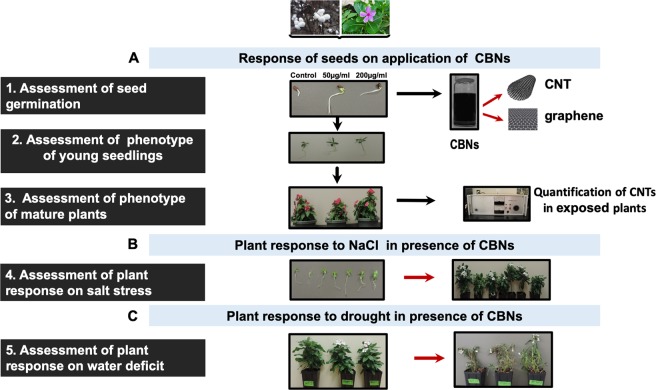
Figure 1
Figure 1
Experimental design for the study of the impact of CBNs on seed germination, plant growth, and osmotic stress tolerance of selected fiber-producing (cotton) and ornamental species (Catharanthus). The seeds of Catharanthus and cotton were exposed to growth media with CNTs or graphene. Long-term application of CBNs to tested crops was achieved by cultivating in the soil supplemented with CNTs or graphene.
Figure 2
Figure 2
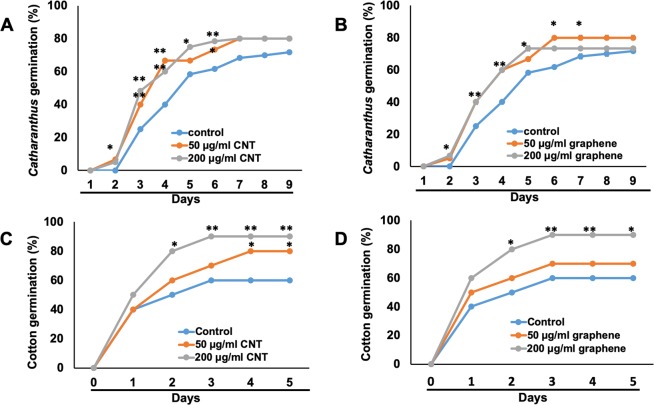
Enhancement of seed germination of fiber-producing and ornamental species by the application of CBNs. Effects of CNTs (A,C) and graphene (B,D) added to the growth medium on seed germination of Catharanthus (A,B) and cotton (C,D). The presented graph shows the percentage of seed germination by exposures to CBNs at a concentration of 50 µg/ml and 200 µg/ml. The entire seed germination experiments were repeated twice (n = 60 for each treatment and for conrol). The statistical significance was determined as compared to control (untreated) seeds by p < 0.05 and p < 0.01 (**p < 0.01 and *p < 0.05).
Figure 3
Figure 3
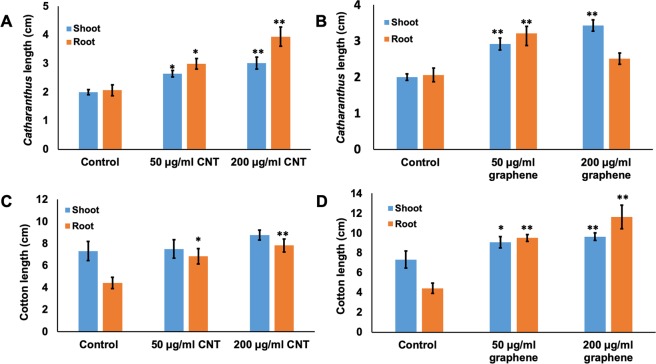
The activation of growth and development of seedlings of cotton and Catharanthus exposed to two types of CBNs. Effects of CNTs (A,C) and graphene (B,D) on the growth of seedlings of Catharanthus (A,B) and cotton (C,D). The presented graphs show the root length and shoot length of 4 week-old Catharanthus and 1 week-old cotton exposed to 50 µg/ml and 200 µg/ml CBNs. Experiments were repeated twice (n = 20 for each treatment and for control). The statistical significance was determined as compared to control (untreated) seedlings by p < 0.05 and p < 0.01 (*p < 0.05 and **p < 0.01).
Figure 4
Figure 4
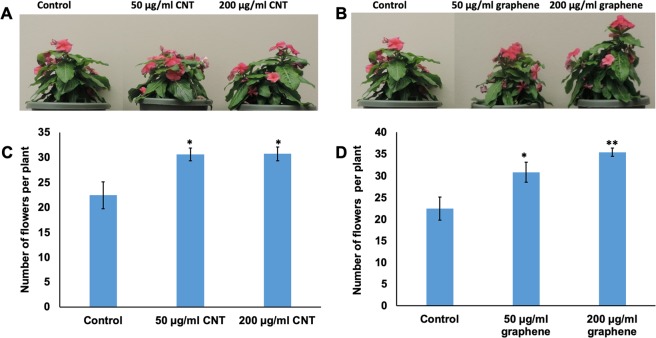
Activation of flower production in Catharanthus as a result of the application of CBNs (CNT, graphene) to the soil mix. Effects of CNTs (A,C) and graphene (B,D) on the total number of produced flowers. The statistical significance was determined as compared to untreated (control) Catharanthus plants. The entire plant growth and flower production experiments were repeated twice (n = 15 for each treatment of Catharanthus). The statistical significance was determined as compared to control (untreated) plants by p < 0.05 and p < 0.01(*p < 0.05 and **p < 0.01).
Figure 5
Figure 5
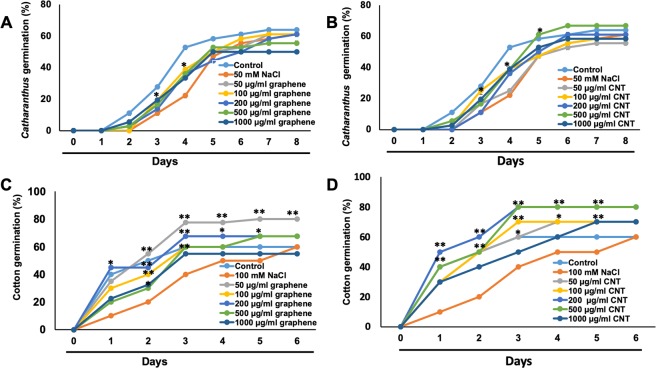
Activation of seed germination by application of CBNs in cotton and Catharanthus under salt stress. Effects of graphene (A,C) and CNTs (B,D) on seed germination of Catharanthus (A,B) and cotton (C,D) exposed to salty growth media. 50 mM NaCl and 100 mM NaCl were used to impose salt stress in Catharanthus and cotton, respectively. The seed germination experiments were repeated twice (n = 60 for each treatment of cotton and Catharanthus) The statistical significance was determined as compared to seeds exposed to only NaCl by p < 0.05 and p < 0.01 (*p < 0.05 and**p < 0.01).
Figure 6
Figure 6
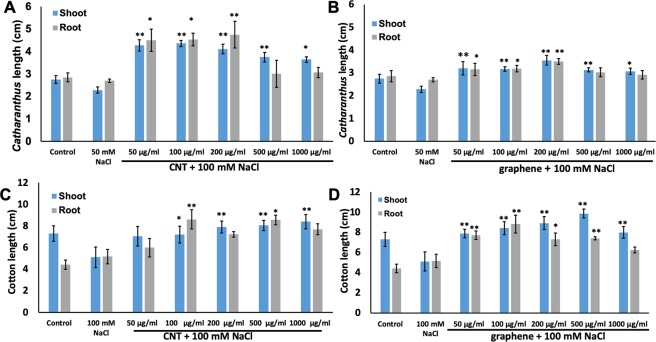
Growth and developments of seedlings of cotton and Cathatanthus exposed to CBNs under salt stress in vitro. Effects of CNTs (A,C) and graphene (B,D) on the growth of 4-week-old Catharanthus (A,B) and 1-week-old cotton (C,D) exposed to agar MS medium supplemented with NaCl. The seedlings development experiments were repeated twice (n = 20 for each treatment of cotton and Catharanthus). The statistical significance was determined as compared to seedlings treated with only NaCl by p < 0.05 and p < 0.01 (*p < 0.05 and **p < 0.01).
Figure 7
Figure 7
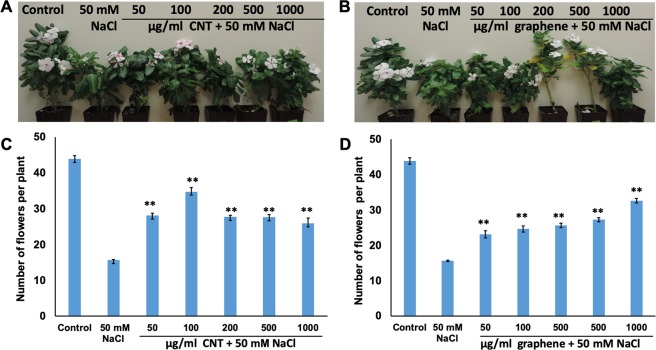
Long-term application of CBNs to salty soil reduced the toxic effects of salt stress and improved the growth and yield of Catharanthus. The introduction of CBNs to salty soil positively affected the production of flowers in Catharanthus cultivated in CNT-mixed soil (A,C) and graphene mixed-soil (B,D) under imposed salt stress. Control Catharanthus were grown in regular soil, NaCl exposed Catharanthus were grown at soil supplemented with 50 mM NaCl and CBNs exposed Catharanthus were cultivated in soil supplemented with 50 mM NaCl in presence of different concentrations of CNTs or graphene. The greenhouse experiment was repeated twice (n = 8 for each treatment). The statistical significance was determined as compared to Catharanthus treated with 50 mM NaCl by p < 0.05 and p < 0.01 (*p < 0.05 and **p < 0.01).
Figure 8
Figure 8
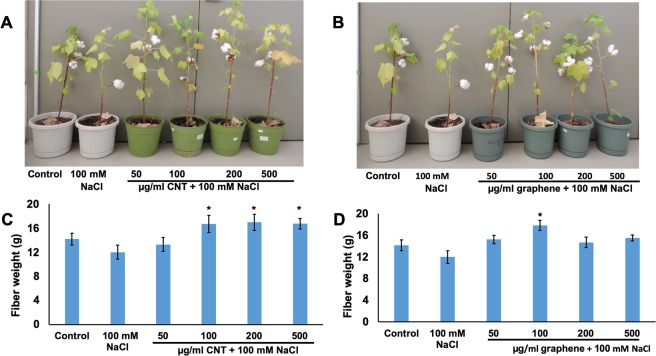
Long-term application of CBNs to salty soil reduced the toxic effects of salt and improved the growth and yield of cotton. The introduction of CBNs to salty soil positively affected the fiber yield of cotton cultivated in the soil supplemented with CNTs (A,C) and in soil supplemented with graphene (B,D) under imposed salt stress condition. Control cotton plants were grown in regular soil, NaCl treated cotton plants were grown in soil supplemented with 100 mM NaCl and CBNs exposed cotton plants were grown in salty soil (100 mM NaCl) supplemented with CNTs or graphene in a wide range of concentrations. The experiment was repeated twice (n = 8 for each treatment and for control) The statistical significance was determined as compared to cotton plants treated with 100 mM NaCl by p < 0.05 and p < 0.01 (*p < 0.05 and **p < 0.01).
Figure 9
Figure 9
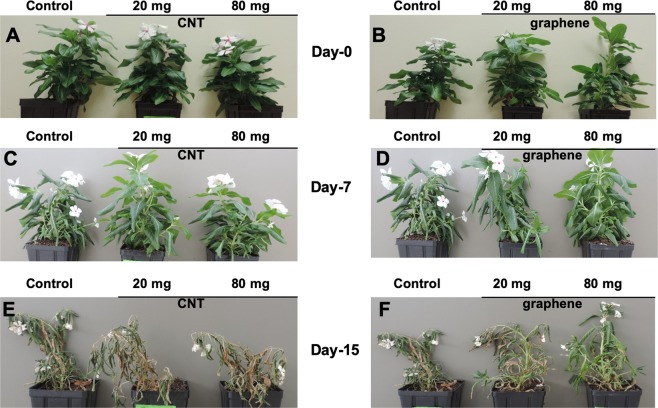
The phenotype of Catharanthus plants grown in conditions of water deficit stress in presence of CBNs. Effects of CNTs (A,C,E) and graphene (B,D,F) on the phenotype of Catharanthus at day-0 (A,B), day-7 (C,D) and day-15 (E,F) of water deficit stress. The final concentrations of CNTs and graphene were 20 mg and 80 mg per 400 g of soil mix. Delivery of CBNs to soil mix was achieved by the addition of CNTs or graphene solution to the soil for 4 weeks. The experiments were repeated twice (n = 10 for each treatment and for control).
Figure 10
Figure 10
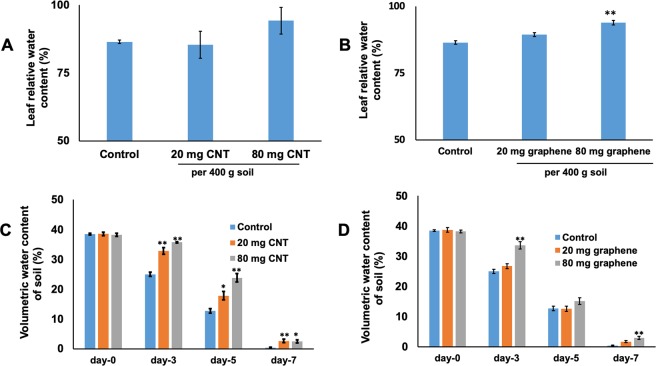
Effects of CBNs on leaf relative water content of Catharanthus cultivated at CNT -mixed soil (A) and graphene mixed soil (B) in conditions of more water deficit stress. Measurement of moisture content of Catharanthus cultivated soil mixed with CNTs (C) and graphene (D). The final concentrations of CNTs and graphene were 20 mg and 80 mg per 400 g of soil mix. Delivery of CNT to soil mix was achieved by the addition of CNT or graphene solution to the soil for 4 weeks. The experiments were repeated twice (n = 5 for (A,B) and n = 10 for (C,D) (*p < 0.05 and **p < 0.01).

References

    1. Zaytseva O, Neumann G. Carbon nanomaterials: production, impact on plant development, agricultural and environmental applications. Chem Biol Technol Agric. 2016;3:17. doi: 10.1186/s40538-016-0070-8. - DOI
    1. Joseph, T. & Morrison, M. Nanotechnol Agric foodInstitute Nanotechnology. Nanoforum Organ (2006).
    1. Scrinis G, Lyons K. The emerging nano-corporate paradigm: nanotechnology and the transformation of nature, food and agri-food systems. Int J Sociol Food Agric. 2007;15:22–44.
    1. Kole, C. Kumar D. D. & Khodakovskaya, M. V. Plant Nanotechnology principles and practice. Springer (2016).
    1. Servin AE, et al. A review of the use of engineered nanomaterials to s.ppress plant disease and enhance crop yield. J Nanoparticle Res. 2015;17:1–21. doi: 10.1007/s11051-015-2907-7. - DOI

Publication types