Review
. 2020 Feb 19;71(4):1215-1225.
doi: 10.1093/jxb/erz496.

Beyond the darkness: recent lessons from etiolation and de-etiolation studies

Affiliations
Review

Beyond the darkness: recent lessons from etiolation and de-etiolation studies

Tegan Armarego-Marriott et al. J Exp Bot. .

Abstract

The state of etiolation is generally defined by the presence of non-green plastids (etioplasts) in plant tissues that would normally contain chloroplasts. In the commonly used dark-grown seedling system, etiolation is coupled with a type of growth called skotomorphogenesis. Upon illumination, de-etiolation occurs, marked by the transition from etioplast to chloroplast, and, at the seedling level, a switch to photomorphogenic growth. Etiolation and de-etiolation systems are therefore important for understanding both the acquisition of photosynthetic capacity during chloroplast biogenesis and plant responses to light-the most relevant signal in the life and growth of the organism. In this review, we discuss recent discoveries (within the past 2-3 years) in the field of etiolation and de-etiolation, with a particular focus on post-transcriptional processes and ultrastructural changes. We further discuss ambiguities in definitions of the term 'etiolation', and benefits and biases of common etiolation/de-etiolation systems. Finally, we raise several open questions and future research possibilities.

Keywords: chloroplast biogenesis; de-etiolation; etiolation; etioplast; prolamellar body; skotomorphogenesis.


Figures

Fig. 1.
Fig. 1.
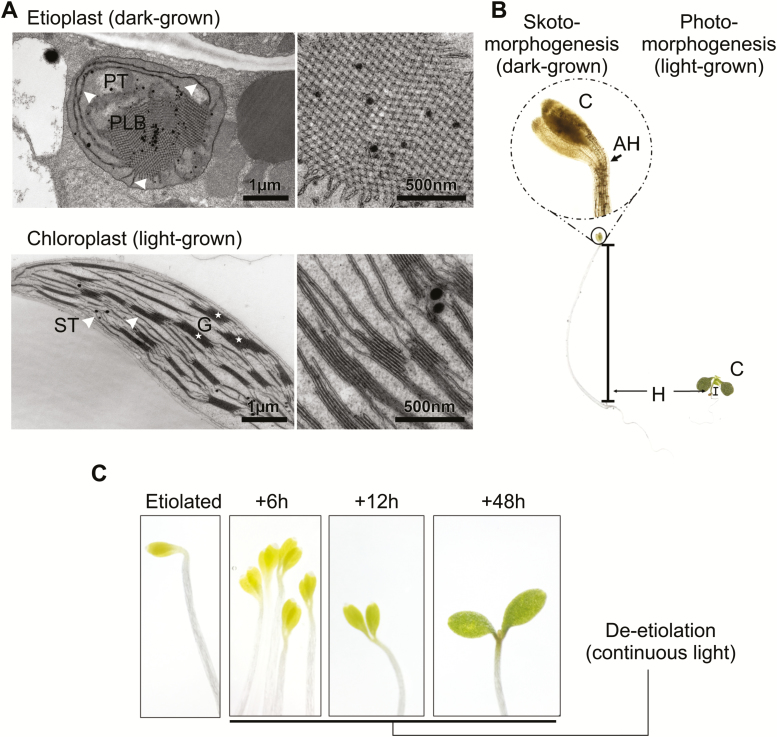
Etiolated phenotypes in plants (exemplified in Arabidopsis). (A) Plants grown in extended darkness develop etioplasts (upper panels). These plastids are physically defined by the presence of a paracrystalline membrane structure called prolamellar body (PLB), as well as prothylakoids (PT, indicated by white arrowheads). In the light, photosynthetic tissue develops chloroplasts (lower panels), which are defined structurally by thylakoid membranes that contain grana stacks (G, white asterisks) and stroma lamellae called stroma thylakoids (ST, white arrowheads). Images are from 6-day-old dark-grown Arabidopsis plant (upper panel), and a light-grown Arabidopsis plant at the rosette stage (lower panel). (B) Etiolation and de-etiolation studies generally involve germination and growth of seedlings in darkness, resulting in skotomorphogenic growth (left). This is defined by the presence of an apical hook (AH), closed and pale cotyledons, and an elongated hypocotyl. By contrast, plants grown the light (photomorphogenic conditions; right) have shorter hypocotyls, and open, green cotyledons. C, cotyledon; H, hypocotyls. Images taken from a 7-day-old dark-grown and a 9-day-old light-grown Arabidopsis seedling. (C) De-etiolation of dark-grown (etiolated) seedlings involves straightening of the apical hook, opening and greening of the cotyledons, as well as the transition from etioplast to chloroplasts (refer to Fig. 3). The etiolated seedlings were exposed to continuous white light (95 µmol photons m−2 s−1) for 6, 12, and 48 h.
Fig. 2.
Fig. 2.
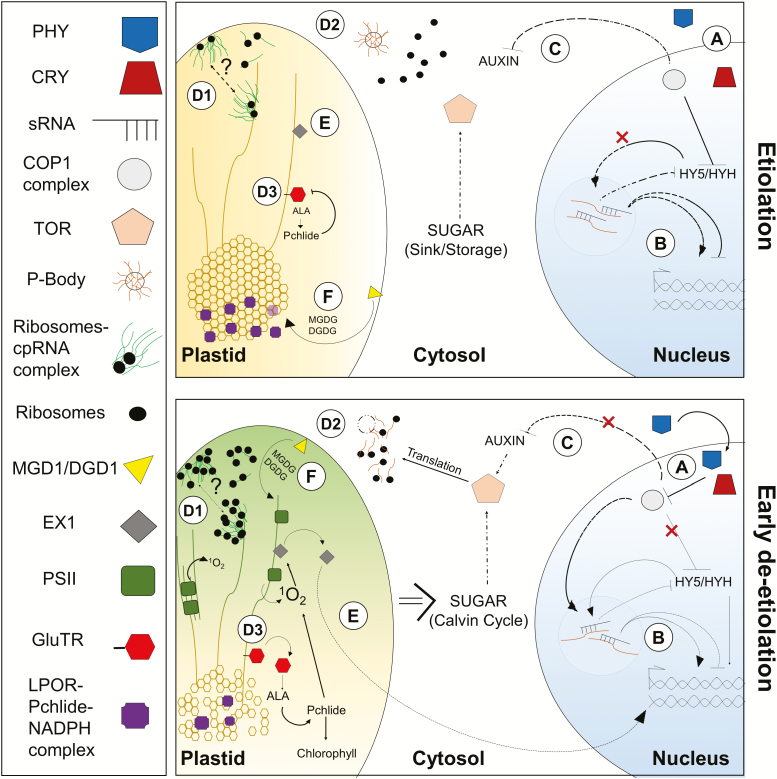
Signaling cascade and recently described players in de-etiolation. This simplified model shows a basic overview of (A) the PHY/CRY-mediated light-responsive signaling cascade, and (B–F) recent discoveries in the field discussed in this review. The upper panel shows the etiolated state, the lower panel shows the changes that occur early upon de-etiolation. (A) Light is perceived by photoreceptors such as phytochromes (PHY) and cryptochromes (CRY), resulting in indirect activation of the expression of Elongated Hypocotyl5/HY5 Homolog (HY5/HYH)-dependent photomorphogenesis-related genes by repression of the COP1 complex. (B) Small RNAs (sRNA) modulate transcript accumulation of both light-signaling molecules and ownstream effector genes, and the sRNA pathway itself is also controlled via light signaling pathways. (C) TOR indirectly activates translation via auxin, and is itself stimulated by light as well as by sugars. (D) Physical sequestration can limit functionality. (D1) Increased translation in the plastid is likely linked to increased ribosome density, as opposed to occupancy. (D2) Cytosolic transcripts are sequestered in processing bodies (P-bodies) during etiolation, with release allowing their translation. (D3) GluTR is soluble and active in the light, with the soluble form correlating with chlorophyll content during greening. (E) Retrograde signalling mediated by 1O2 produced by the early assembly of the oxygen evolving complex of PSII might contribute to the EXECUTER1 signaling pathway. (F) MGDG and DGDG, produced in the envelopes by monogalactosyldiacylglycerol synthase 1 (MGD1) and digalactosyldiacylglycerol synthase 1 (DGD1), are the primary plastid lipids, and have crucial and disparate roles in PLB formation and etioplast-to-chloroplast transition, but more research is required to understand the role of both lipids and proteins in membrane biogenesis.
Fig. 3.
Fig. 3.
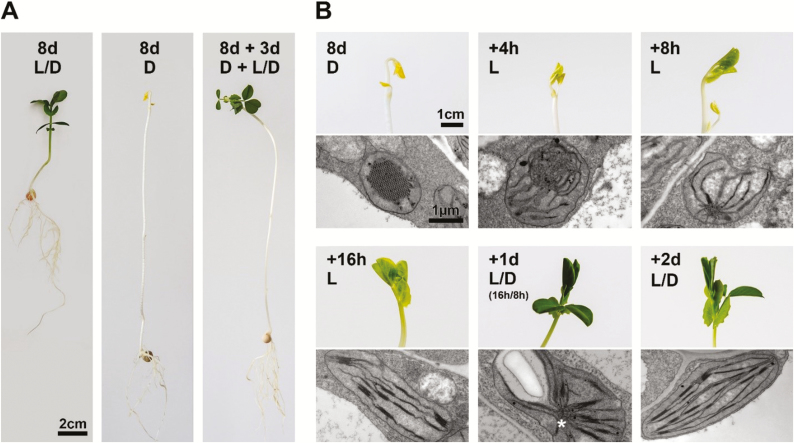
Pea (Pisum sativum) de-etiolating under light/dark conditions. (A) Pea seedlings grown for 8 d under light dark (L/D) conditions (16 h of light at 40 µmol photons m−2 s−1–8 h of darkness) (left panel), darkness (D) (middle panel), 8 d of darkness followed by 3 d of L/D (right panel). Pea, which develops true leaves in darkness, as well as other hypogeal germinating plants, may be used as an alternative system to epigeal germinating Arabidopsis plants, which only develop cotyledons in the dark. As ‘maternal tissue’, cotyledons are formed by and undergo different developmental programing from true leaves. (B) De-etiolating pea. The upper panels show seedling shoot apices; the lower panels show transmission electron micrograph. Plants grown in darkness for 8 d were de-etiolated under light–dark conditions (16 h of light at 40 µmol photons m−2 s−1–8 h of darkness). Note that following the first 24 h of growth there is partial reformation of the PLB, indicated by the white asterisk.

References

    1. Achkar NP, Cho SK, Poulsen C, et al. 2018. A quick HYL1-dependent reactivation of microRNA production is required for a proper developmental response after extended periods of light deprivation. Developmental Cell 46, 236–247.e6. - PubMed
    1. Armarego-Marriott T, Kowalewska Ł, Burgos A, et al. 2019. Highly resolved systems biology to dissect the etioplast-to-chloroplast transition in tobacco leaves. Plant Physiology 180, 654–681. - PMC - PubMed
    1. Aronsson H, Schöttler MA, Kelly AA, Sundqvist C, Dörmann P, Karim S, Jarvis P. 2008. Monogalactosyldiacylglycerol deficiency in Arabidopsis affects pigment composition in the prolamellar body and impairs thylakoid membrane energization and photoprotection in leaves. Plant Physiology 148, 580–592. - PMC - PubMed
    1. Avin-Wittenberg T, Bajdzienko K, Wittenberg G, Alseekh S, Tohge T, Bock R, Giavalisco P, Fernie AR. 2015. Global analysis of the role of autophagy in cellular metabolism and energy homeostasis in Arabidopsis seedlings under carbon starvation. The Plant Cell 27, 306–322. - PMC - PubMed
    1. Borges F, Martienssen RA. 2015. The expanding world of small RNAs in plants. Nature Reviews. Molecular cell biology 16, 727–741. - PMC - PubMed