


Concealed Wolff-Parkinson-White Syndrome revealed by acute coronary syndrome
- PMID: 31856385
- PMCID: PMC7507436
- DOI: 10.1111/anec.12735
Concealed Wolff-Parkinson-White Syndrome revealed by acute coronary syndrome
Abstract
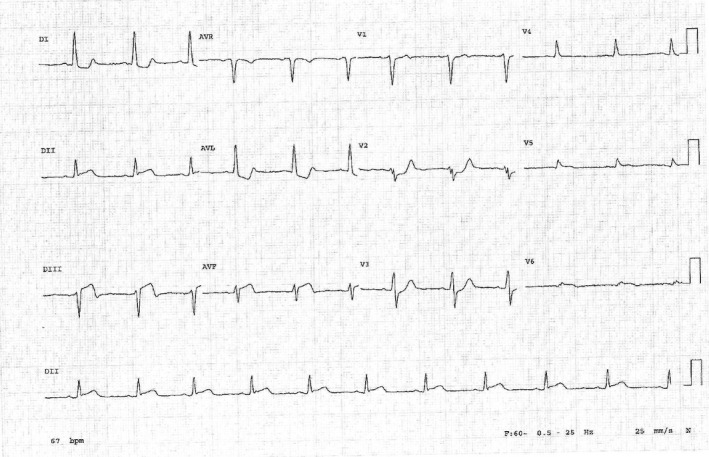
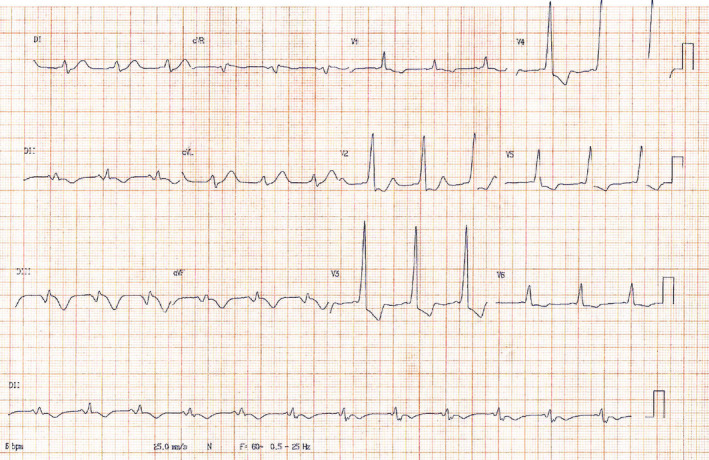
Wolff-Parkinson-White (WPW) syndrome is a conduction disturbance in which atrial impulses are transmitted to the ventricles by an accessory pathway instead of the normal atrioventricular conduction. The WPW syndrome may either simulate myocardial infarction or mask the electrocardiographic abnormalities of an acute MI. However, concealed WPW revealed after an acute coronary syndrome is rare with few cases reported in the literature. This article reports a case of coronary artery disease with ST-segment elevation in a 57-year-old man, previously asymptomatic, with an initial electrocardiogram showing no conduction abnormalities that subsequently presented with an ECG compatible with WPW.
Keywords: Parkinson; White; Wolff; acute myocardial infarct; coronary artery disease.
© 2019 The Authors. Annals of Noninvasive Electrocardiology published by Wiley Periodicals, Inc.
Conflict of interest statement
The authors declare that they have no conflicts of interest with the content of this case report.
Figures
References
-
- Kaya, M. G. , Ozdogru, I. , Yarlioglues, M. , Inanc, T. , Dogan, A. , & Eryol, N. K. (2008). Coronary ischemia induced Wolff–Parkinson–White syndrome. International Journal of Cardiology, 129(1), e3–4. - PubMed
-
- Pappone, C. , Vicedomini, G. , Manguso, F. , Baldi, M. , Pappone, A. , Petretta, A. , … Giannelli, L. (2012). Risk of malignant arrhythmias in initially symptomatic patients with Wolff‐Parkinson‐White Syndrome. Results of a prospective long‐term electrophysiological follow‐up study pappone. Circulation, 125, 661–668. 10.1161/CIRCULATIONAHA.111.065722 - DOI - PubMed
Publication types
MeSH terms
Substances
LinkOut - more resources
Full Text Sources
