. 2020 Feb 15;80(4):890-900.
doi: 10.1158/0008-5472.CAN-19-2830. Epub 2019 Dec 19.

NAMPT Inhibition Suppresses Cancer Stem-like Cells Associated with Therapy-Induced Senescence in Ovarian Cancer

Affiliations

NAMPT Inhibition Suppresses Cancer Stem-like Cells Associated with Therapy-Induced Senescence in Ovarian Cancer

Timothy Nacarelli et al. Cancer Res. .

Abstract

Epithelial ovarian cancer (EOC) is the most lethal of gynecologic malignancies. The standard-of-care treatment for EOC is platinum-based chemotherapy such as cisplatin. Platinum-based chemotherapy induces cellular senescence. Notably, therapy-induced senescence contributes to chemoresistance by inducing cancer stem-like cells (CSC). However, therapeutic approaches targeting senescence-associated CSCs remain to be explored. Here, we show that nicotinamide phosphoribosyltransferase (NAMPT) inhibition suppresses senescence-associated CSCs induced by platinum-based chemotherapy in EOC. Clinically applicable NAMPT inhibitors suppressed the outgrowth of cisplatin-treated EOC cells both in vitro and in vivo. Moreover, a combination of the NAMPT inhibitor FK866 and cisplatin improved the survival of EOC-bearing mice. These phenotypes correlated with inhibition of the CSCs signature, which consists of elevated expression of ALDH1A1 and stem-related genes, high aldehyde dehydrogenase activity, and CD133 positivity. Mechanistically, NAMPT regulates EOC CSCs in a paracrine manner through the senescence-associated secretory phenotype. Our results suggest that targeting NAMPT using clinically applicable NAMPT inhibitors, such as FK866, in conjunction with platinum-based chemotherapy represents a promising therapeutic strategy by suppressing therapy-induced senescence-associated CSCs. SIGNIFICANCE: This study highlights the importance of NAMPT-mediated NAD+ biosynthesis in the production of cisplatin-induced senescence-associated cancer stem cells, as well as tumor relapse after cisplatin treatment.


Conflict of interest statement

Disclosure of Potential Conflicts of Interests: The authors declare no competing financial interests.

Figures

Figure 1.
Figure 1.. NAMPT inhibition suppresses cisplatin-induced SASP.
(A) OVCAR3 cells treated with or without 250 nM cisplatin for four days were subjected to ChIP analysis for the enrichment of HMGA1 on the NAMPT gene enhancer using an anti-HMGA1 antibody or isotype-match IgG control. (B) OVCAR3 cells treated with cisplatin with or without 1 nM FK866 or 0.5 nM GMX1778 for four days were examined for the expression of HMGA1, NAMPT, Lamin B1, and a loading control β-actin by immunoblotting. (C) Same as (B), but cells were examined for the NAD+/NADH ratio. (D) Cells treated under the indicated conditions were examined for SA-β-Gal activity or colony formation at day 5 with the indicated treatment. Scale bar = 100 μm. (E) Quantification of SA-β-Gal positive cells in (D). (F) Quantification of integrated intensity of colony formation in (D). (G) Cells under the indicated conditions were assayed for NFκB reporter activity. (H) Same as in (B), but cells were examined for SASP gene expression using qRT-PCR. Note that high cell density was used for SA-β-Gal assay to avoid stress-induced false positivity, while low cell density was used for colony formation to examine the differences in cell proliferation. Error bars represent ± S.E.M. n = 3 independent experiments. P values were calculated using a two-tailed Student’s t-test.
Figure 2.
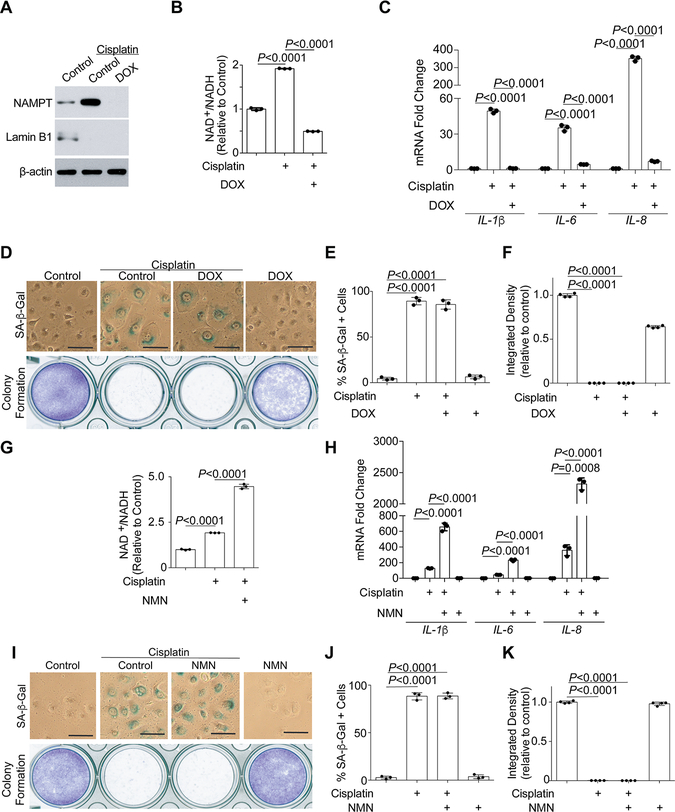
Figure 2.. NAD+ level regulates cisplatin-induced SASP.
(A) OVCAR3 cells treated with cisplatin with or without DOX-inducible knockdown of NAMPT for four days were examined for expression of NAMPT, Lamin B1, and a loading control β-actin by immunoblot. (B) Same as (A), but cells were examined for the NAD+/NADH ratio. (C) Same as (A), but cells were examined for the indicated SASP gene expression using qRT-PCR. (D) Cells treated under the indicated conditions were examined for SA-β-Gal activity or colony formation. Scale bar = 100 μm. (E) Quantification of SA-β-Gal positive cells in (D). (F) Quantification of integrated intensity of colony formation in (D). (G) Cells treated with cisplatin with or without 500 μM NMN supplementation were examined for the NAD+/NADH ratio. (H) Same as in (G), but cells were examined for the indicated SASP gene expression using qRT-PCR. (I) Cells treated under the indicated conditions were examined for SA-β-Gal activity or colony formation. Scale bar = 100 μm. (J) Quantification of SA-β-Gal positive cells in (I). (K) Quantification of integrated intensity of colony formation in (I). Error bars represent ± S.E.M. n = 3 independent experiments. P values were calculated using a two-tailed Student’s t-test.
Figure 3.
Figure 3.. NAMPT inhibition suppresses therapy-induced CSCs.
(A) OVCAR3 cells were treated with 250 nM cisplatin with or without 1 nM FK866 or 0.5 nM GMX1778 and released from treatment and further cultured in drug-free medium for 9 days and assayed for colony formation. (B) Quantification of integrated intensity of colony formation in (A). (C-D) Same as in (A), but cells were only treated for four days and examined for expression of ALDH1A1, NAMPT, Cleaved PARP1, Cleaved Caspase 3, and a loading β-actin by immunoblot. (E) Same as in (C), but cells were analyzed for expression of the indicated stem-related genes by qRT-PCR. (F) Same as in (C), but cells were analyzed for ALDH activity and CD133 positivity by FACS. (G) Quantification of the percentage of ALDH and CD133-positive cells in (F). DEAB-treated cells were used as a negative control for ALDH activity. Error bars represent ± S.E.M. n = 3 independent experiments. (H) Primary EOC cells were harvested from a serous EOC histosubtype tumor specimen, grown into organoid structures under three-dimensional conditions, and subjected to phase contract microscopy and hematoxylin–eosin (H&E) staining. Scale bar for phase contrast = 100 μm. Scale bar for H&E staining = 40 μm. (I) Organoid structures were treated with 250 nM cisplatin with or without 1 nM FK866 and examined for organoid diameter. Organoids larger than 40 μm were quantified. (J) Same as in (I), but cells were stained for ALDH activity and imaged on a Celígo imaging cytometer. Error bars represent ± S.E.M. n = 2 independent experiments. P values were calculated using a two-tailed Student’s t-test.
Figure 4.
Figure 4.. NAMPT inhibitors suppress senescence-associated EOC CSCs.
(A) OVCAR3 cells were treated with 250 nM cisplatin with or without 1 nM FK866 or 0.5 nM GMX1778 and analyzed for ALDH and SA-β-Gal activity by FACS. (B) Quantification of the percentage of ALDH and SA-β-Gal-positive cells in (A). (C) FACS-sorted ALDH and SA-β-Gal-positive cells were cultured in low attachment plates to assess sphere formation with or without 1 nM FK866, 0.5 nM GMX1778, or 500 μM NMN treatment. Scale bar = 100 μm. (D) Quantification of sphere formation in (C). Error bars represent ± S.E.M. n = 3 independent experiments. P values were calculated using a two-tailed Student’s t-test.
Figure 5.
Figure 5.. NAMPT-driven SASP promotes stemness.
(A) Schematic of experimental design. OVCAR3 cells were treated with 250 nM cisplatin with or without 1 nM FK866 or 0.5 nM GMX1778 and released from treatment for the collection of conditioned media. Naïve OVCAR3 cells were treated with conditioned media and assayed for stemness markers. (B) Cells were analyzed for ALDH activity and CD133 positivity by FACS. (C) Quantification of the percentage of ALDH and CD133-positive cells in (B). (D) Same as in (A), but cells were analyzed for expression of the indicated stem-related genes by qRT-PCR. Error bars represent ± S.E.M. n = 3 independent experiments. P values were calculated using a two-tailed Student’s t-test.
Figure 6.
Figure 6.. The combination of FK866 and cisplatin suppresses tumor outgrowth and improves survival of EOC-bearing mice.
(A) The growth of tumors formed by OVCAR3 cells in the indicated treatment groups (n=6 mice/group) was monitored at the indicated time points during the three weeks of treatment. (B) After three weeks of treatment, the mice from the indicated treatment groups were euthanized and the weights of the dissected tumors were quantified as a surrogate for tumor burden (n=4 mice/group). (C) Tumors from in (B) were examined for ALDH activity by FACS (n=4 mice/group). (D) Tumors from in (B) were examined for ALDH1A1 expression by qRT-PCR (n=4 mice/group). (E) The tumor tissue sections from the indicated treatment groups were subjected to hematoxylin–eosin (H&E) staining and immunohistochemical staining using an antibody against ALDH1. Scale bar = 100 μm. (F) The histological score (H-score) of ALDH1 was calculated from (E) (n=4 mice/group). (G) Quantification of tumor outgrowth in the indicated groups after terminating drug treatment (n=6 mice/group). (H) After three weeks of treatment of cisplatin with or without FK866, the mice were followed for survival and shown are the Kaplan-Meier survival curves (n=6 mice/group). Error bars represent ± S.E.M. P values were calculated using a two-tailed Student’s t-test.

References

    1. Kurman RJ, Shih Ie M. The Dualistic Model of Ovarian Carcinogenesis: Revisited, Revised, and Expanded. Am J Pathol 2016;186:733–47 - PMC - PubMed
    1. Bowtell DD, Bohm S, Ahmed AA, Aspuria PJ, Bast RC Jr., Beral V, et al. Rethinking ovarian cancer II: reducing mortality from high-grade serous ovarian cancer. Nat Rev Cancer 2015;15:668–79 - PMC - PubMed
    1. Zhang S, Balch C, Chan MW, Lai HC, Matei D, Schilder JM, et al. Identification and characterization of ovarian cancer-initiating cells from primary human tumors. Cancer Res 2008;68:4311–20 - PMC - PubMed
    1. Silva IA, Bai S, McLean K, Yang K, Griffith K, Thomas D, et al. Aldehyde dehydrogenase in combination with CD133 defines angiogenic ovarian cancer stem cells that portend poor patient survival. Cancer Res 2011;71:3991–4001 - PMC - PubMed
    1. Deng S, Yang X, Lassus H, Liang S, Kaur S, Ye Q, et al. Distinct expression levels and patterns of stem cell marker, aldehyde dehydrogenase isoform 1 (ALDH1), in human epithelial cancers. PLoS One 2010;5:e10277. - PMC - PubMed

Publication types

MeSH terms

Substances