


Tailored eradication vs empirical bismuth-containing quadruple therapy for first-line Helicobacter pylori eradication: A comparative, open trial
- PMID: 31857776
- PMCID: PMC6920661
- DOI: 10.3748/wjg.v25.i46.6743
Tailored eradication vs empirical bismuth-containing quadruple therapy for first-line Helicobacter pylori eradication: A comparative, open trial
Abstract
Background: Few studies have compared the efficacy and safety profile of a tailored eradication (TR) strategy based on the presence of a 23S ribosomal RNA point mutation with those of empirical bismuth-based quadruple therapy (EBQT) for first-line eradication of Helicobacter pylori (H. pylori) in Korean patients.
Aim: To compare the efficacy and safety of a TR strategy and those of EBQT regimen as first-line eradication therapy for H. pylori.
Methods: This is an open-label, comparative study in which we prospectively enrolled patients over 18 years of age with H. pylori infection and retrospectively reviewed their data. H. pylori-positive patients diagnosed by rapid urease test, Giemsa staining, or dual priming oligonucleotide polymerase chain reaction (DPO-PCR) were enrolled from May 2016 to September 2018 at Gil Medical Center. Patients with H. pylori infection received either a TR regimen or the EBQT regimen. In the tailored therapy group that underwent DPO-PCR testing, patients with A2142G and/or A2143G point mutations were treated with a bismuth-containing quadruple regimen. The eradication rate, patient-reported side effect rate, and H. pylori eradication success rate were evaluated and compared between the groups.
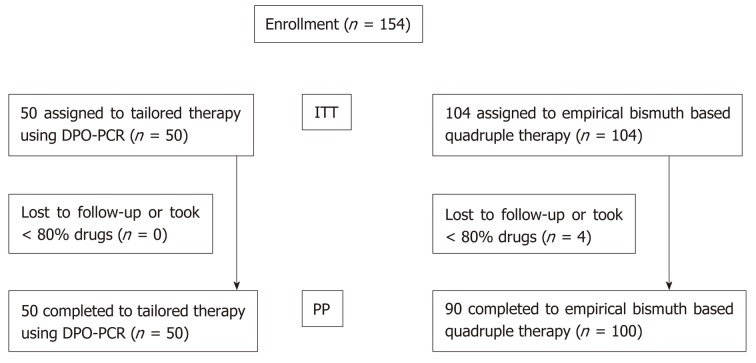
Results: A total of 150 patients were assigned to the TR (n = 50) or EBQT group (n = 100). The first-line eradication rate of H. pylori did not differ between the groups (96.0% vs 95.7%, P = 0.9). The rate of eradication-related side effects for TR was 12.0%, which differed significantly from that of EBQT (43.0%) for first-line treatment (P < 0.001).
Conclusion: DPO-PCR-based TR for H. pylori eradication may be equally efficacious, with less treatment-related complications, compared to EBQT in Korea, where clarithromycin resistance is high.
Keywords: Helicobacter pylori; Empirical; Eradication; Quadruple; Tailored.
©The Author(s) 2019. Published by Baishideng Publishing Group Inc. All rights reserved.
Conflict of interest statement
Conflict-of-interest statement: No benefits in any form have been received or will be received from a commercial party related directly or indirectly to the subject of this article.
Figures
References
-
- Wang F, Meng W, Wang B, Qiao L. Helicobacter pylori-induced gastric inflammation and gastric cancer. Cancer Lett. 2014;345:196–202. - PubMed
-
- Jonaitis L, Pellicano R, Kupcinskas L. Helicobacter pylori and nonmalignant upper gastrointestinal diseases. Helicobacter. 2018;23 Suppl 1:e12522. - PubMed
-
- Lee YC, Chiang TH, Chou CK, Tu YK, Liao WC, Wu MS, Graham DY. Association Between Helicobacter pylori Eradication and Gastric Cancer Incidence: A Systematic Review and Meta-analysis. Gastroenterology. 2016;150:1113–1124.e5. - PubMed
Publication types
MeSH terms
Substances
LinkOut - more resources
Full Text Sources
Medical
