


Sexual Dimorphism for Coping Styles Complements Traditional Methods for Sex Determination in a Multivariety Endangered Hen Breed
- PMID: 31861237
- PMCID: PMC6941311
- DOI: 10.3390/ani9121165
Sexual Dimorphism for Coping Styles Complements Traditional Methods for Sex Determination in a Multivariety Endangered Hen Breed
Abstract
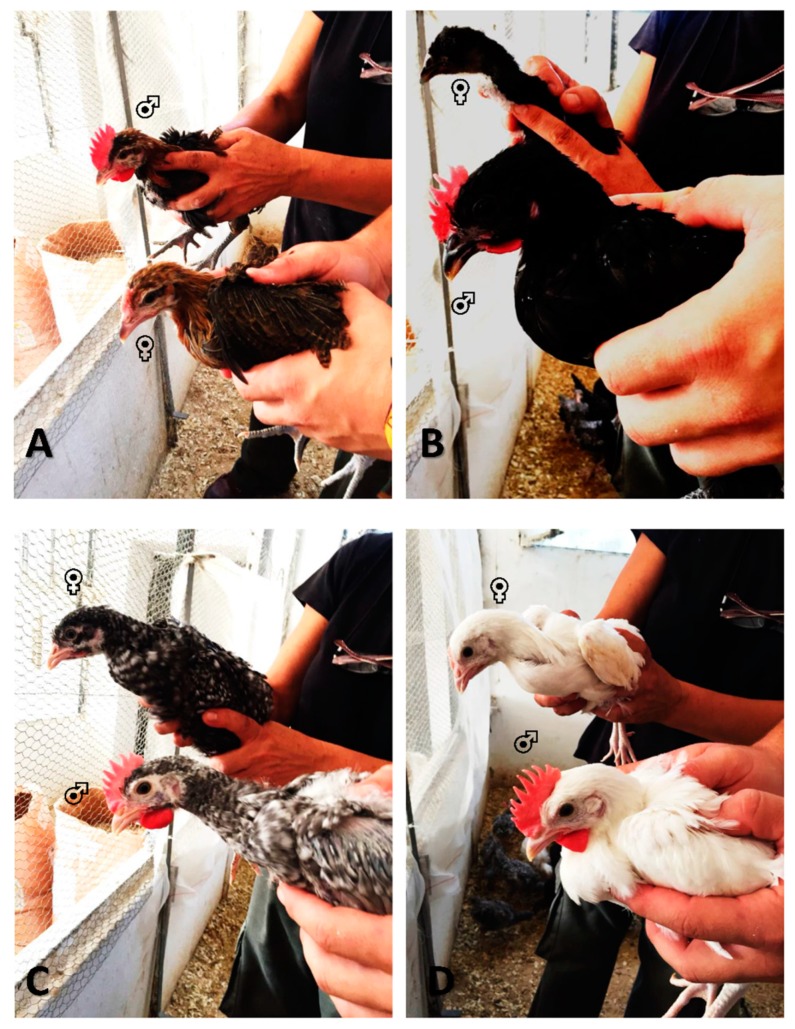
Sex determination is key to designing endangered poultry population conservation and breeding programs when sex distribution departs from Hardy-Weinberg equilibrium. A total of 112 Utrerana chickens (28 per variety, partridge, black, white, and franciscan) were selected for hatching day sexing. Sex assignation was performed through 10 methods. Three sex assignment criteria comprised criteria found in literature, opposite criteria to that in the literature, and composite criteria combining methods reporting the highest predictive success from the previous ones. This study aims to determine which method combinations may more successfully determine sex across the four varieties of Utrerana endangered hen breed to tailor noninvasive early specific models to determine sex in local chicken populations. Although the explanatory power of the three assignation criteria is equal (75%), assignation criteria 2 resulted to be the most efficient as it correctly assigns males more frequently. Only methods 3 (English method), 5 (general down feathers coloration), 7 (wing fan), and 10 (behavior/coping styles) reported significant differences regardless of the variety, hence, are appropriate for early sexing. Sex confirmation was performed at 1.5 months old. Identifying sex proportions enhances genetic management tasks in endangered populations, complementing more standardized techniques, which may result inefficient given the implicit diversity found in local populations.
Keywords: autochthonous breed; behavior; morphometric measurements; postincubation; preincubation; sexing tests.
Conflict of interest statement
The authors declare no conflict of interest. The funders had no role in the design of the study; in the collection, analyses, or interpretation of data; in the writing of the manuscript, or in the decision to publish the results.
Figures


References
-
- Somsen D., Capelle A., Tramper J. Production yield analysis in the poultry processing industry. J. Food Eng. 2004;65:479–487. doi: 10.1016/j.jfoodeng.2004.02.008. - DOI
-
- Gerber P., Opio C., Steinfeld H. Poultry production and the environment—A review. Anim. Prod. Health Div. 2007;153:1–27.
-
- Glatz P., Pym R. Alojamiento y manejo de las aves de corral en los países en desarrollo. Revisión Desarro. Avícola. 2013;26:1–5. (In Spanish)
Grants and funding
LinkOut - more resources
Full Text Sources
