Review
. 2019 Dec 19;9(1):17.
doi: 10.3390/cells9010017.

Mitochondrial Gene Expression and Beyond-Novel Aspects of Cellular Physiology

Affiliations
Review

Mitochondrial Gene Expression and Beyond-Novel Aspects of Cellular Physiology

Anna V Kotrys et al. Cells. .

Abstract

Mitochondria are peculiar organelles whose proper function depends on the crosstalk between two genomes, mitochondrial and nuclear. The human mitochondrial genome (mtDNA) encodes only 13 proteins; nevertheless, its proper expression is essential for cellular homeostasis, as mtDNA-encoded proteins are constituents of mitochondrial respiratory complexes. In addition, mtDNA expression results in the production of RNA molecules, which influence cell physiology once released from the mitochondria into the cytoplasm. As a result, dysfunctions of mtDNA expression may lead to pathologies in humans. Here, we review the mechanisms of mitochondrial gene expression with a focus on recent findings in the field. We summarize the complex turnover of mitochondrial transcripts and present an increasing body of evidence indicating new functions of mitochondrial transcripts. We discuss mitochondrial gene regulation in different cellular contexts, focusing on stress conditions. Finally, we highlight the importance of emerging aspects of mitochondrial gene regulation in human health and disease.

Keywords: dsRNA; innate immunity; interferon response; mitochondria; mitochondrial gene expression; mtDNA; mtDNA transcription; mtRNA; post-transcriptional mtRNA processing.


Conflict of interest statement

The authors declare no conflict of interest.

Figures
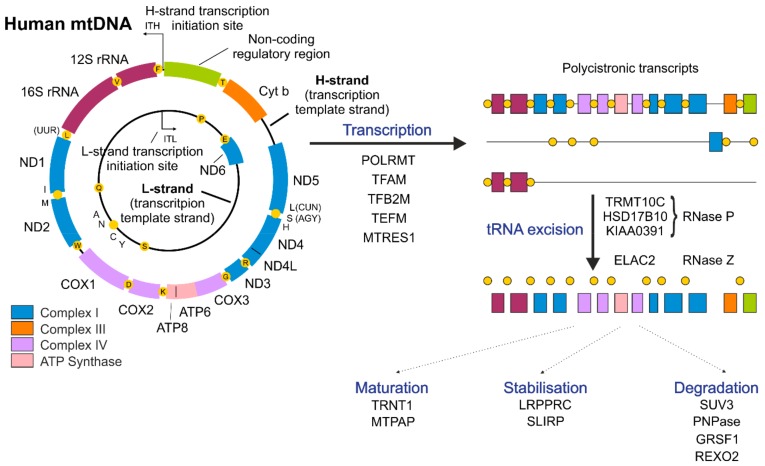
Figure 1
Figure 1
Schematic of human mtDNA and basic steps of mtRNA metabolism. Human mtDNA is a circular double-stranded molecule. Marked are template heavy (H-strand) and light (L-strand) strands of mtDNA. Marked are genes encoding subunits of Complex I (blue), III (orange), IV (violet) and subunits of ATP Synthase (pink). ND4/ND4L and ATP6/ATP8 open reading frames are overlapping and are included in bicistronic mRNAs. Genes encoding rRNAs are colored purple. Genes encoding tRNAs are represented as yellow dots with single letter code depicting their aminoacids. Mitochondrial transcription is initiated from L- and H- strand promoters (ITL and ITH, respectively) located within non-coding regulatory region (NCR). Transcription is driven by DNA-dependent RNA polymerase (POLRMT) with help of its co-factors: TFAM, TFB2M, TEFM and MTRES1. Mitochondrial transcription leads to the formation of three polycistronic transcripts that undergo further processing. Most of mitochondrial mRNAs and rRNAs are punctuated by tRNAs which are excised from the nascent RNA precursors by RNAse P and Z. Arisen transcripts may be subjected to various subsequent processes as maturation, stabilization, degradation, and modification. Selected factors engaged in these processes are presented.
Figure 2
Figure 2
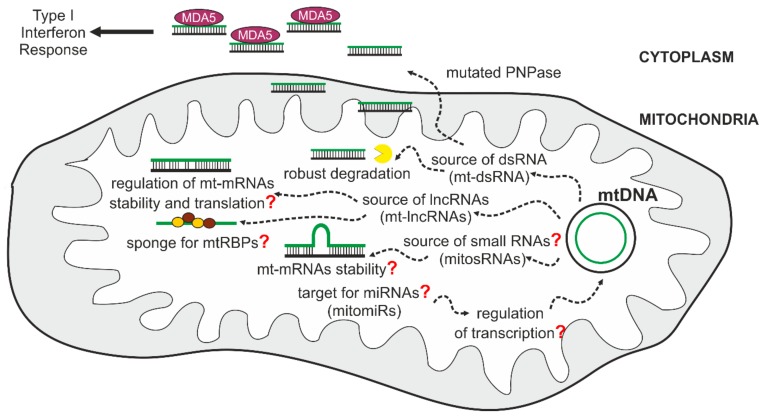
Cellular functions of mitochondria-derived transcripts. MtDNA may be a source and a target for non-coding RNA. Question mark indicates that the process or mechanism is currently undefined. Nucleus-encoded miRNAs (mitomiRs) are suggested to enter mitochondria and regulate mtDNA expression, nevertheless their exact import pathway is currently unexplained. Transcription of mtDNA may result in formation of small non-coding RNAs (mitosRNAs) which may interplay with mt-mRNAs stability. Mechanism of action of mitochondrial small non-coding RNAs is currently undefined. Long non-coding RNAs (mt-lncRNAs) may arise from mtDNA transcription and may regulate stability and transcription of mt-mRNAs or may serve as baits for mitochondrial RNA-binding proteins (mtRBPs). Convergent transcription of mtDNA may result in formation of double-stranded RNA (mt-dsRNA). Under normal conditions, L-strand derived transcripts are swiftly degraded which prevents formation of mt-dsRNAs. Dysfunction of PNPase causes accumulation of mt-dsRNA and its release into cytoplasm. Once released into the cytoplasm, mt-dsRNAs can induce type I interferon response via activation of MDA5 receptors.

References

    1. Brown G.C. Control of respiration and ATP synthesis in mammalian mitochondria and cells. Biochem. J. 1992;284:1–13. doi: 10.1042/bj2840001. - DOI - PMC - PubMed
    1. Go Y.-M., Jones D.P. Redox compartmentalization in eukaryotic cells. Biochim. Biophys. Acta. 2008;1780:1273–1290. doi: 10.1016/j.bbagen.2008.01.011. - DOI - PMC - PubMed
    1. Titov D.V., Cracan V., Goodman R.P., Peng J., Grabarek Z., Mootha V.K. Complementation of mitochondrial electron transport chain by manipulation of the NAD+/NADH ratio. Science. 2016;352:231–235. doi: 10.1126/science.aad4017. - DOI - PMC - PubMed
    1. Galluzzi L., Kepp O., Trojel-Hansen C., Kroemer G. Mitochondrial control of cellular life, stress, and death. Circ. Res. 2012;111:1198–1207. doi: 10.1161/CIRCRESAHA.112.268946. - DOI - PubMed
    1. Pizzo P., Drago I., Filadi R., Pozzan T. Mitochondrial Ca2+ homeostasis: Mechanism, role, and tissue specificities. Pflugers Arch. 2012;464:3–17. doi: 10.1007/s00424-012-1122-y. - DOI - PubMed

Publication types

Substances