. 2020 Feb;29(3):639-653.
doi: 10.1111/mec.15344. Epub 2020 Jan 3.

The microbiota influences the Drosophila melanogaster life history strategy

Affiliations

The microbiota influences the Drosophila melanogaster life history strategy

Amber W Walters et al. Mol Ecol. 2020 Feb.

Abstract

Organisms are locally adapted when members of a population have a fitness advantage in one location relative to conspecifics in other geographies. For example, across latitudinal gradients, some organisms may trade off between traits that maximize fitness components in one, but not both, of somatic maintenance or reproductive output. Latitudinal gradients in life history strategies are traditionally attributed to environmental selection on an animal's genotype, without any consideration of the possible impact of associated microorganisms ("microbiota") on life history traits. Here, we show in Drosophila melanogaster, a key model for studying local adaptation and life history strategy, that excluding the microbiota from definitions of local adaptation is a major shortfall. First, we reveal that an isogenic fly line reared with different bacteria varies the investment in early reproduction versus somatic maintenance. Next, we show that in wild fruit flies, the abundance of these same bacteria was correlated with the latitude and life history strategy of the flies, suggesting geographic specificity of the microbiota composition. Variation in microbiota composition of locally adapted D. melanogaster could be attributed to both the wild environment and host genetic selection. Finally, by eliminating or manipulating the microbiota of fly lines collected across a latitudinal gradient, we reveal that host genotype contributes to latitude-specific life history traits independent of the microbiota and that variation in the microbiota can suppress or reverse the differences between locally adapted fly lines. Together, these findings establish the microbiota composition of a model animal as an essential consideration in local adaptation.

Keywords: Drosophila; acetic acid bacteria; lactic acid bacteria; latitude; life history; local adaptation; microbiome; microbiota.


Figures

FIGURE 1
FIGURE 1
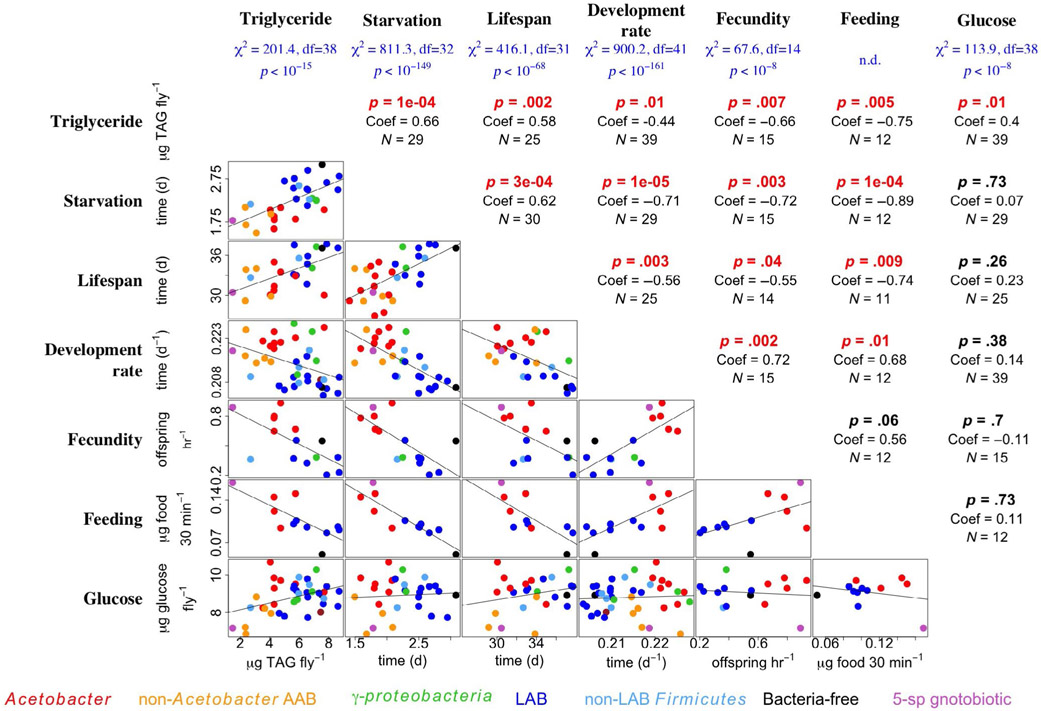
Microbial variation influences life history patterns in a laboratory-reared isogenic fly line. Six life history traits were measured in Drosophila melanogaster that were mono-associated with different bacterial species and reared on a YG diet: whole-body triacylglyceride content (Triglyceride), survival under starvation conditions (Starvation), lifespan, the rate of development to pupariation (Development rate), number of pupariating offspring produced in the first 2–4 days after eclosion (Fecundity) and feeding rate (Feeding). Fly whole-body glucose content (Glucose), a trait that is not correlated with most other life history traits, was also measured. Significant influence of microbial treatment on the trait is shown at the top of the figure in blue under each trait. For triglyceride, fecundity and glucose, the chi-square statistic is from a Kruskal–Wallis test; for the other traits, it is from a Cox proportional hazards model. In the table portion, mean trait values conferred by different bacteria are plotted in the bottom half whereas the top half shows the results of correlation tests between traits in flies reared individually with the same microbe: p-values (p), correlation coefficients (Coef) and number of different mono-associations (N). p-values that were significant are shown in red. The data for triglyceride content, SR, development rate and feeding rate were published previously (Chaston et al., 2014; Judd et al., 2014; Newell et al., 2014)
FIGURE 2
FIGURE 2
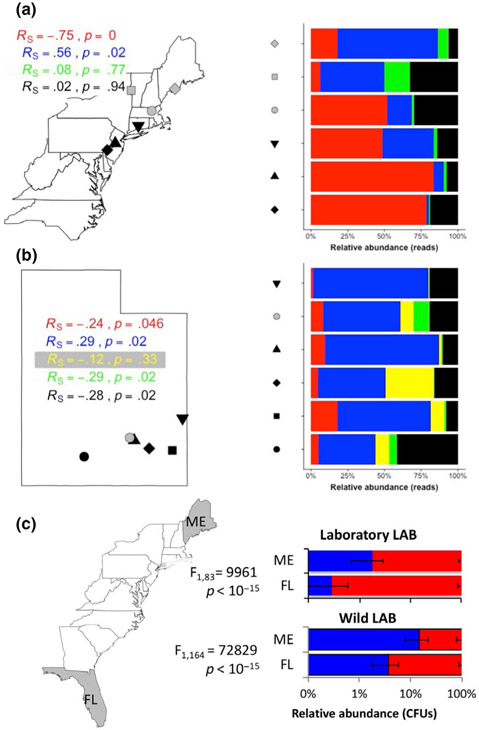
Latitudinal variation in the microbiota of wild sampled Drosophila melanogaster. (a) Relative abundances of reads assigned to different bacterial orders in a 16S rRNA marker gene survey of D. melanogaster caught fresh in the wild in 2009. Spearman's rank correlations revealed significant positive and negative correlations between latitude and AAB (red) or LAB (blue) read abundances, respectively, but not for the Enterobacteriaceae (green) or all other bacterial reads detected (black). RS, Spearman's rho. p, p-value. N = 1–3 replicate pools of 10 flies each per geographic site. (b) Relative abundances of reads assigned to different bacterial orders in a 16S rRNA marker gene survey of fresh, wild-caught flies collected in summer, 1991–1993. Spearman's rank correlations for the AAB (red), LAB (blue), Clostridiales (yellow), Enterobacteriales (green) or all other bacterial reads detected (black). N = 6–15 individual flies per sampled location and time. (c) Relative abundance of AAB (red) and LAB (blue) in isofemale lines derived from Maine (ME) and Florida (FL) wild populations, kept in the laboratory for several years and then reared in the laboratory under gnotobiotic conditions. Flies were reared with a 5-species microbiota, including 3 LAB isolated from laboratory D. melanogaster (Laboratory LAB) or with a 6-species gnotobiotic microbiota, including 4 LAB isolated from wild D. melanogaster (Wild LAB). The statistical difference between relative LAB and AAB abundance was determined by a generalized linear mixed (GLM) effects model using a binomial family. F, F statistic of the GLM. N = 9 per treatment (triplicate vials in three separate experiments), except where vials were discarded for contamination
FIGURE 3
FIGURE 3
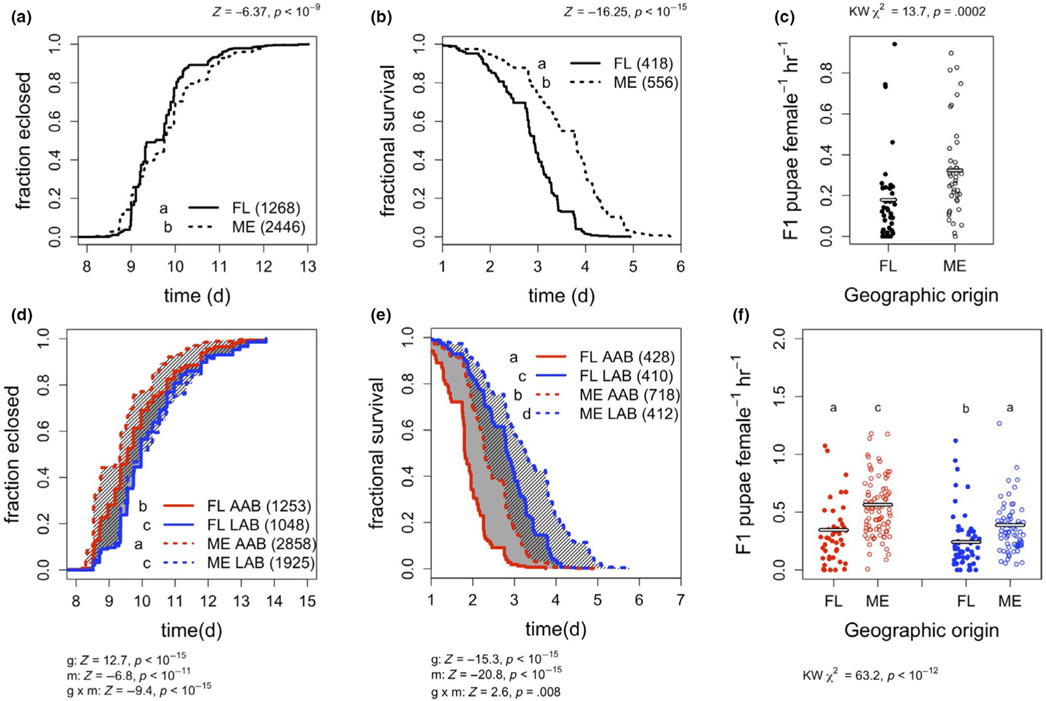
Microbial presence and identity influence life history of wild female Drosophila melanogaster. Locally adapted ME (dashed lines) and FL (solid lines) flies reared with different bacterial treatments were tested for variation in time to eclosion (a, d), SR (b, e) and fecundity (c, f) when reared bacteria free (a–c); or in mono-association with AAB (red lines) or LAB (blue lines) strains (d–f). Solid or hatched shading represents the capacity for microbe-dependent variation in FL or ME fly phenotypes, respectively. Data were collected from triplicate vials in three separate experiments, except where vials were discarded for contamination or where low egg yields reduced the number of vials (exact N in parentheses and Table S6). Significant differences in the development or survival curves were determined by a Cox proportional hazards model (Z- and p-values are next to the genotype [g; or data in a, b], microbiota [m], or interactive [g × m] effect). Differences in fecundity were determined by a Kruskal–Wallis test, followed by a Dunn test for multiple comparisons. Different letters next to the legends represent significant differences between treatments

References

    1. Adair KL, Wilson M, Bost A, & Douglas AE (2018). Microbial community assembly in wild populations of the fruit fly Drosophila melanogaster. The ISME Journal, 12(4), 959–972. 10.1038/S41396-017-0020-x - DOI - PMC - PubMed
    1. Adrion JR, Hahn MW, & Cooper BS (2015). Revisiting classic clines in Drosophila melanogaster in the age of genomics. Trends in Genetics, 31(8), 434–444. 10.1016/j.tig.2015.05.006 - DOI - PMC - PubMed
    1. Bates D, Mächler M, Bolker B, & Walker S (2015). Fitting linear mixed-effects models using lme4. Journal of Statistical Software, 67(1), 1–48. 10.18637/jss.v067.i01 - DOI
    1. Benson AK, Kelly SA, Legge R, Ma F, Low SJ, Kim J, … Pomp D (2010). Individuality in gut microbiota composition is a complex polygenic trait shaped by multiple environmental and host genetic factors. Proceedings of the National Academy of Sciences of the United States of America, 107(44), 18933–18938. 10.1073/pnas.1007028107 - DOI - PMC - PubMed
    1. Bergland AO, Behrman EL, O'Brien KR, Schmidt PS, & Petrov DA (2014). Genomic evidence of rapid and stable adaptive oscillations over seasonal time scales in Drosophila. PLoS Genetics, 10(11), e1004775 10.1371/journal.pgen.1004775 - DOI - PMC - PubMed

Publication types

LinkOut - more resources