. 2020 May;127(5):616-636.
doi: 10.1016/j.ophtha.2019.11.004. Epub 2019 Nov 14.

Consensus Nomenclature for Reporting Neovascular Age-Related Macular Degeneration Data: Consensus on Neovascular Age-Related Macular Degeneration Nomenclature Study Group

Affiliations

Consensus Nomenclature for Reporting Neovascular Age-Related Macular Degeneration Data: Consensus on Neovascular Age-Related Macular Degeneration Nomenclature Study Group

Richard F Spaide et al. Ophthalmology. 2020 May.

Erratum in

  • Corrigendum.
    [No authors listed] [No authors listed] Ophthalmology. 2020 Oct;127(10):1434-1435. doi: 10.1016/j.ophtha.2020.07.019. Ophthalmology. 2020. PMID: 32951677 No abstract available.

Abstract

Purpose: To establish a process to evaluate and standardize a state-of-the-art nomenclature for reporting neovascular age-related macular degeneration (AMD) data.

Design: Consensus meeting.

Participants: An international panel of retina specialists, imaging and image reading center experts, and ocular pathologists.

Methods: During several meetings organized under the auspices of the Macula Society, an international study group discussed and codified a set nomenclature framework for classifying the subtypes of neovascular AMD and associated lesion components.

Main outcome measures: A consensus classification of neovascular AMD.

Results: The study group created a standardized working definition of AMD. The components of neovascular AMD were defined and subclassified. Disease consequences of macular neovascularization were delineated.

Conclusions: The framework of a consensus nomenclature system, a definition of AMD, and a delineation of the subtypes of neovascular AMD were developed. Establishing a uniform set of definitions will facilitate comparison of diverse patient groups and different studies. The framework presented is modified and updated readily, processes that are anticipated to occur on a periodic basis. The study group suggests that the consensus standards outlined in this article be used in future reported studies of neovascular AMD and clinical practice.


Figures

Figure 1.
Figure 1.
Electron microscopic image showing the retinal pigment epithelium (RPE) and Bruchs membrane (BRUCHS). The basal laminar deposit (BLamD) is located between the plasma membrane (pm) of the RPE and the basement membrane (bm). Between the basal lamina and the trilaminar Bruchs membrane is a collection of basal linear deposit (×1500).
Figure 2.
Figure 2.
Light microscopy images showing drusen. A, A solitary druse and thick layer of basal laminar deposit (BLamD). Although drusenoid deposits are visible by ophthalmoscopy, BLamD is not typically recognized in the clinic. B, Confluent soft drusen, which are accumulations of BLamD, are clinically evident (toluidine blue, ×100).
Figure 3.
Figure 3.
Light microscopy images showing neovascularization arising from the choroid. A, Neovascularization in this case proliferates in the potential space under the basal laminar deposit (BlamD) above the trilaminar Bruchs membrane. B, The ingrowth site is evident as a defect in Bruchs membrane (arrow) (hematoxylin and eosin, ×250).
Figure 4.
Figure 4.
Diagram showing type 1 macular neovascularization. The ingrowth of vessels arises from the choriocapillaris and extends up to and under the retinal pigment epithelium.
Figure 5.
Figure 5.
Images showing type 1 macular neovascularization. A, Fundus photograph from a 78-year-old with hemorrhage in the nasal macula. B, Fluorescein angiography image showing blocking defect caused by the hemorrhage, subtle diffuse leakage (arrow), and punctate leakage (arrowheads). C, OCT image (top) demonstrating heterogeneous reflectivity in a fibrovascular pigment epithelial detachment and (bottom) OCT angiographic overlay showing flow within the pigment epithelial elevation. D, En face OCT image showing the neovascular network (arrow) and the center of the fovea (asterisk).
Figure 6.
Figure 6.
Images showing polypoidal choroidal vasculopathy (also known as aneurysmal type 1 macular neovascularization). A, Color photograph showing extensive exudation with subretinal lipid and an epiretinal membrane. B, Fluorescein angiogram showing hyperfluorescence in the region of neovascularization and adjacent dye pooling within a pigment epithelial detachment. C, Indocyanine green angiogram showing hyperfluorescent dilations, which are interconnected by a branching vascular network, some of which are seen. D, Structural OCT showing a nodular vascular structure (arrow) buried in hyperreflective exudative material and an adjacent detachment of the pigment epithelium. E, En face slab structural OCT showing the elevations caused by aneurysmal aggregates (arrows). F, OCT angiogram showing flow within the RPE elevations with some suggestion of the aneurysmal dilations, but there are internal details present that suggest tightly entangled vascular elements. RPE = retinal pigment epithelium.
Figure 7.
Figure 7.
Light microscopy images showing polypoidal choroidal vasculopathy. A, Alarge lesion with subretinal and suberetinal pigment epithelium hemorrhage (hematoxylin and eosin, ×100). B, Area shown in the bounding box in (A). Note the large thin-walled neovascular vessel (arrow) flanked by intralesional hemorrhage (arrowheads) (hematoxylin and eosin, ×200).
Figure 8.
Figure 8.
Diagram showing type 2 macular neovascularization. The ingrowth of vessels arises from the choriocapillaris and extends up through the retinal pigment epithelium (RPE) monolayer to proliferate in the subretinal space. To arrive in the subretinal space, the blood flow must traverse the sub-RPE space to reach the plane of neovascularization.
Figure 9.
Figure 9.
Images showing type 2 neovascularization. A, Fundus photograph from a 74-year-old showing a hyperpigmented ring in the fovea (arrow). B, C, Early-phase fluorescein angiogram showing (B) a well-defined lesion with late leakage and (C) obscuration of the borders of the neovascular lesion. D, B-scan OCT showing the outer retinal lesion with extension of subretinal fluid under the fovea. The ingrowth site through the retinal pigment epithelium is evident (arrow).
Figure 10.
Figure 10.
Diagram showing initiation of type 3 neovascularization. When the regional proangiogenic–antiangiogenic balances shift in favor of neovascularization, proliferation of vessels occurs along a vector along the vascular endothelial growth factor concentration gradient. The new vessels originate from and invade into tissues below the plane of the deep capillary plexus. Elevated cytokines, particularly vascular endothelial growth factor levels, can induce vascular leakage and intraretinal hemorrhage in addition to stimulating angiogenesis. RPE = retinal pigment epithelium.
Figure 11.
Figure 11.
Images showing type 3 neovascularization. A, Diagram showing proliferation of vessels posteriorly with formation of what has been called an angiomatous lesion. The vessels supplying the blood flow to the angiomatous proliferation remodel into larger feeding and draining vessels. The edema and hemorrhage in the retina are from both the neovascularization and to increased local tissue levels of vascular endothelial growth factor. Some evidence is present that the retinal pigment epithelium monolayer may not be intact, even before penetration of new vessels into the basal laminar or basal linear material. B, Comparative indocyanine green angiographic image of a patient with an established type 3 neovascular lesion.
Figure 12.
Figure 12.
Images showing development of early type 3 macular neovascularization. A, Fundus photograph obtained at baseline showing drusen in the macular region. The green arrow indicates the location for future B-scan OCT images. B, Early-phase fluorescein angiogram showing decreased early fluorescence of the central macula. C, Early indocyanine green angiogram showing the decreased early fluorescence of the central macula seen in (B). D, OCT image showing drusen of varying sizes. E, Fundus photograph obtained 8 months later showing that the patient continued to harbor drusen. F, Fluorescein angiogram showing a very small dot of hyperfluorescence (arrow). G, Indocyanine green angiogram in which the very small dot of hyper-fluorescence seen in (F) is barely visible. H, OCT image showing increased reflectivity in Henles fiber layer above the solitary larger druse. I, Fundus photograph obtained 9 months later showing that the patient harbored small hemorrhages (arrows). J, Fluorescein angiogram in which the hyperfluorescence is more evident. K, Indocyanine green angiogram in which the spot seen in (J) also is more evident. L, OCT image showing cystoid spaces within the retina adjacent to the neovascularization descending to the druse.
Figure 13.
Figure 13.
Images showing type 3 neovascularization with prominent edema and hemorrhage. A, Fundus photograph from an 87-year-old showing dozens of small fleck hemorrhages in the superior and nasal macula. The blue arrows show the location of the structural OCT scans. B, OCT scan of the section through the superior arcade showing expansion of the inner nuclear layer (arrowhead) and Henles fiber layer from edema fluid (arrow). C, OCT scan of the section through the superior parafovea revealing edema of inner nuclear layer and Henles fiber layer with cystoid spaces (yellow and green asterisks, respectively). Hyperreflectivity within the retina overlying the apex of the retinal pigment epithelial detachment (arrow) is evident. Note the edema nasal and temporal to the area of neovascularization is greater than that immediately surrounding the new vessels. D, OCT scan of the inferior macula showing edematous thickening of the retina and subretinal fluid. E, Fluorescein angiogram showing a small area of hyperfluorescence corresponding to the hyper-reflective area in (C). F, Later fluorescein angiogram showing pooling of dye in cystoid spaces as well as diffuse staining well away from the area highlighted by the arrow in (E). G, Fundus photograph of magnification of the central portion of the involved macula showing the numerous isolated hemorrhages, many of which were in the inner retina. The green arrow shows the section captured by the OCT angiogram in (H). H, OCT angiogram showing the small focus neovascularization found within the outer retina (open arrow). The vertical double arrow is 150 μm. Note that the hemorrhages do not colocalize with the neovascularization.
Figure 14.
Figure 14.
Light microscopy images showing histopathologic analysis of type 3 neovascularization. A, Entanglement of capillaries in a neovascular frond extending down through the outer nuclear layer (open arrow) to a retinal pigment epithelium (RPE) defect. Note the gap in the RPE layer at the region of contact (double arrow). The choriocapillaris bears numerous areas absent of vessels, some of which are shown by the black arrows, and the green arrows highlight deeper vessels that have been enfaced to the choriocapillaris level (hematoxylin and eosin, ×100). B, Higher magnification of the neovascularization (hematoxylin and eosin, ×200).
Figure 15.
Figure 15.
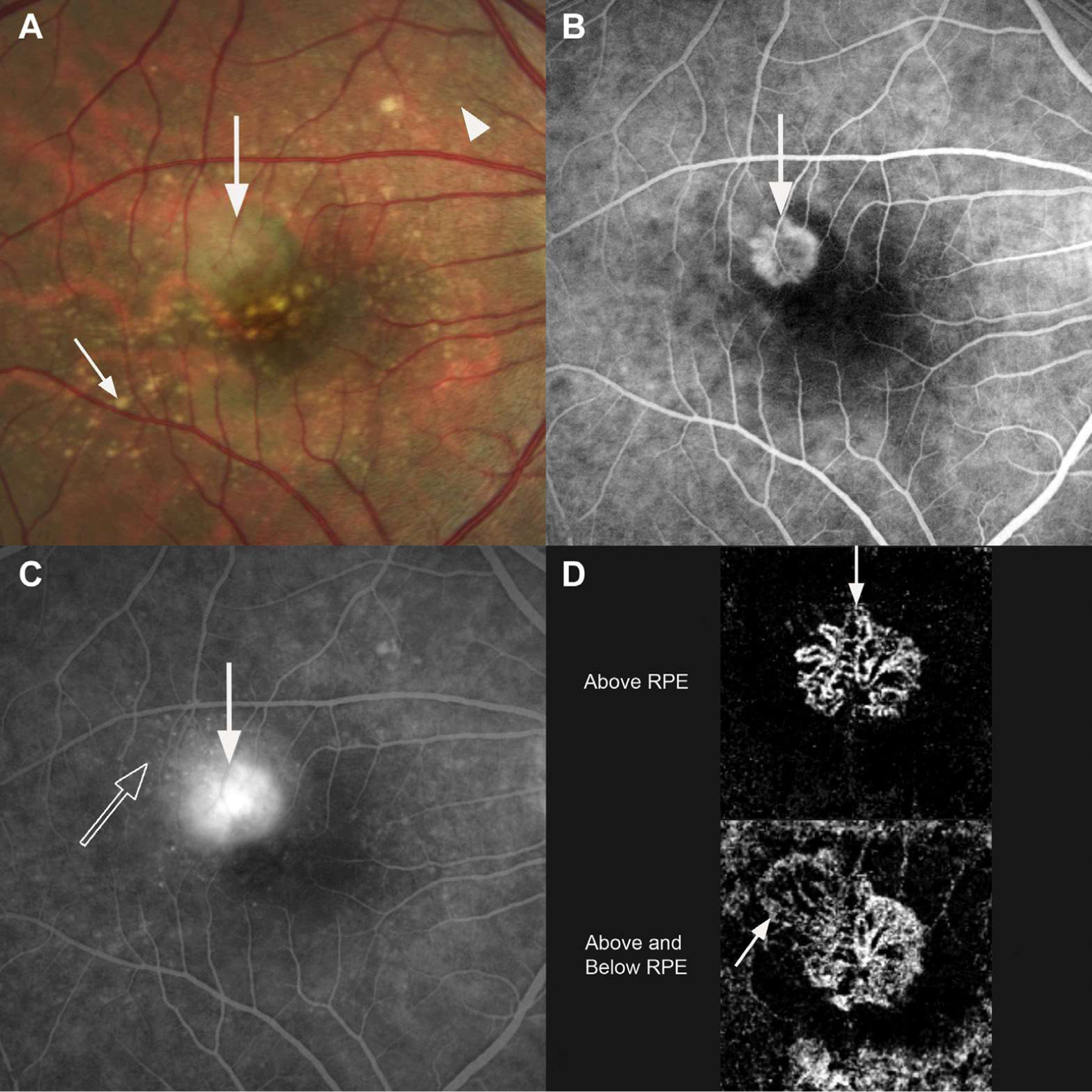
Images showing mixed type 1 and type 2 macular neovascularization. A, Fundus photograph from 62-year-old showing a region of yellowish exudation (larger arrow). Note the drusen (smaller arrow) and pseudodrusen (arrowhead). B, Early-phase fluorescein angiogram showing a well-defined area of neovascularization (vertical arrow). C, Later-phase fluorescein angiogram showing pronounced leakage from the well-defined neovascularization and some punctate leakage from and adjacent area (open arrow). D, En face OCT angiogram showing 2 perspectives: (Top) above the level of the retinal pigment epithelium (RPE), the well-defined lesion seen in the fluorescein angiogram is evident (vertical arrow); (Bottom) the slab section was deepened to include visualization of neovascularization below the RPE. The neovascularization above the RPE, seen as the well-defined lesion, is type 2, and the deeper proliferation, below the RPE, is type 2 macular neovascularization.
Figure 16.
Figure 16.
Light microscopy images showing variations on neovascularization arising from the choroid. A, The proliferation can occur directly under the retinal pigment epithelium (RPE). Note that the RPE and photoreceptors are intact. B, Neovascularization may grow in a purely subretinal location. The RPE is disrupted, the photoreceptors are atrophic, and cystoid edema is present. C, A mixed pattern of neovascular proliferation manifesting as both sub-PRE and subretinal growth. The neovascularization is collagenized; this may be considered a disciform scar (hematoxylin and eosin, ×100).
Figure 17.
Figure 17.
Complete retinal pigment epithelial and outer retinal atrophy in an eye with type 1 macular neovascularization (MNV) (arrow). Loss of the outer retina over the fibrovascular pigment epithelial detachment is present. The ellipsoid termination is demarcated by the arrowheads. Central to this is a tapering discontinuance of the outer nuclear layer (angled double arrow).Absence of the underlying retinal pigment epithelium with hyper-transmission into the choroid (horizontal double arrow) is present.

References

    1. Gass JD. Pathogenesis of disciform detachment of the neuroepithelium. Am J Ophthalmol 1967;63(3 Suppl):1–139. - PubMed
    1. Gass JD. Drusen and disciform macular detachment and degeneration. Trans Am Ophthalmol Soc 1972;70:409–436. - PMC - PubMed
    1. Gass JDM. Stereoscopic Atlas of Macular Diseases: A Funduscopic and Angiographic Presentation St. Louis: Mosby; 1970.
    1. Blair CJ. Geographic atrophy of the retinal pigment epithelium. A manifestation of senile macular degeneration. Arch Ophthalmol 1975;93(1):19–25. - PubMed
    1. Novais EA, Baumal CR, Sarraf D, et al. Multimodal imaging in retinal disease: a consensus definition. Ophthalmic Surg Lasers Imaging Retina. 2016;47(3):201–205. - PubMed

Publication types

LinkOut - more resources