


Prospecting Peptides Isolated From Black Soldier Fly (Diptera: Stratiomyidae) With Antimicrobial Activity Against Helicobacter pylori (Campylobacterales: Helicobacteraceae)
- PMID: 31865367
- PMCID: PMC6925832
- DOI: 10.1093/jisesa/iez120
Prospecting Peptides Isolated From Black Soldier Fly (Diptera: Stratiomyidae) With Antimicrobial Activity Against Helicobacter pylori (Campylobacterales: Helicobacteraceae)
Erratum in
-
Correction to: Prospecting Peptides Isolated From Black Soldier Fly (Diptera: Stratiomyidae) With Antimicrobial Activity Against Helicobacter pylori (Campylobacterales: Helicobacteraceae).J Insect Sci. 2022 Jul 1;22(4):12. doi: 10.1093/jisesa/ieac053. J Insect Sci. 2022. PMID: 36006826 Free PMC article. No abstract available.
Abstract
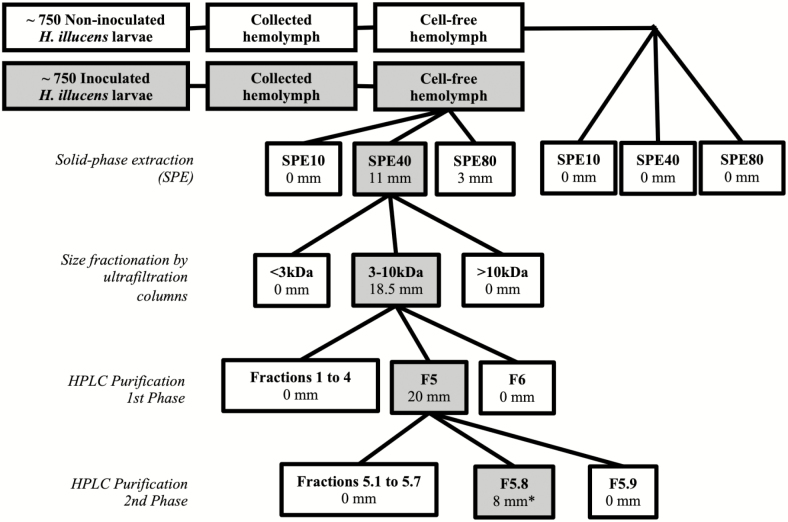
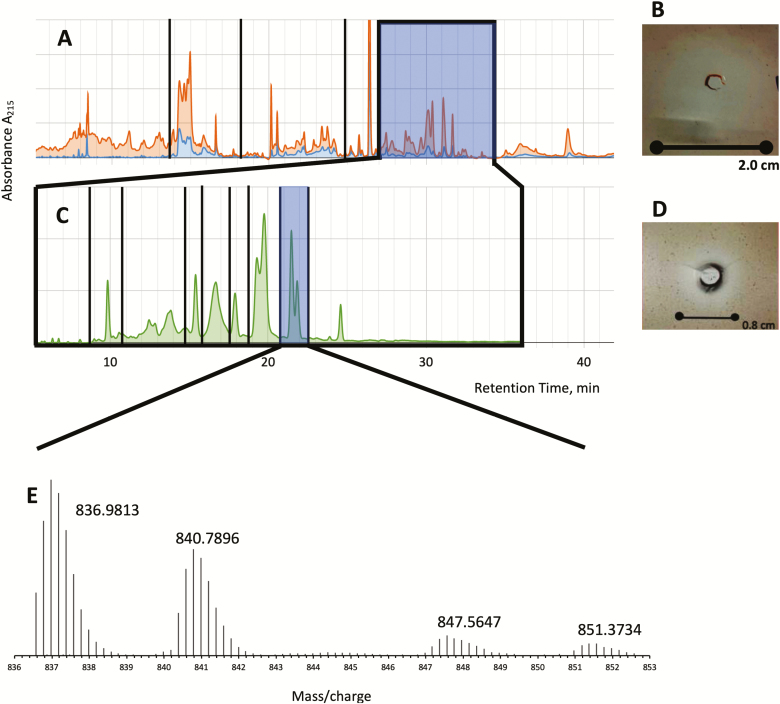
Helicobacter pylori (Marshall & Goodwin) is a widespread human pathogen that is acquiring resistance to the antibiotics used to treat it. This increasing resistance necessitates a continued search for new antibiotics. An antibiotic source that shows promise is animals whose immune systems must adapt to living in bacteria-laden conditions by producing antibacterial peptides or small molecules. Among these animals is the black soldier fly (BSF; Hermetia illucens Linnaeus), a Diptera that colonizes decomposing organic matter. In order to find anti-H. pylori peptides in BSF, larvae were challenged with Escherichia coli (Enterobacteriales: Enterobacteriaceae). Small peptides were extracted from hemolymph and purified using solid-phase extraction, molecular weight cutoff filtration and two rounds of preparative high performance liquid chromatography (HPLC). The anti-H. pylori fraction was followed through the purification process using the inhibition zone assay in brain-heart infusion agar, while peptides from uninoculated larvae had no activity. The inhibition halo of the active sample was comparable to the action of metronidazole in the inhibition zone assay. The purified sample contained four peptides with average masses of approximately 4.2 kDa that eluted together when analyzed by HPLC-mass spectrometry. The peptides likely have similar sequences, activity, and properties. Therefore, BSF produces inducible antibacterial peptides that have in vitro activity against H. pylori, which highlights BSF's position as an important target for further bioprospecting.
Keywords: Helicobacter pylori; Hermetia illucens; antimicrobial peptides; bioprospecting.
© The Author(s) [2019]. Published by Oxford University Press on behalf of Entomological Society of America.
Figures
References
-
- Akbar N., Siddiqui R., Sagathevan K. A., and Khan N. A.. . 2019. Gut bacteria of animals/pests living in polluted environments are a potential source of antibacterials. Appl. Microbiol. Biotechnol. 103: 3955–3964. - PubMed
-
- Choi W. H., Choi H. J., Goo T. W., and Quan F. S.. . 2018. Novel antibacterial peptides induced by probiotics in Hermetia illucens (Diptera: Stratiomyidae) larvae. Entomol. Res. 48: 237–247.
-
- Chung P. Y., and Khanum R.. . 2017. Antimicrobial peptides as potential anti-biofilm agents against multidrug-resistant bacteria. J. Microbiol. Immunol. Infect. 50: 405–410. - PubMed
MeSH terms
Substances
LinkOut - more resources
Full Text Sources
Other Literature Sources
