


Adapting electronic health records-derived phenotypes to claims data: Lessons learned in using limited clinical data for phenotyping
- PMID: 31866433
- PMCID: PMC7390483
- DOI: 10.1016/j.jbi.2019.103363
Adapting electronic health records-derived phenotypes to claims data: Lessons learned in using limited clinical data for phenotyping
Abstract
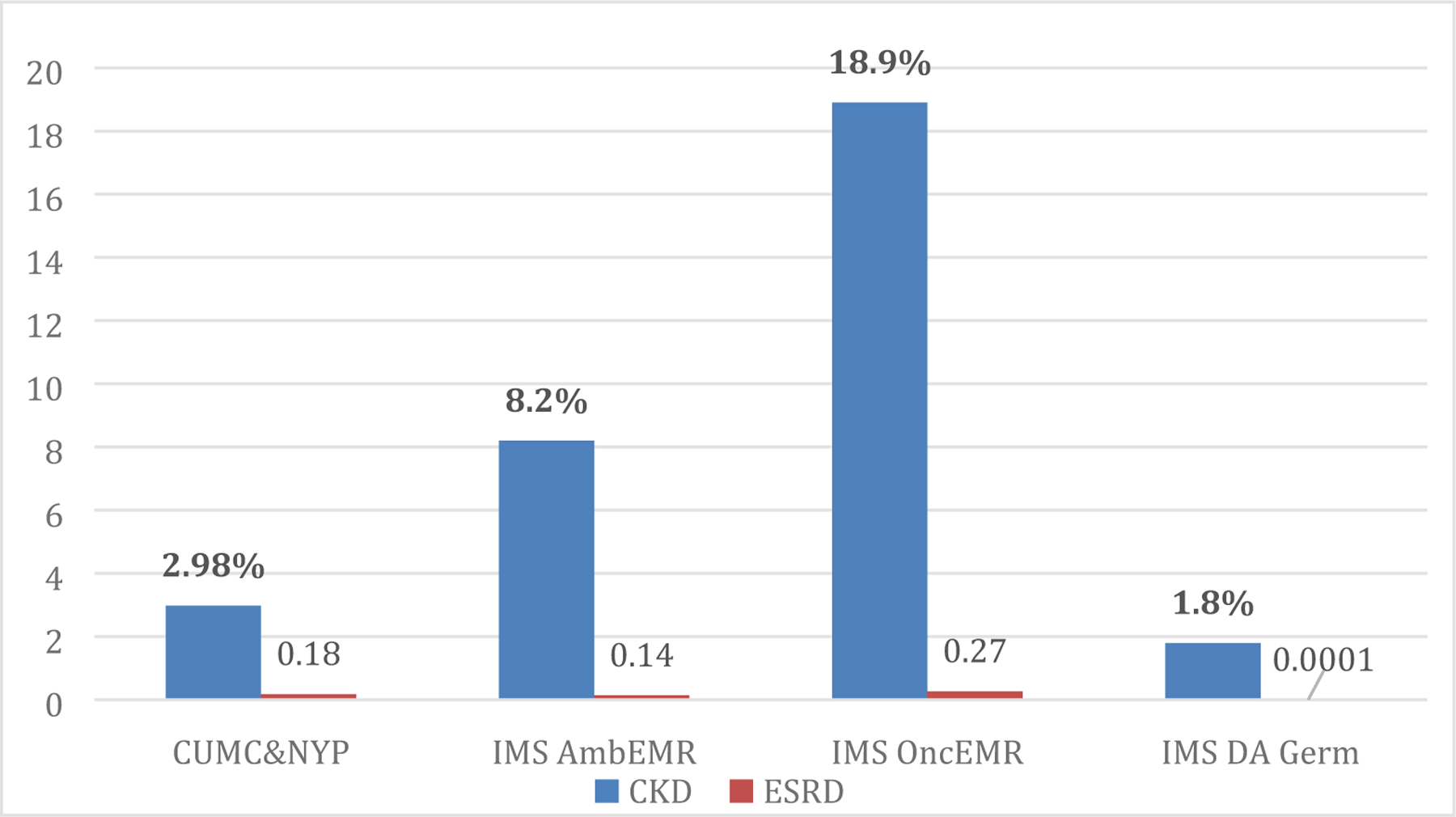
Algorithms for identifying patients of interest from observational data must address missing and inaccurate data and are desired to achieve comparable performance on both administrative claims and electronic health records data. However, administrative claims data do not contain the necessary information to develop accurate algorithms for disorders that require laboratory results, and this omission can result in insensitive diagnostic code-based algorithms. In this paper, we tested our assertion that the performance of a diagnosis code-based algorithm for chronic kidney disorder (CKD) can be improved by adding other codes indirectly related to CKD (e.g., codes for dialysis, kidney transplant, suspicious kidney disorders). Following the best practices from Observational Health Data Sciences and Informatics (OHDSI), we adapted an electronic health record-based gold standard algorithm for CKD and then created algorithms that can be executed on administrative claims data and account for related data quality issues. We externally validated our algorithms on four electronic health record datasets in the OHDSI network. Compared to the algorithm that uses CKD diagnostic codes only, positive predictive value of the algorithms that use additional codes was slightly increased (47.4% vs. 47.9-48.5% respectively). The algorithms adapted from the gold standard algorithm can be used to infer chronic kidney disorder based on administrative claims data. We succeeded in improving the generalizability and consistency of the CKD phenotypes by using data and vocabulary standardized across the OHDSI network, although performance variability across datasets remains. We showed that identifying and addressing coding and data heterogeneity can improve the performance of the algorithms.
Keywords: Chronic kidney disorder; Data quality; Observational Health Data Sciences and Informatics (OHDSI); Phenotyping; Portability; Reproducibility.
Copyright © 2019 Elsevier Inc. All rights reserved.
Conflict of interest statement
Declaration of Competing Interest The authors declare that they have no known competing financial interests or personal relationships that could have appeared to influence the work reported in this paper.
Figures


References
-
- Hripcsak G, Duke JD, Shah NH, Reich CG, Huser V, Schuemie MJ, Suchard MA, Park RW, Wong ICK, Rijnbeek PR, van der Lei J, Pratt N, Norén GN, Li Y-C, Stang PE, Madigan D, Ryan PB, Observational Health Data Sciences and Informatics (OHDSI): Opportunities for Observational Researchers, Stud Health Technol Inform 216 (2015) 574–578. - PMC - PubMed
-
- OHDSI Data Network, (n.d.). http://www.ohdsi.org/web/wiki/doku.php?id=resources:2018_data_network (accessed May 21, 2019).
-
- Page not found – KDIGO, (n.d.). https://kdigo.org/clinical_practice_guidelines/pdf/CKD/KDIGO_2012_CKD_GL... (accessed July 11, 2019).
-
- Levey AS, de Jong PE, Coresh J, M.E. l. Nahas, B.C. Astor, K. Matsushita, R.T. Gansevoort, B.L. Kasiske, K.-U. Eckardt, The definition, classification, and prognosis of chronic kidney disease: a KDIGO Controversies Conference report, Kidney International. 80 (2011) 17–28. 10.1038/ki.2010.483. - DOI - PubMed
Publication types
MeSH terms
Grants and funding
LinkOut - more resources
Full Text Sources
