. 2019 Dec 5;4(25):21446-21458.
doi: 10.1021/acsomega.9b03142. eCollection 2019 Dec 17.

Porous Graphene-like Carbon from Fast Catalytic Decomposition of Biomass for Energy Storage Applications

Affiliations

Porous Graphene-like Carbon from Fast Catalytic Decomposition of Biomass for Energy Storage Applications

Aurora Gomez-Martin et al. ACS Omega. .

Abstract

A novel carbon material made of porous graphene-like nanosheets was synthesized from biomass resources by a simple catalytic graphitization process using nickel as a catalyst for applications in electrodes for energy storage devices. A recycled fiberboard precursor was impregnated with saturated nickel nitrate followed by high-temperature pyrolysis. The highly exothermic combustion of in situ formed nitrocellulose produces the expansion of the cellulose fibers and the reorganization of the carbon structure into a three-dimensional (3D) porous assembly of thin carbon nanosheets. After acid washing, nickel particles are fully removed, leaving nanosized holes in the wrinkled graphene-like sheets. These nanoholes confer the resulting carbon material with ≈75% capacitance retention, when applied as a supercapacitor electrode in aqueous media at a specific current of 100 A·g-1 compared to the capacitance reached at 20 mA·g-1, and ≈35% capacity retention, when applied as a negative electrode for lithium-ion battery cells at a specific current of 3720 mA·g-1 compared to the specific capacity at 37.2 mA·g-1. These findings suggest a novel way for synthesizing 3D nanocarbon networks from a cellulosic precursor requiring low temperatures and being amenable to large-scale production while using a sustainable starting precursor such as recycled fiberwood.


Conflict of interest statement

The authors declare no competing financial interest.

Figures
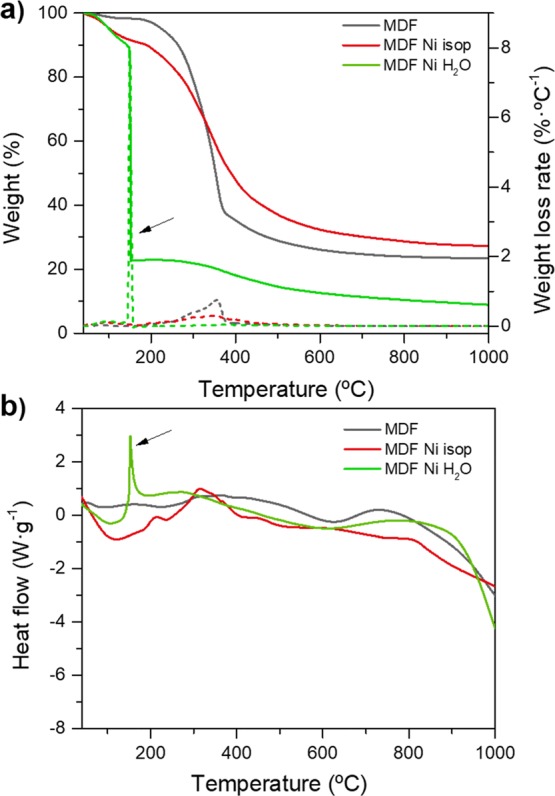
Figure 1
Figure 1
TGA/DSC analysis using a heating rate of 10 °C·min–1 from room temperature to 1000 °C under a constant nitrogen flow rate of 100 mL·min–1. Comparison between the thermal behavior of raw MDF, MDF impregnated with Ni(NO3)2 isopropanol-based solution and MDF impregnated with Ni(NO3)2 water-based solution: (a) Weight curve (left; solid lines) and derivative weight loss (right; dashed lines) versus temperature during pyrolysis; (b) heat flow curve versus temperature (black arrows point to the exothermic reactions).
Figure 2
Figure 2
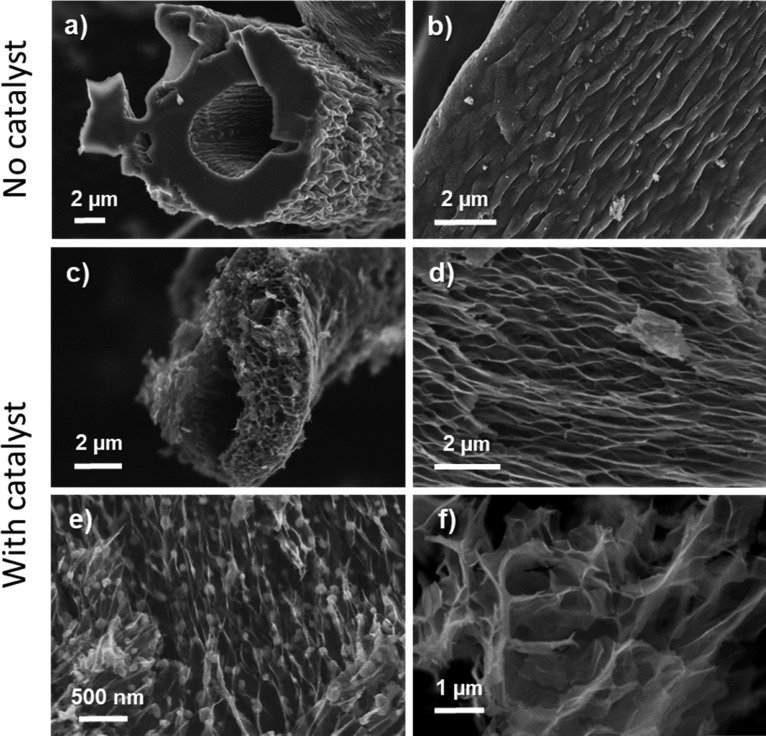
Representative SEM micrographs: (a, b) Front and side views of a representative fiber from conventional, nontreated MDF carbon carbonized at 300 °C; (c, d) front and side views of a representative fiber of MDF Ni H2O 300 °C sample; (e) MDF Ni H2O 1000 °C sample where globular nickel nanoparticles are appreciable under light contrast before acid washing, and (f) MDF Ni H2O 1000 °C after acid washing with HCl.
Figure 3
Figure 3
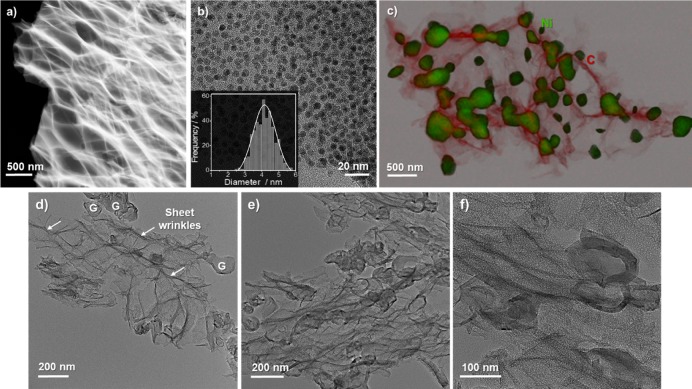
Representative TEM micrographs: (a) Dark-field (DF) STEM image of MDF Ni H2O 300 °C sample; (b) bright-field TEM image of the same sample showing the homogeneous distribution of Ni nanoparticles (particle size distribution shown in the inset of the figure); and (c) combined elemental mapping and STEM images of MDF Ni H2O 1000 °C. The green-colored area corresponds to the nickel phase, while the red one corresponds to carbon. (d–f) Representative TEM micrographs of MDF Ni H2O 1000 °C after acid washing (the letter G represents the hollow ordered graphitic structures, and the arrows show the edges and corrugations on the sheets’ surface).
Figure 4
Figure 4
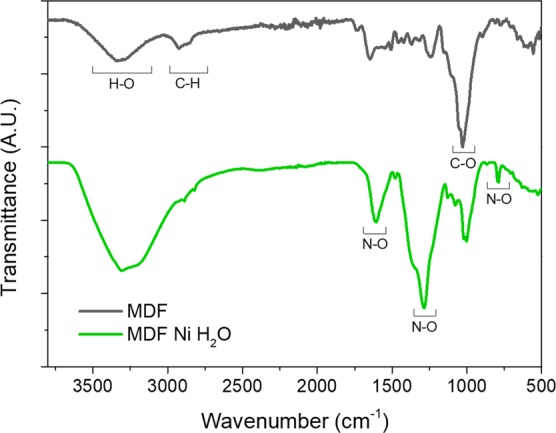
FTIR spectra of raw MDF and MDF impregnated with a water-based Ni(NO3)2 solution.
Figure 5
Figure 5
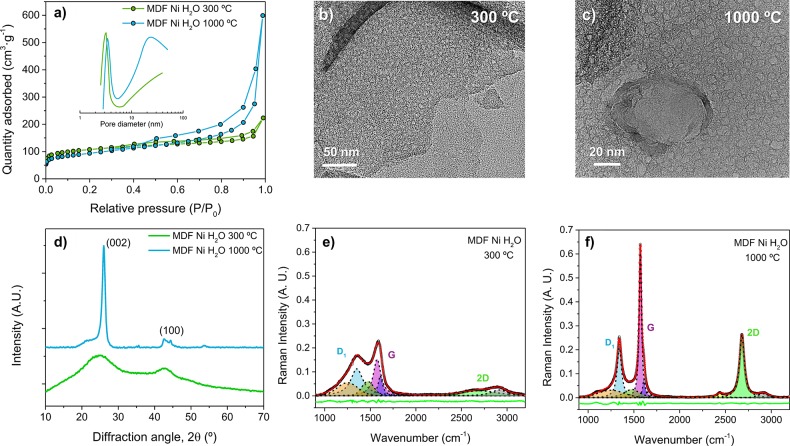
(a) N2 adsorption/desorption isotherms and pore size distributions (inset of the figure) calculated by applying the BJH method to the desorption data of MDF Ni H2O 300 and 1000 °C samples. (b, c) High-resolution TEM images showing the porous structure. (d) X-ray diffraction patterns of MDF Ni H2O 300 and 1000 °C. (e, f) Raman spectra of MDF Ni H2O 300 and 1000 °C. Spectra were deconvoluted into relevant carbonaceous bands as described in the main text, using a least-squares method and pseudo-Voigt line shapes. The green line corresponds to the residual, while the red one represents the fitted data.
Figure 6
Figure 6
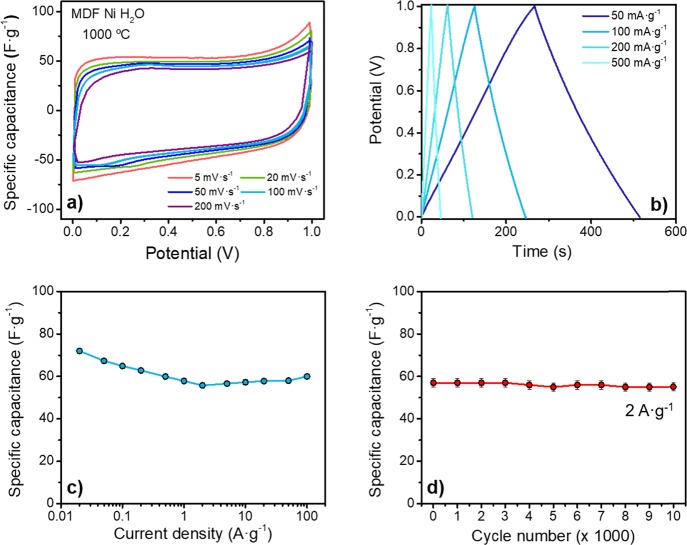
Summary of relevant electrochemical measurements in a symmetrical two-electrode cell setup of MDF Ni H2O 1000 °C. (a) Representative CV curves at different sweep rates ranging from 5 to 200 mV·s–1. (b) Typical galvanostatic charge/discharge curves at different specific currents. (c) Variation of specific capacitance as a function of specific current from 20 mA·g–1 to 100 A·g–1. (d) Variation of specific capacitance as a function of cycle number, measured up to 10,000 cycles at a rate of 2 A·g–1.
Figure 7
Figure 7
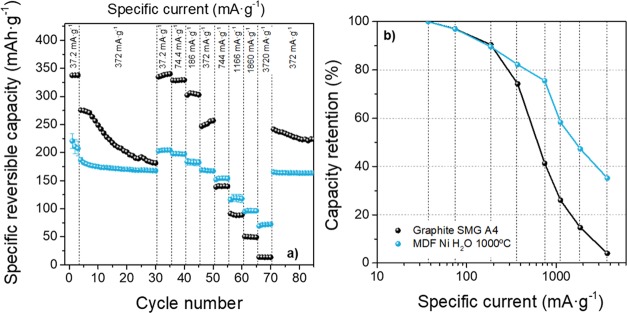
(a) Discharge capacities of MDF Ni H2O 1000 °C carbon electrodes compared to one commercial graphite (SMG A4) during cycling at different specific currents. (b) Capacity retention as a function of specific charge/discharge current. Rate performance investigations: Cycles 1–3: 37.2 mA·g–1; Cycles 4–30: 372 mA·g–1; Cycles 31–70: specific currents of 37.2, 74.4, 186, 372, 744, 1166, 1860, and 3720 mA·g–1 for each step (five cycles); Cycle 70 onward: 372 mA·g–1.

References

    1. Leitner K.; Lerf A.; Winter M.; Besenhard J. O.; Villar-Rodil S.; Suárez-García F.; Martínez-Alonso A.; Tascón J. M. D. Nomex-derived activated carbon fibers as electrode materials in carbon based supercapacitors. J. Power Sources 2006, 153, 419–423. 10.1016/j.jpowsour.2005.05.078. - DOI
    1. Badenhorst H. A review of the application of carbon materials in solar thermal energy storage. Solar Energy 2019, 192, 35–68. 10.1016/j.solener.2018.01.062. - DOI
    1. Titirici M.-M.; White R. J.; Brun N.; Budarin V. L.; Su D. S.; del Monte F.; Clark J. H.; MacLachlan M. J. Sustainable carbon materials. Chem. Soc. Rev. 2015, 44, 250–290. 10.1039/C4CS00232F. - DOI - PubMed
    1. Xu J.; Cao Z.; Zhang Y.; Yuan Z.; Lou Z.; Xu X.; Wang X. A review of functionalized carbon nanotubes and graphene for heavy metal adsorption from water: Preparation, application, and mechanism. Chemosphere 2018, 195, 351–364. 10.1016/j.chemosphere.2017.12.061. - DOI - PubMed
    1. Satayeva A. R.; Howell C. A.; Korobeinyk A. V.; Jandosov J.; Inglezakis V. J.; Mansurov Z. A.; Mikhalovsky S. V. Investigation of rice husk derived activated carbon for removal of nitrate contamination from water. Sci. Total Environ. 2018, 630, 1237–1245. 10.1016/j.scitotenv.2018.02.329. - DOI - PubMed

LinkOut - more resources