


Reciprocal Effects Between Loneliness and Sleep Disturbance in Older Americans
- PMID: 31868077
- PMCID: PMC7309370
- DOI: 10.1177/0898264319894486
Reciprocal Effects Between Loneliness and Sleep Disturbance in Older Americans
Abstract
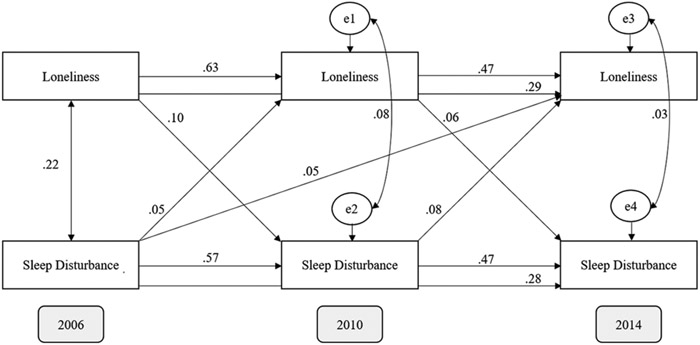
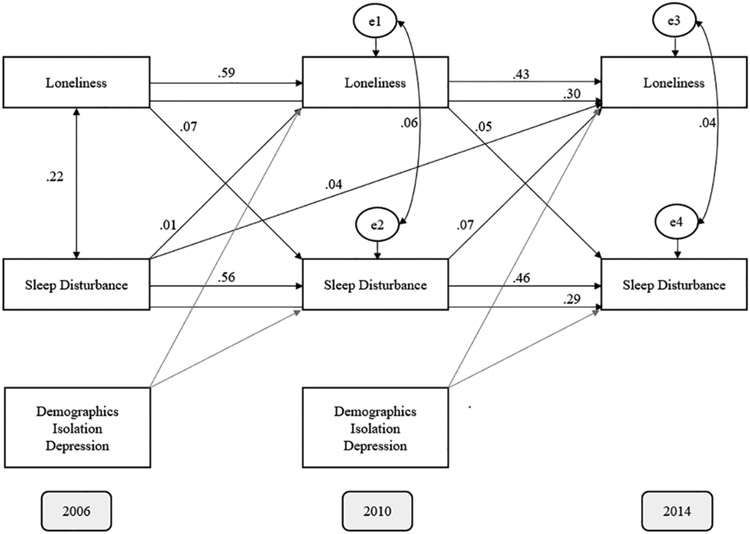
Objectives: To model the relationship between loneliness and sleep disturbance over time. Method: Data came from the Health and Retirement Study (2006, 2010, 2014 waves; age ≥ 65 years; n = 5,067). Loneliness was measured via the Hughes Loneliness Scale and sleep disturbance via a four-item scale assessing sleep and restedness. Cross-lagged panel modeling (path analysis) was used to jointly examine reciprocal effects between loneliness and sleep disturbance. Results: Higher loneliness correlated with higher sleep disturbance at baseline. There was evidence of reciprocal effects between loneliness and sleep across timepoints. These associations overall remained when accounting for demographics, objective isolation, and depression. Discussion: Although causality cannot be established, the findings indicate that the relationship between loneliness and sleep disturbance is bidirectional. This requires revision to the current theory on sleep disturbance as a mechanism for the relationship between loneliness and health and indicates that effective treatment of sleep disturbance may reduce loneliness.
Keywords: health; insomnia; loneliness; older adults; sleep.
Conflict of interest statement
Declaration of Conflicting Interests
The authors declared no potential conflicts of interest with respect to the research, authorship, and/or publication of this article.
Figures
References
-
- Beller J, & Wagner A (2018). Disentangling loneliness: Differential effects of subjective loneliness, network quality, network size, and living alone on physical, mental, and cognitive health. Journal of Aging and Health, 30(4), 521–539. - PubMed
-
- Bowen NK, & Guo S (2011). Structural equation modeling. Oxford University Press.
Publication types
MeSH terms
Grants and funding
LinkOut - more resources
Full Text Sources
Medical
