. 2020 Feb 1;318(2):F354-F362.
doi: 10.1152/ajprenal.00408.2019. Epub 2019 Dec 23.

Cyclophosphamide-induced cystitis results in NLRP3-mediated inflammation in the hippocampus and symptoms of depression in rats

Affiliations

Cyclophosphamide-induced cystitis results in NLRP3-mediated inflammation in the hippocampus and symptoms of depression in rats

Nathan A Hirshman et al. Am J Physiol Renal Physiol. .

Abstract

Recent breakthroughs demonstrate that peripheral diseases can trigger inflammation in the brain, causing psychosocial maladies, including depression. While few direct studies have been made, anecdotal reports associate urological disorders with mental dysfunction. Thus, we investigated if insults targeted at the bladder might elicit behavioral alterations. Moreover, the mechanism of neuroinflammation elicited by other peripheral diseases involves the NOD-like receptor family pyrin domain containing 3 (NLRP3) inflammasome, which is present in microglia in the brain and cleaves and activates proinflammatory cytokines such as IL-1β. Thus, we further explored the importance of NLRP3 in behavioral and neuroinflammatory changes. Here, we used the well-studied cyclophosphamide (CP)-treated rat model. Importantly, CP and its metabolites do not cross the blood-brain barrier or trigger inflammation in the gut, so that any neuroinflammation is likely secondary to bladder injury. We found that CP triggered an increase in inflammasome activity (caspase-1 activity) in the hippocampus but not in the pons. Evans blue extravasation demonstrated breakdown of the blood-brain barrier in the hippocampal region and activated microglia were present in the fascia dentata. Both changes were dependent on NLRP3 activation and prevented with 2-mercaptoethane sulfonate sodium (Mesna), which masks the effects of the CP metabolite acrolein in the urine. Finally, CP-treated rats displayed depressive symptoms that were prevented by NLRP3 inhibition or treatment with Mesna or an antidepressant. Thus, we conclude that CP-induced cystitis causes NLRP3-dependent hippocampal inflammation leading to depression symptoms in rats. This study proposes the first-ever causative explanation of the previously anecdotal link between benign bladder disorders and mood disorders.

Keywords: bladder; cystitis; hippocampus; immunity; neuroinflammation.


Conflict of interest statement

No conflicts of interest, financial or otherwise, are declared by the authors.

Figures
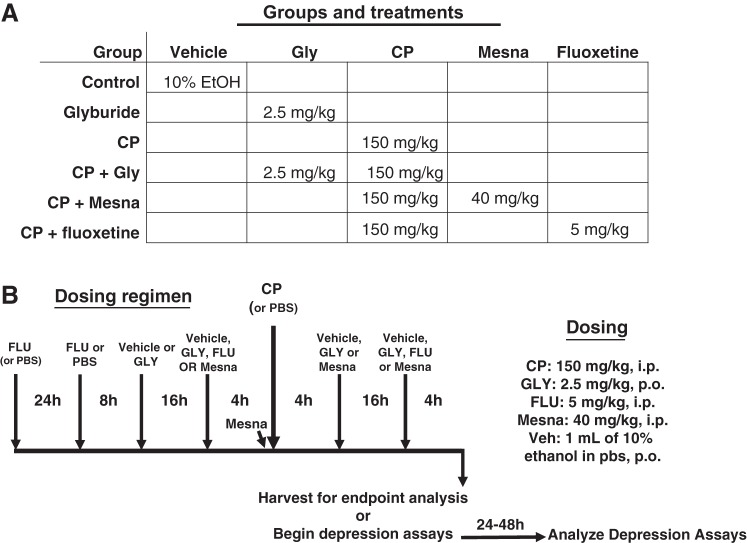
Fig. 1.
Fig. 1.
Groups and treatments used in this study. A: diagram of the various groups utilized in this project and the doses of the various treatments used for each group. Not all groups were used for all end points, as described in the text. B: dosing regimen for the experiments. Rats were given the drugs at the indicated doses at the indicated times. CP, cyclophosphamide; GLY, glyburide; FLU, fluoxetine; Veh, vehicle; Mesna, 2-mercaptoethane sulfonate sodium.
Fig. 2.
Fig. 2.
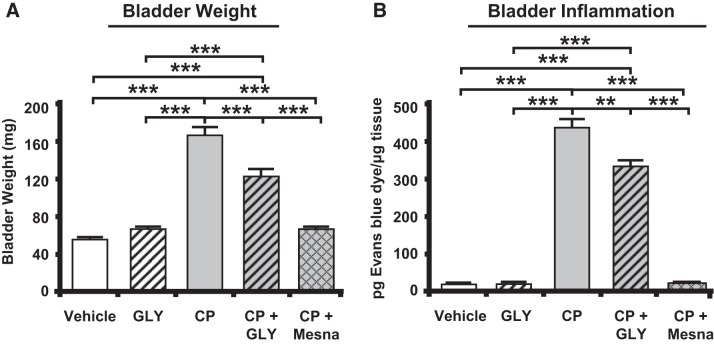
Bladder weights and inflammation are increased in response to cyclophosphamide (CP), and this is blocked by glyburide (GLY) or 2-mercaptoethane sulfonate sodium (Mesna). A: bladder weights at euthanize were higher after CP treatment, and this was reduced by treatment with GLY or Mesna. Bars represent mean bladder weight ± SE (vehicle: n = 32, CP: n = 42, GLY: n = 17, CP + GLY: n = 20, and CP + Mesna: n = 34). B: inflammation in the bladder, as measured by Evans blue dye extravasation, was increased after CP treatment, and this was reduced by treatment with GLY or Mesna. Results are reported as pg Evans blue dye/µg tissue. Bars represent means ± SE (vehicle: n = 3, GLY: n = 3, CP: n = 4, CP + GLY: n = 4, and CP + Mesna: n = 4). **P < 0.01, ***P < 0.001 by one-way ANOVA and Student-Newman-Keuls post hoc analysis.
Fig. 3.
Fig. 3.
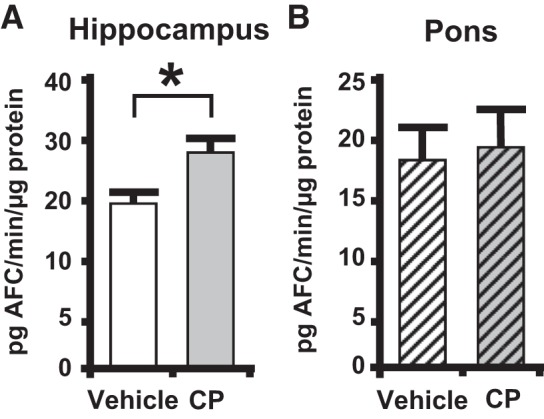
Caspase-1 activity is increased in the hippocampus, not the pons, of cyclophosphamide (CP)-treated rats. Central nervous system tissue was harvested and processed as described in methods. A: hippocampus caspase-1 activity in vehicle- and CP-treated rats. Results are reported as pg 4-trifluoromethylcoumarin (AFC)·min−1·µg protein−1. Bars represent mean activity ± SE. B: caspase-1 activity in the pons in vehicle- and CP-treated rats. Results are reported as pg AFC·min−1·µg protein−1. Bars represent mean activity ± SE (for both A and B, vehicle: n = 4 and CP: n = 4). *P < 0.05 by a two-tailed Student’s t test.
Fig. 4.
Fig. 4.
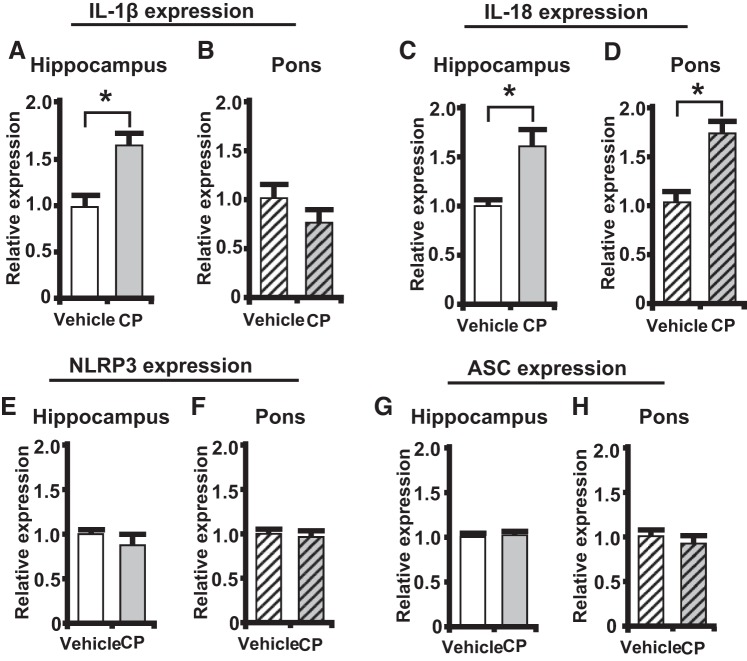
Pro-IL-1β and pro-IL-18 mRNA expression levels are increased in the hippocampus during cyclophosphamide (CP)-induced cystitis. NOD-like receptor family pyrin domain containing 3 (NLRP3) and associated speck-like protein containing a COOH-terminal caspase recruitment domain (ASC) mRNA expression levels were unchanged in the hippocampus during CP-induced cystitis. Results are expressed as relative expression of the studied genes in treated rats compared with vehicle. Bars represent mean expression levels ± SE. A: pro-IL-1β levels in the hippocampus (vehicle: n = 13 and CP: n = 12). B: pro-IL-1β levels in the pons (vehicle: n = 6 and CP: n = 6). C: pro-IL-18 expression levels in the hippocampus (vehicle: n = 8 and CP: n = 7). D: pro-IL-18 expression levels in the pons (vehicle: n = 4 and CP: n = 4). E: NLRP3 levels in the hippocampus (vehicle: n = 9 and CP: n = 8). F: NLRP3 levels in the pons (vehicle: n = 6 and CP: n = 6). G: ASC expression levels in the hippocampus (vehicle: n = 9 and CP: n = 8). H: ASC expression levels in the pons (vehicle: n = 6 and CP: n = 6). *P < 0.05 by a two-tailed Student’s t test.
Fig. 5.
Fig. 5.
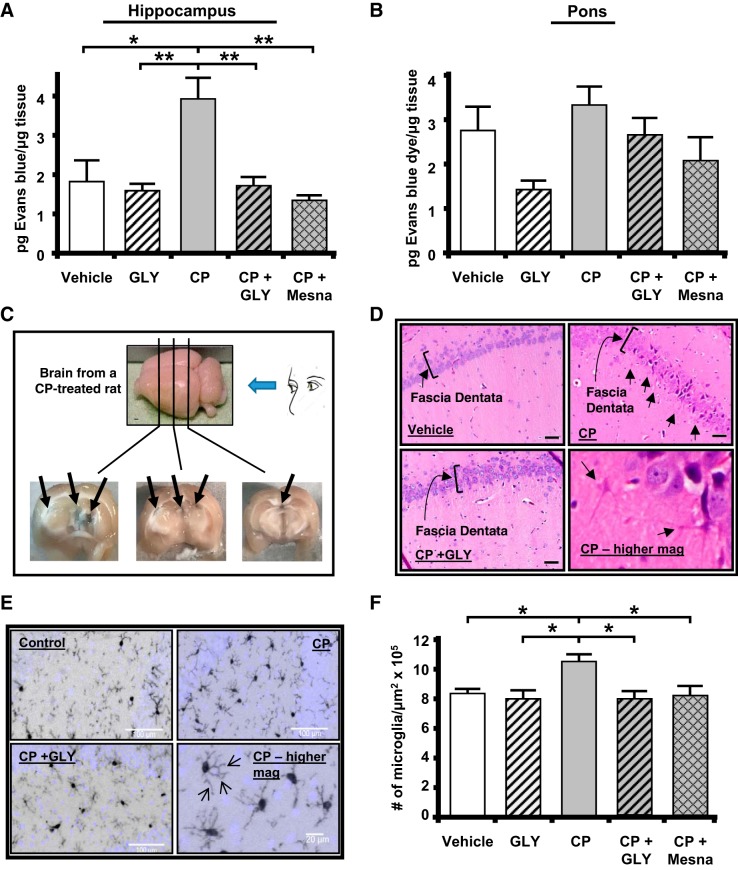
Cyclophosphamide (CP)-induced cystitis results in inflammation and breakdown of the blood-brain barrier in the hippocampus, not in the pons. Administration of glyburide (GLY) or 2-mercaptoethane sulfonate sodium (Mesna) blocks this effect. A: Evans blue extravasation was increased in the hippocampus by CP. This increase was prevented by treatment with GLY or Mesna. All results were calculated as pg Evans blue per μg tissue. B: Evans blue extravasation was not significantly changed in the pons by any treatment. Bars represent means ± SE. For A, vehicle: n = 3, GLY: n = 3, CP: n = 4, CP + GLY: n = 4, and CP + Mesna: n = 4. For B, vehicle: n = 4, GLY: n = 3, CP: n = 4, CP + GLY: n = 4, and CP + Mesna: n = 8. C: CP-induced cystitis resulted in areas of gross blood-brain barrier breakdown, with Evans blue dye apparent (arrows) in the periventricular region of the hippocampus. A CP-treated rat was injected with Evans blue as described in methods. After 1 h, the brain was removed, sectioned coronally with a scalpel at the approximate locations indicated, and photographed. D: CP resulted in a NOD-like receptor family pyrin domain containing 3 (NLRP3)-dependent increase in the number of microglia-like cells within the fascia dentata of the hippocampus. Coronal sections (10 µm) were cut through the hippocampus, and a hematoxylin and eosin stain was performed using routine methodical techniques. Slides were visualized at ×60. Activated glial cells are indicated by arrows. E: immunohistochemistry showed increased density of activated microglia within the fascia dentata. Coronal sections (10 µm) were cut, and immunohistochemistry was performed using an anti-IbA1/AIF1 antibody and routine histological methods. Slides were visualized at ×20, and the number of microglia was quantitated. Arrows demonstrating increased glial processes (arrows) at higher magnification are shown. F: density of microglia. Results are depicted as the number of microglia per μm2. Bars represent means ± SE (vehicle: n = 5, GLY: n = 6, CP: n = 7, CP + GLY: n = 4, and CP + Mesna: n = 8). *P < 0.05 and **P < 0.01 by one-way ANOVA and Student-Newman-Keuls post hoc analysis.
Fig. 6.
Fig. 6.
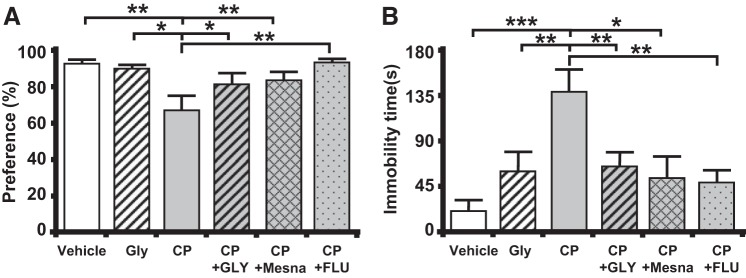
Cyclophosphamide (CP) induces behavioral signs of depression through NOD-like receptor family pyrin domain containing 3 (NLRP3). A: sucrose preference test. A reduction of preference indicates depression. Bars represent means ± SE [vehicle: n = 10, glyburide (GLY): n = 4, CP: n = 8, CP + GLY: n = 6, CP + 2-mercaptoethane sulfonate sodium (Mesna): n = 12, and GP + fluoxetine (FLU): n = 8]. *P < 0.05 and **P < 0.01 by one-way ANOVA and Student-Newman-Keuls post hoc analysis. B: forced swim assay. An increase in time spent immobile indicates depression. Bars represent means ± SE (vehicle: n = 9, GLY: n = 18, CP: n = 8, CP + GLY = 18, CP + Mesna: n = 6, and GP + FLU: n = 11). *P < 0.05, **P < 0.01, and ***P < 0.001 by one-way ANOVA and Student-Newman-Keuls post hoc analysis.

References

    1. Ali SA, Danda SK, Basha SA, Rasheed A, Ahmed O, Ahmed MM. Comparision of uroprotective activity of reduced glutathione with mesna in ifosfamide induced hemorrhagic cystitis in rats. Indian J Pharmacol 46: 105–108, 2014. doi:10.4103/0253-7613.125188. - DOI - PMC - PubMed
    1. Barta Z, Tóth L, Zeher M. Pulse cyclophosphamide therapy for inflammatory bowel disease. World J Gastroenterol 12: 1278–1280, 2006. doi:10.3748/wjg.v12.i8.1278. - DOI - PMC - PubMed
    1. Belayev L, Busto R, Zhao W, Ginsberg MD. Quantitative evaluation of blood-brain barrier permeability following middle cerebral artery occlusion in rats. Brain Res 739: 88–96, 1996. doi:10.1016/S0006-8993(96)00815-3. - DOI - PubMed
    1. Berry SH, Elliott MN, Suttorp M, Bogart LM, Stoto MA, Eggers P, Nyberg L, Clemens JQ. Prevalence of symptoms of bladder pain syndrome/interstitial cystitis among adult females in the United States. J Urol 186: 540–544, 2011. doi:10.1016/j.juro.2011.03.132. - DOI - PMC - PubMed
    1. Birder L, Andersson KE. Animal modelling of interstitial cystitis/bladder pain syndrome. Int Neurourol J 22, Suppl 1: S3–S9, 2018. doi:10.5213/inj.1835062.531. - DOI - PMC - PubMed

Publication types

MeSH terms