


Variability in urinary neonicotinoid concentrations in single-spot and first-morning void and its association with oxidative stress markers
- PMID: 31869729
- PMCID: PMC6957733
- DOI: 10.1016/j.envint.2019.105415
Variability in urinary neonicotinoid concentrations in single-spot and first-morning void and its association with oxidative stress markers
Abstract
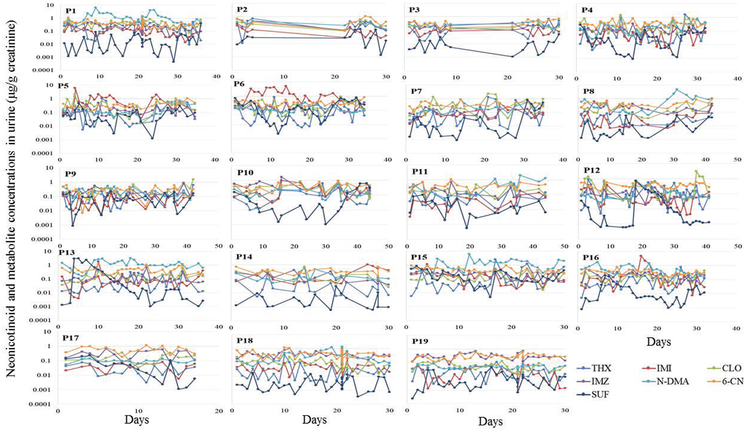
Human exposure to neonicotinoid insecticides (hereafter "neonics") is a concern. Spot urine samples have been widely used in the assessment of exposure to neonics. Urinary concentrations, however, can vary greatly over time due to variable exposure, potentially leading to exposure misclassification. In this study, within- and between-individual variability of urinary concentrations of 13 neonics and their metabolites collected consecutively for up to 44 days from 19 individuals were examined. We also measured seven oxidative stress biomarkers (OSBs) in repeated urine samples to elucidate their relationship with neonic exposure by mixed regression models. Intraclass correlation coefficients (ICCs, a ratio of between-individual variance to total variance) were used to assess the reproducibility of neonic/metabolite concentrations. Sensitivity and specificity were used to evaluate how well spot urine samples determined an individual's average exposure over 44 days. A fair to good reproducibility was observed for N-desmethyl-acetamiprid (ICC = 0.42), whereas thiamethoxam, imidacloprid, clothianidin, imidaclothiz, 6-chloronicotinic acid, and sulfoxaflor showed poor reproducibility (ICC = 0.02-0.37). Use of single-spot urine samples to classify high (top 33%) exposure showed higher specificities (0.68-0.92) than sensitivities (0.32-0.88). The minimum number of specimens (k) required to estimate participant-specific mean for neonic exposures within 20% of the "true" values ranged from 16 to 172. Significant positive correlations were found between some of neonic and OSB concentrations. The high variability found in the urinary concentrations of most neonics/metabolites suggests that a single measurement can result in exposure misclassification.
Keywords: Exposure; ICC; Insecticide; Neonicotinoid; Oxidative stress; Urine.
Copyright © 2019 The Authors. Published by Elsevier Ltd.. All rights reserved.
Conflict of interest statement
The authors declare no competing financial interest.
Declaration of interests
The authors declare that they have no known competing financial interests or personal relationships that could have appeared to influence the work reported in this paper.
Figures

References
-
- Al-Sarar AS, Abobakr Y, Bayoumi AE, Hussein HI, 2015. Cytotoxic and genotoxic effects of abamectin, chlorfenapyr, and imidacloprid on CHOK1 cells. Environ Sci Pollut Res 22, 17041–17052. - PubMed
-
- Anderson JC, Dubetz C, Palace VP, 2015. Neonicotinoids in the Canadian aquatic environment: a literature review on current use products with a focus on fate, exposure, and biological effects. Sci Total Environ 505, 409–422. - PubMed
-
- Aylward LL, Hays SM, Smolders R, Koch HM, Cocker J, Jones K, Warren N, Levy L, Bevan R, 2014. Sources of variability in biomarker concentrations. J Toxicol Env Heal B 17, 45–61. - PubMed
-
- Basley K, Goulson D, 2018. Effects of field-relevant concentrations of clothianidin on larval development of the butterfly Polyommatus icarus (Lepidoptera, Lycaenidae). Environ Sci Technol 52, 3990–3996. - PubMed
Publication types
MeSH terms
Substances
Grants and funding
LinkOut - more resources
Full Text Sources
