. 2020 Feb 21;64(3):e01963-19.
doi: 10.1128/AAC.01963-19. Print 2020 Feb 21.

VNRX-5133 (Taniborbactam), a Broad-Spectrum Inhibitor of Serine- and Metallo-β-Lactamases, Restores Activity of Cefepime in Enterobacterales and Pseudomonas aeruginosa

Affiliations

VNRX-5133 (Taniborbactam), a Broad-Spectrum Inhibitor of Serine- and Metallo-β-Lactamases, Restores Activity of Cefepime in Enterobacterales and Pseudomonas aeruginosa

Jodie C Hamrick et al. Antimicrob Agents Chemother. .

Abstract

As shifts in the epidemiology of β-lactamase-mediated resistance continue, carbapenem-resistant Enterobacterales (CRE) and carbapenem-resistant Pseudomonas aeruginosa (CRPA) are the most urgent threats. Although approved β-lactam (BL)-β-lactamase inhibitor (BLI) combinations address widespread serine β-lactamases (SBLs), such as CTX-M-15, none provide broad coverage against either clinically important serine-β-lactamases (KPC, OXA-48) or clinically important metallo-β-lactamases (MBLs; e.g., NDM-1). VNRX-5133 (taniborbactam) is a new cyclic boronate BLI that is in clinical development combined with cefepime for the treatment of infections caused by β-lactamase-producing CRE and CRPA. Taniborbactam is the first BLI with direct inhibitory activity against Ambler class A, B, C, and D enzymes. From biochemical and structural analyses, taniborbactam exploits substrate mimicry while employing distinct mechanisms to inhibit both SBLs and MBLs. It is a reversible covalent inhibitor of SBLs with slow dissociation and a prolonged active-site residence time (half-life, 30 to 105 min), while in MBLs, it behaves as a competitive inhibitor, with inhibitor constant (Ki ) values ranging from 0.019 to 0.081 μM. Inhibition is achieved by mimicking the transition state structure and exploiting interactions with highly conserved active-site residues. In microbiological testing, taniborbactam restored cefepime activity in 33/34 engineered Escherichia coli strains overproducing individual enzymes covering Ambler classes A, B, C, and D, providing up to a 1,024-fold shift in the MIC. Addition of taniborbactam restored the antibacterial activity of cefepime against all 102 Enterobacterales clinical isolates tested and 38/41 P. aeruginosa clinical isolates tested with MIC90s of 1 and 4 μg/ml, respectively, representing ≥256- and ≥32-fold improvements, respectively, in antibacterial activity over that of cefepime alone. The data demonstrate the potent, broad-spectrum rescue of cefepime activity by taniborbactam against clinical isolates of CRE and CRPA.

Keywords: antibacterial; biochemistry; microbiology; structural biology; β-lactamases; β-lactams.


Figures

FIG 1
FIG 1
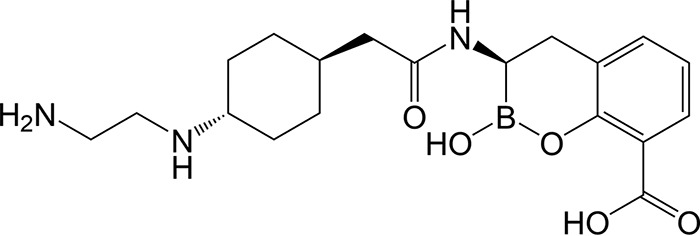
Structure of taniborbactam (VNRX-5133).
FIG 2
FIG 2
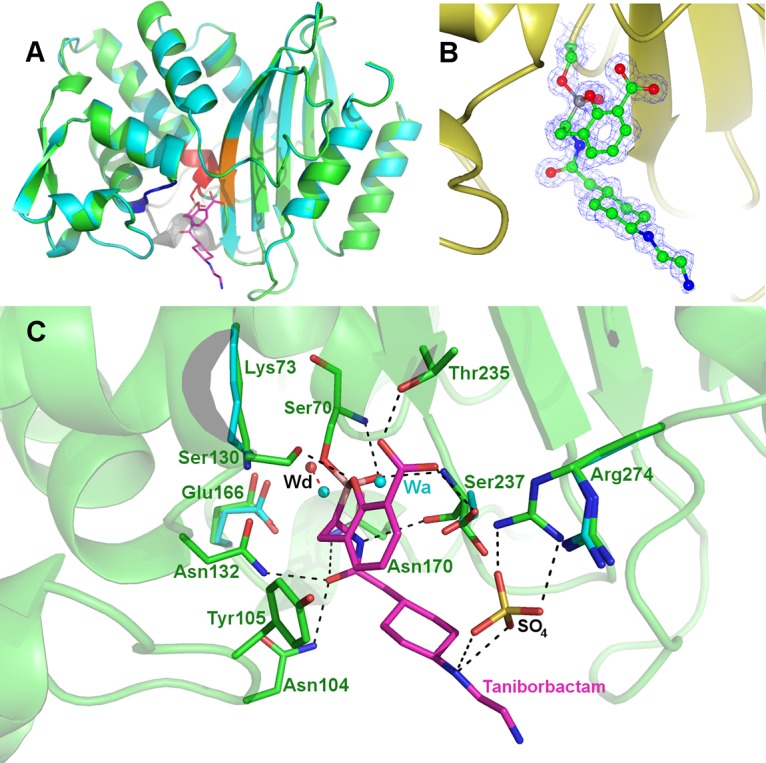
(A) Overall fold of the superimposed native CTX-M-15 (cyan; PDB accession number 4HBT) (55) and its covalent complex with taniborbactam (green; PDB accession number 6SP6) (32). (B) Active-site close-up and omit map of the taniborbactam-bound CTX-M-15 complex. (C) Mode of binding of taniborbactam in the active site of the class A ESBL CTX-M-15, showing the main interactions between the enzyme and taniborbactam (magenta); taniborbactam interacts with many conserved residues of serine-β-lactamases (Asn104, Ser130, Asn132, Asn170, Thr235); compared to the structure of the native CTX-M-15 (PDB accession number 4HBT), the deacylation water molecule (Wd) is displaced by 1.4 Å upon inhibitor binding. Wa refers to acylation water, and SO4 is the sulfate from the crystallization buffer solution. Figures were prepared with the CCP4mg (56) or PyMOL (https://pymol.org) program.
FIG 3
FIG 3
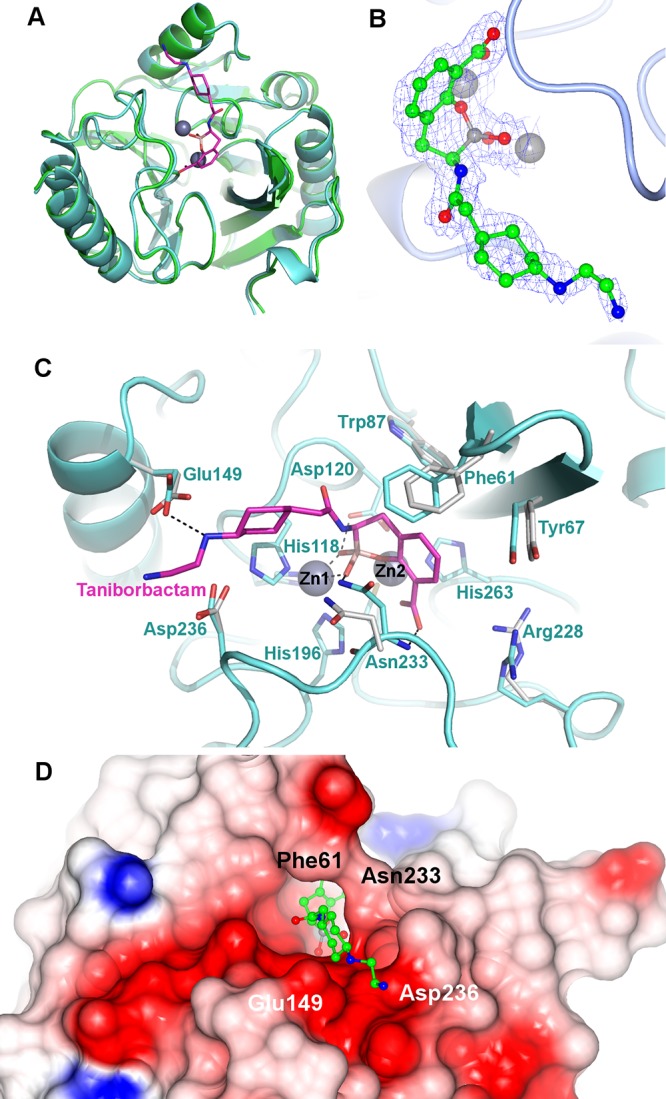
(A) Overall fold of the superimposed native VIM-2 metallo-β-lactamase (cyan; PDB accession number 1KO3) (34) and its covalent complex with taniborbactam (green; PDB accession number 6SP7) (32). (B) Active-site close-up and omit map of the taniborbactam-bound VIM-2 complex. (C) Mode of binding of taniborbactam in the active site of the VIM-2 metallo-β-lactamase, showing the main interactions between the enzyme and VNRX-5133 (magenta). Residues were numbered according to the BBL consensus numbering scheme (57). (D) Surface rendering of the VIM-2 active site in the VNRX-5133-inhibited complex, showing an inhibitor-induced narrowing of the active-site cleft resulting from a closer contact between the side chains Phe61 and Asn233. The presence of the electronegative pocket interacting with the inhibitor side chain and contributing to the stability of the inhibitor-enzyme complex is also shown.
FIG 4
FIG 4
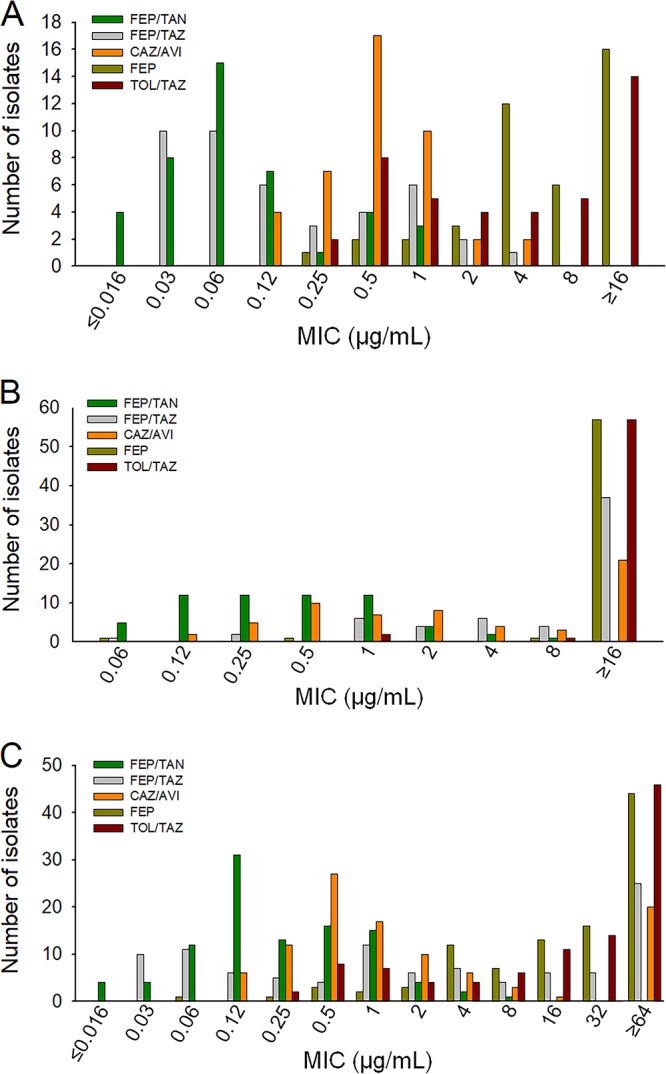
MIC distributions from broth microdilution testing of cefepime-taniborbactam and comparators in Enterobacterales. The number of isolates at each MIC for cefepime is shown relative to that for cefepime-tazobactam, cefepime-taniborbactam, ceftazidime-avibactam, and ceftolozane-tazobactam, with the concentration of the BLI being fixed at 4 μg/ml for all combinations except cefepime-tazobactam, for which the concentration of the BLI was fixed at 8 μg/ml. Susceptibility was defined as an MIC of ≤8 μg/ml for cefepime alone, cefepime-tazobactam, cefepime-taniborbactam, and ceftazidime-avibactam or an MIC of ≤2 μg/ml for ceftolozane-tazobactam in Enterobacterales. (A) Enterobacterales producing mixed class A and C and extended-spectrum β-lactamases (n = 42). The MIC50/MIC90 values were 8/128, 0.12/1, 0.06/0.5, 0.5/1, and 4/32 μg/ml for cefepime, cefepime-tazobactam, cefepime-taniborbactam, ceftazidime-avibactam, and ceftolozane-tazobactam, respectively. Percent susceptibility to these drugs was 61.9%, 100%, 100%, 100%, and 42.9%, respectively. (B) Enterobacterales producing carbapenemases, including OXA-48/OXA-48-like and KPC β-lactamases and metallo-β-lactamases (n = 60). The MIC50/MIC90 values were 64/≥256, 32/≥64, 0.5/2, 2/≥64, and ≥64/≥64 μg/ml for cefepime, cefepime-tazobactam, cefepime-taniborbactam, ceftazidime-avibactam, and ceftolozane-tazobactam, respectively. Percent susceptibility to these drugs was 5%, 38.3%, 100%, 65%, and 3.3%, respectively. (C) Overall distribution of MICs in all 102 isolates of Enterobacterales class A and C, OXA-48/OXA-48-like β-lactamases, ESBLs, and KPC, VIM-type, and NDM-type β-lactamases. The MIC50/MIC90 values were 32/≥256, 2/≥64, 0.12/1, 1/≥64, and 32/≥64 μg/ml for cefepime, cefepime-tazobactam, cefepime-taniborbactam, ceftazidime-avibactam, and ceftolozane-tazobactam, respectively. Percent susceptibility to these drugs was 28.4%, 63.7%, 100%, 79.4%, and 19.6%, respectively. FEP, cefepime; FEP/TAZ, cefepime-tazobactam; FEP/TAN, cefepime-taniborbactam; CAZ/AVI, ceftazidime-avibactam; TOL/TAZ, ceftolozane-tazobactam.
FIG 5
FIG 5
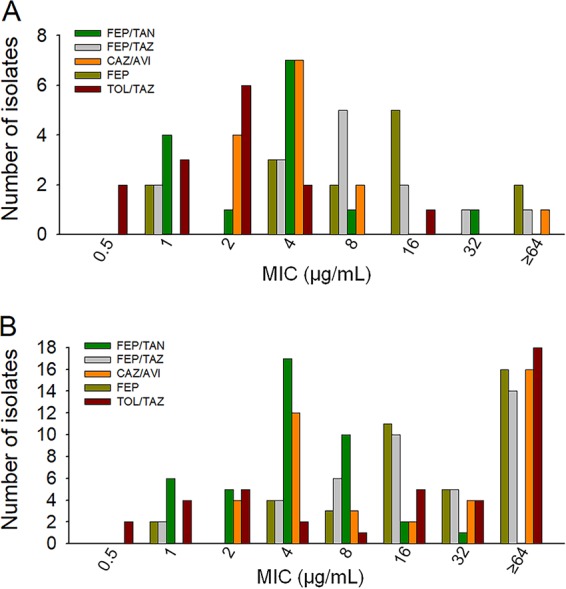
MIC distributions from broth microdilution testing in P. aeruginosa. The number of isolates at each MIC for cefepime is shown relative to that for cefepime-tazobactam, cefepime-taniborbactam, ceftazidime-avibactam, and ceftolozane-tazobactam, with the concentration of the BLI being fixed at 4 μg/ml for all combinations except cefepime-tazobactam, for which the concentration of the BLI was fixed at 8 μg/ml. Susceptibility was defined as an MIC of ≤8 μg/ml for cefepime alone, cefepime-tazobactam, cefepime-taniborbactam, and ceftazidime-avibactam or an MIC ≤4 μg/ml for ceftolozane-tazobactam in P. aeruginosa. (A) P. aeruginosa with wild-type basal PDC expression or downregulated OprD combined with upregulated RND drug efflux systems and PDC variant expression levels (n = 14). MIC50/MIC90 values were 8/≥64, 8/32, 4/8, 4/8, and 2/4 μg/ml for cefepime, cefepime-tazobactam, cefepime-taniborbactam, ceftazidime-avibactam, and ceftolozane-tazobactam, respectively. Percent susceptibility to these drugs was 50%, 71.4%, 92.9%, 92.9%, and 92.9%, respectively. (B) Overall distribution of MICs in 41 isolates of P. aeruginosa producing wild-type PDCs with various levels of production of OprD and MexAB-OprM/MexXY-OprM efflux pumps, PDC variants affecting the activity of ceftolozane-tazobactam, and KPC, GES, or VIM carbapenemases. The MIC50/MIC90 values were 32/≥256, 16/≥64, 4/8, 16/≥64, and 32/≥64 μg/ml for cefepime, cefepime-tazobactam, cefepime-taniborbactam, ceftazidime-avibactam, and ceftolozane-tazobactam, respectively. Percent susceptibility to these drugs was 22%, 29.3%, 92.7%, 46.3%, and 31.7%, respectively. FEP, cefepime; FEP/TAZ, cefepime-tazobactam; FEP/TAN, cefepime-taniborbactam; CAZ/AVI, ceftazidime-avibactam; TOL/TAZ, ceftolozane-tazobactam.
FIG 6
FIG 6
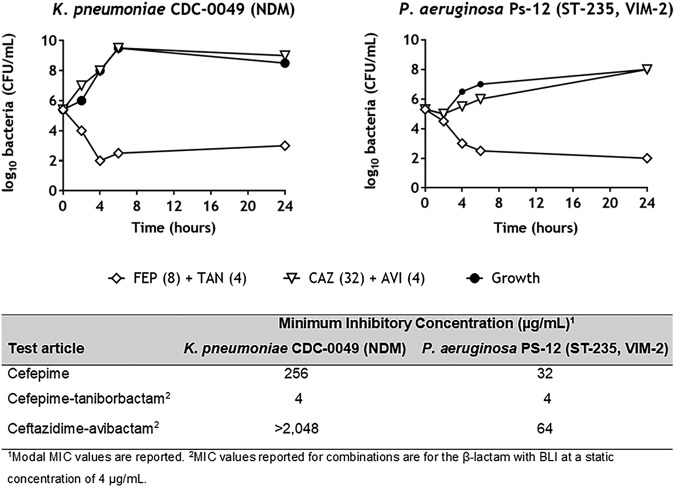
Time-kill curves for cefepime-taniborbactam relative to those for ceftazidime-avibactam in two metallo-β-lactamase-producing clinical isolates. The log10 value of the number of viable CFU per milliliter is displayed on the y axis versus time (in hours) on the x axis. Curves for 1×, 2×, and 4× MIC for cefepime (FEP) with taniborbactam (TAN) fixed at 4 μg/ml are shown for each strain, while the curves for ceftazidime (CAZ) at 32 μg/ml with avibactam (AVI) fixed at 4 μg/ml, representing 0.015× MIC (K. pneumoniae CDC-0049) and 0.5× MIC (P. aeruginosa PS-12) of ceftazidime, which are well above the CLSI susceptibility breakpoint for ceftazidime-avibactam in Enterobacterales and P. aeruginosa of 8 μg/ml, are shown for each strain.

References

    1. Bush K. 2018. Game changers: new β-lactamase inhibitor combinations targeting antibiotic resistance in Gram-negative bacteria. ACS Infect Dis 4:84–87. doi:10.1021/acsinfecdis.7b00243. - DOI - PubMed
    1. Garber KA. 2015. β-Lactamase inhibitor revival provides new hope for old antibiotics. Nat Rev Drug Discov 14:445–447. doi:10.1038/nrd4666. - DOI - PubMed
    1. Chaudhary AS. 2016. A review of global initiatives to fight antibiotic resistance and recent antibiotics discovery. Acta Pharm Sin B 6:552–556. doi:10.1016/j.apsb.2016.06.004. - DOI - PMC - PubMed
    1. Morrill HJ, Pogue JM, Kaye KS, LaPlante KL. 2015. Treatment options for carbapenem-resistant Enterobacteriaceae infections. Open Forum Infect Dis 2:ofv050. doi:10.1093/ofid/ofv050. - DOI - PMC - PubMed
    1. CDC. 2019. Antibiotic resistance threats in the United States 2019. CDC, U.S. Department of Health and Human Services, Atlanta, GA: https://www.cdc.gov/drugresistance/pdf/threats-report/2019-ar-threats-re....

Publication types

MeSH terms

LinkOut - more resources