Review
. 2020 Jul 1;10(7):a038489.
doi: 10.1101/cshperspect.a038489.

The Ecology and Evolution of Influenza Viruses

Affiliations
Review

The Ecology and Evolution of Influenza Viruses

Michelle Wille et al. Cold Spring Harb Perspect Med. .

Abstract

The patterns and processes of influenza virus evolution are of fundamental importance, underpinning such traits as the propensity to emerge in new host species and the ability to rapidly generate antigenic variation. Herein, we review key aspects of the ecology and evolution of influenza viruses. We begin with an exploration of the origins of influenza viruses within the orthomyxoviruses, showing how our perception of the evolutionary history of these viruses has been transformed with metagenomic sequencing. We then outline the diversity of virus subtypes in different species and the processes by which these viruses have emerged in new hosts, with a particular focus on the role played by segment reassortment. We then turn our attention to documenting the spread and phylodynamics of seasonal influenza A and B viruses in human populations, including the drivers of antigenic evolution, and finish with a discussion of virus diversity and evolution at the scale of individual hosts.


Figures

Figure 1.
Figure 1.
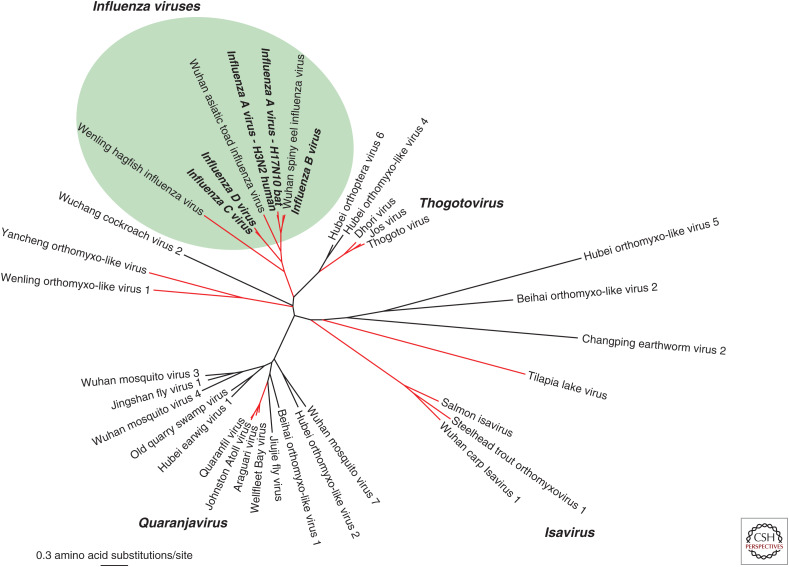
Evolutionary relationships among the orthomyxo-like viruses revealing the position of the vertebrate-associated influenza viruses (shaded green). The phylogeny was inferred using a maximum likelihood approach based on an amino acid alignment of the PB2 protein that encodes the RNA polymerase (original tree kindly provided by Dr. Mang Shi, University of Sydney). Influenza viruses A–D are shown in bold italic. Note the low levels of divergence among these viruses compared to the orthomyxo-like viruses as a whole. Branches shaded red denote those viruses associated with vertebrates, whereas all other (black) branches reflect viruses associated with invertebrates. Documented orthomyxovirus genera, other than those associated with influenza viruses, are indicated. The tree is unrooted with branches scaled to the number of amino acid changes per site.
Figure 2.
Figure 2.
The phylogenetic diversity of avian influenza A viruses. There are 16 different hemagglutinin (HA) subtypes of influenza A virus circulating in wild birds, falling into two main HA groups and further subdivided into a series of clades (Latorre-Margalef et al. 2013). Within each subtype, there is clear genetic structure based upon avian geography, such that sequences sampled from birds of the Americas or Eurasia fall into two distinct and independently evolving clades regardless of subtype. This phylogeographic division is demonstrated in a phylogeny containing all currently available H4 sequences (right panel), and is also observed in all nine neuraminidases (NAs) and the internal gene segments. Occasionally, there is spillover across these main lineages, as demonstrated by the N8 tree (right panel) in which virus sequences originating in Asia cluster in a clade dominated by North American sequences.
Figure 3.
Figure 3.
Reassortment and emergence of influenza viruses. Within the wild bird reservoir, reassortment is most recognizable when viruses contain gene segments with a mosaic of geographic lineages (see Fig. 2). These intercontinental reassortants are most often of the H13/H16 subtype and found in gull species (Wille et al. 2011). Reassortment in birds can cross host species barriers, such as the H7N9 viruses in China that involve viruses isolated in wild birds, domestic ducks, and poultry. According to the model proposed by Wang et al. (2014), an H7Nx virus from a domestic duck reassorted with an HxN9 from a wild bird. This H7N9 virus, once introduced to poultry, reassorted with an H9N2. More recent literature suggests this virus has segments from more than one H9N2 lineage, suggesting additional reassortment events. Following the emergence of this virus in poultry, it continued to reassort, continually producing new genotypes. Cross-species reassortment may also involve mammals. North American triple reassortant viruses in swine populations emerged following a number of reassortment events; segments have been traced back to classical swine lineages, and human seasonal viruses as well as North American avian viruses.
Figure 4.
Figure 4.
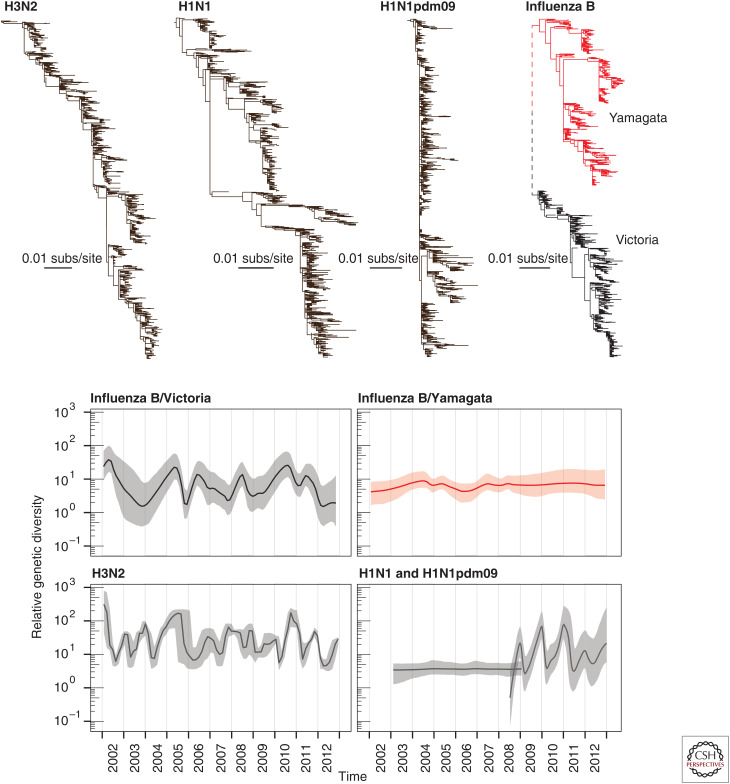
The contrasting phylodynamics of human influenza viruses. (Top) Left-to-right: Phylogenetic trees of globally sampled hemagglutinin (HA) gene segments (∼1200 sequences) of influenza A H3N2 virus, 2002–2013; H1N1 virus, 1998–2009; H1N1pdm09 virus, 2009–2013; and the Yamagata (red) and Victoria (black) lineages of influenza B viruses, 2002–2013. Note the different tree shapes that reflect the impact of differing evolutionary and evolutionary pressures. (Bottom) Left-to-right: Relative genetic diversities through time, a marker of changing population sizes, in the influenza B virus Victoria lineage; influenza B virus Yamagata lineage; H3N2 influenza A virus; H1N1 influenza A virus 2003–2008; and H1N1pdm09 influenza A virus (orange) 2009–2013. Again, note the differences among subtypes. The analysis only utilized viruses sampled in Australia and New Zealand. (From Vijaykrishna et al. 2015; adapted, courtesy of Creative Commons Attribution Licensing.)

References

    1. Al Faress S, Ferraris O, Moules V, Valette M, Hay A, Lina B. 2008. Identification and characterization of a late AH1N2 human reassortant in France during the 2002–2003 influenza season. Virus Res 132: 33–41. 10.1016/j.virusres.2007.10.007 - DOI - PubMed
    1. Bacharach E, Mishra N, Briese T, Zody MC, Kembou Tsofack JE, Zamostiano R, Berkowitz A, Ng J, Nitido A, Corvelo A, et al. 2016. Characterization of a novel orthomyxo-like virus causing mass die-offs of tilapia. mBio 7: e00431-16 10.1128/mBio.00431-16 - DOI - PMC - PubMed
    1. Bahl J, Vijaykrishna D, Holmes EC, Smith GJD, Guan Y. 2009. Gene flow and competitive exclusion of avian influenza A virus in natural reservoir hosts. Virology 390: 289–297. 10.1016/j.virol.2009.05.002 - DOI - PMC - PubMed
    1. Bahl J, Nelson MI, Chan KH, Chen R, Vijaykrishna D, Halpin R, Stockwell T, Lin X, Wentworth DE, Ghedin E, et al. 2011. Temporally structured metapopulation dynamics and persistence of influenza A H3N2 virus in humans. Proc Natl Acad Sci 108: 19359–19364. 10.1073/pnas.1109314108 - DOI - PMC - PubMed
    1. Bahl J, Krauss S, Kühnert D, Fourment M, Raven G, Pryor SP, Niles LJ, Danner A, Walker D, Mendenhall IH, et al. 2013. Influenza A virus migration and persistence in North American wild birds. PLoS Pathog 9: e1003570 10.1371/journal.ppat.1003570 - DOI - PMC - PubMed

Publication types