


Identifying pattern in global developmental delay children: A retrospective study at King Fahad specialist hospital, Dammam (Saudi Arabia)
- PMID: 31871607
- PMCID: PMC6908955
- DOI: 10.4081/pr.2019.8251
Identifying pattern in global developmental delay children: A retrospective study at King Fahad specialist hospital, Dammam (Saudi Arabia)
Abstract
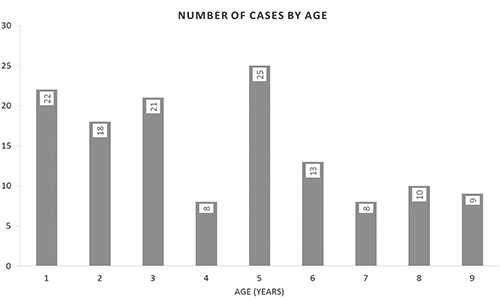
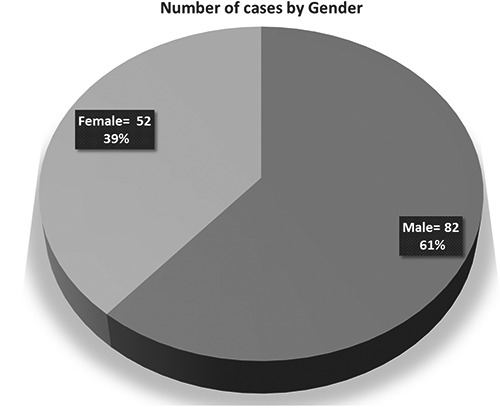
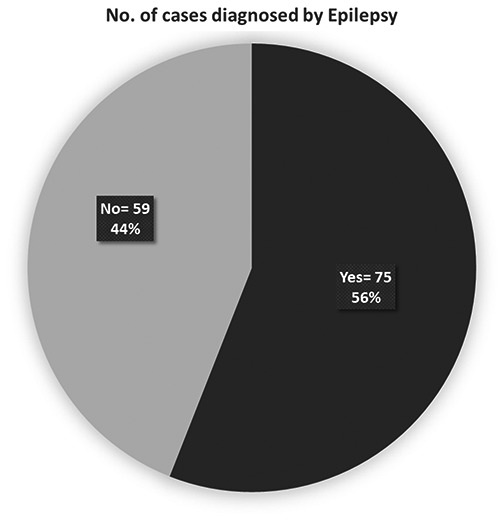
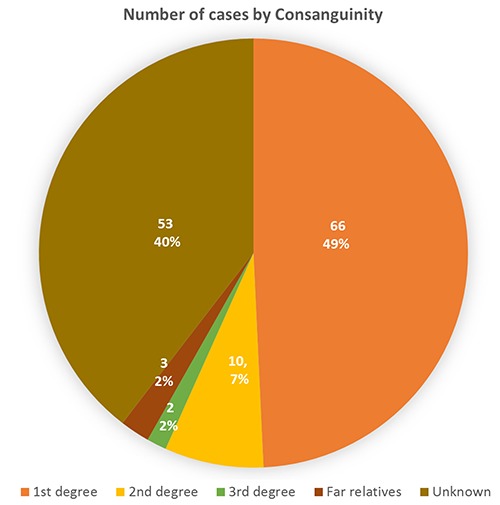
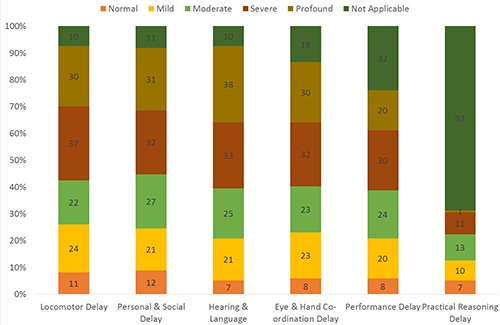
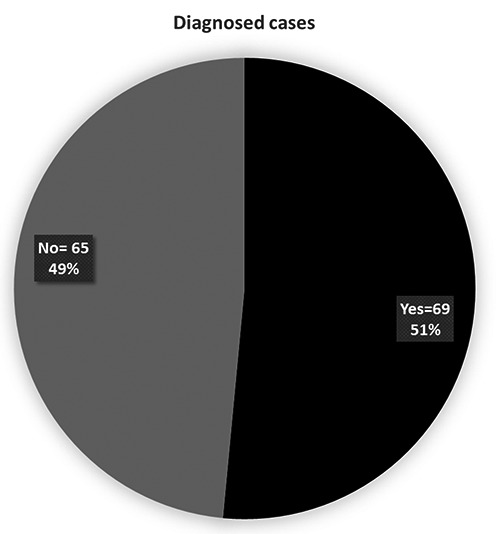
Global developmental delay (GDD) and intellectual disability are relatively common in pediatric neurology conditions. A retrospective study was designed to analyze risk factors and clinical features in children with GDD at our hospital. No previous data is available on GDD from Saudi Arabia. This study was conducted at king Fahad specialist hospital Dammam (KFSHD) of 134 GDD children (82, 61% males, 52, 39% females), (age 1-9 years). They were assessed by using Griffith Mental Development Scales for (0-2) years and 3-8 years old in locomotors, personal/social, communication, eye & hand co-ordination, performance and practical reasoning. Patients with ASD and non-cooperative behavior were excluded. 75% had developmental delay since birth while 84% had no problem during pregnancy. 22% had birth weight below 2.5 kg. 56% had epilepsy and 57 % had interfamily marriages. 51% were diagnosed cases in the present study. 40% had genetic cause, 25% had metabolic problem, 58% had neuroradiology abnormality and 45% had EEG abnormalities. There a variety of delays in development (speech and language variant, global delay, and the motor variant) noted and are commonly seen in a clinical practice in KFSHD. Longitudinal research beginning in early development will help to understand the developmental domains and neurological comorbidities in these children at high risk for neurodevelopmental disorders.
Keywords: Speech and language; fine motor; neurodevelopmental disorder.
©Copyright: the Author(s), 2019.
Conflict of interest statement
Conflict of interest: The authors declare no potential conflict of interest.
Figures
References
-
- Shevell M, Majnemer A, Platt RW, et al. Developmental and functional outcomes in children with global developmental delay or developmental language impairment. Dev Med Child Neurol 2005;47:678-83. - PubMed
-
- Shevell M, Ashwal S, Donley D, et al. Practice parameter: evaluation of the child with global developmental delay: report of the Quality Standards Subcommittee of the American Academy of Neurology and The Practice Committee of the Child Neurology Society. Neurology 2003;60:367-80. - PubMed
-
- Jimenez-Gomez A, Standridge SM. A refined approach to evaluating global developmental delay for the international medical community. Pediatr Neurol 2014;51:198-206. - PubMed
-
- American Association on Mental Retardation. Mental retardation: definition, classification and systems of supports 10th edn. Washington, DC: American Association on Mental Retardation; 2002.
-
- Johnson JH, Goldman J. Developmental assessment in clinical child psychology. New York, NY: Pergamon Press, 1990.
LinkOut - more resources
Full Text Sources