. 2019 Jun 7;6(11):1762-1774.
doi: 10.1039/C9QO00074G. Epub 2019 Apr 11.

A joint molecular networking study of a Smenospongia sponge and a cyanobacterial bloom revealed new antiproliferative chlorinated polyketides

Affiliations

A joint molecular networking study of a Smenospongia sponge and a cyanobacterial bloom revealed new antiproliferative chlorinated polyketides

Roberta Teta et al. Org Chem Front. .

Abstract

The bloom-forming cyanobacteria Trichodesmium sp. have been recently shown to produce some of the chlorinated peptides/polyketides previously isolated from the marine sponge Smenospongia aurea. A comparative analysis of extracts from S. aurea and Trichodesmium sp. was performed using tandem mass spectrometry-based molecular networking. The analysis, specifically targeted to chlorinated metabolites, showed that many of them are common to the two organisms, but also that some general differences exist between the two metabolomes. Following this analysis, six new chlorinated metabolites were isolated and their structures elucidated: four polyketides, smenolactones A-D (1-4) from S. aurea, and two new conulothiazole analogues, isoconulothiazole B (5) and conulothiazole C (6) from Trichodesmium sp. The absolute configuration of smenolactone C (3) was determined by taking advantage of the conformational rigidity of open 1,3-disubstituted alkyl chains. The antiproliferative activity of smenolactones was evaluated on three tumor cell lines, and they were active at low-micromolar or sub-micromolar concentrations.


Conflict of interest statement

Conflicts of interest There are no conflicts to declare

Figures
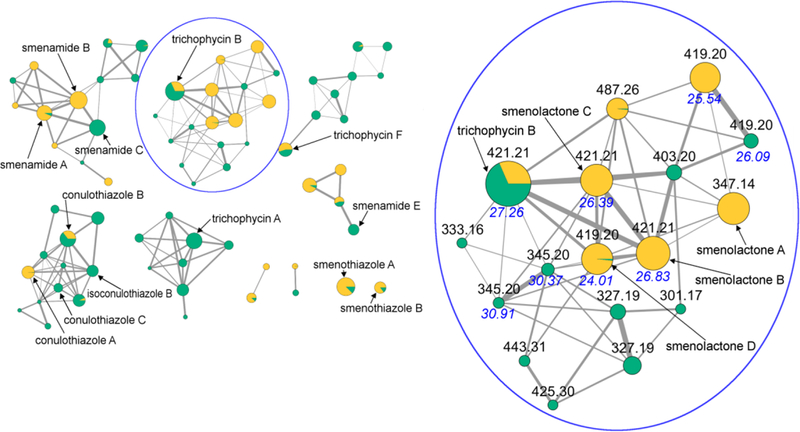
Fig. 1.
Fig. 1.
The molecular network obtained combining the LC-MS/MS analyses of extracts from S. aurea and Trichodesmium sp‥ Nodes are represented as a pie chart showing the source of the compound (yellow: S. aurea, green: Trichodesmium sp.). Node size is relative to ion count, edge thickness is relative to cosine score. The networking cluster containing trichophycin B (17) and the new smenolactones A-D (1-4) is expanded, and nodes are labeled with parent m/z values and HPLC retention times. Retention times of isomeric compounds are shown in blue.
Fig. 2.
Fig. 2.
Key connections determined from 2D NMR spectra for compound 1 (A), compounds 2 and 3 (B) and compound 4 (C). Bold bonds are used to show proton-proton connections determined through vicinal couplings, dashed bold bonds are used to show proton-proton connections determined through allylic and homoallylic couplings, and arrows are used to show HMBC correlations.
Fig. 3.
Fig. 3.
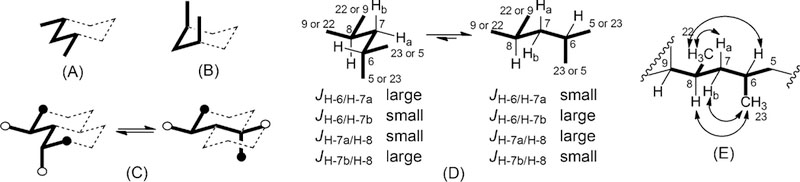
(A) The most stable conformer of pentane. (B) A high-energy conformer of pentane showing the destabilizing syn-pentane interaction. (C) The two only low-energy conformers of 2,4-dimethylpentane. (D) The two only possible low-energy conformations of the C-5/C-9 segment of compound 3. Coupling constants of H-7a and H-7b show that the conformation shown on the right is highly preferred, whatever configurations at C-6 and C-8 may be. (E) NOESY correlations of H3-23 with H-8 and H-7b (but not with H-7a) and of H3-22 with H-6 and H-7a (but not with H-7b) define relative configuration of C-6 and C-8.
Fig. 4.
Fig. 4.
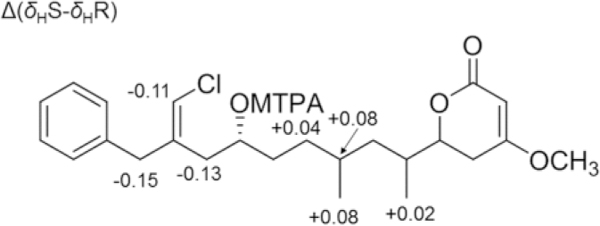
Δ(δHS-δHR) values determined for S- and R-MTPA esters of smenolactone C (3).
Figure 5.
Figure 5.
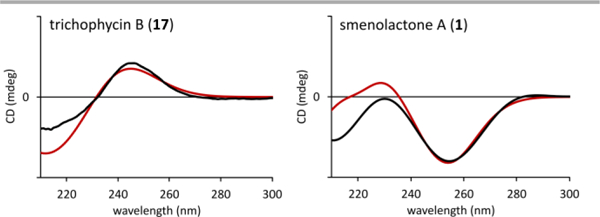
Predicted (red curve) and experimental (black curve) ECD spectra of trichophycin B (17) and smenolactone A (1).
Figure 6.
Figure 6.
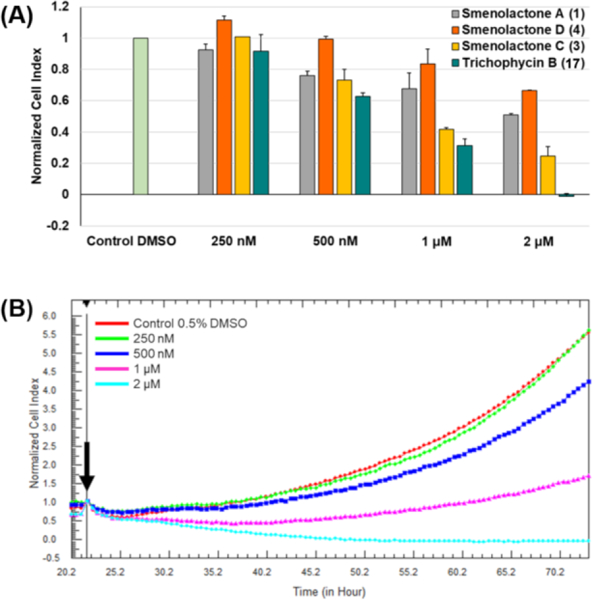
Effects of smenolactones on the proliferation of MCF7 cells monitored in real time using the RTCA platform. (A) Normalized cell index (NCI) variation of the MCF7 cells exposed to different concentrations (250 nM, 500 nM, 1 μM, 2 μM) of trichophycin B and smenolactones A, C, and D after 48h of treatment. NCI values are relative to controls treated with DMSO vehicle. Data are presented as mean ± SD; n=3. p < 0.0001. (B) Normalized cell index kinetics of the MCF7 cells exposed to different concentrations (250 nM, 500 nM, 1 μM, 2 μM) of trichophycin B (17) and to DMSO vehicle. Arrow shows the starting point of treatment of the cells. Each cell index value was normalized to this starting point. Dose-dependent decrease of the slope of the NCI of MCF7 describes the steepness of cell proliferation curves after 48h treatment at each concentration.
Figure 7.
Figure 7.
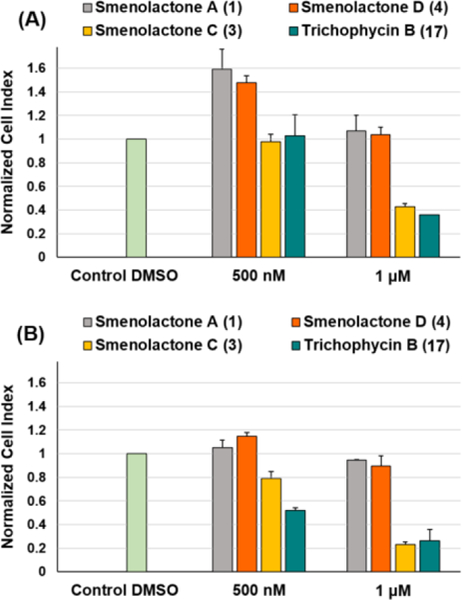
Evaluation of antiproliferative effects of trichophycin B and smenolactones A, C, and D against PANC1 (A) and BxPC-3 (B) cell lines at 500 nM and 1 μM, within 48 h of treatment. NCI values are relative to controls treated with DMSO vehicle. Data are presented as mean ± SD; n=3. p < 0.0001.
Figure 8.
Figure 8.
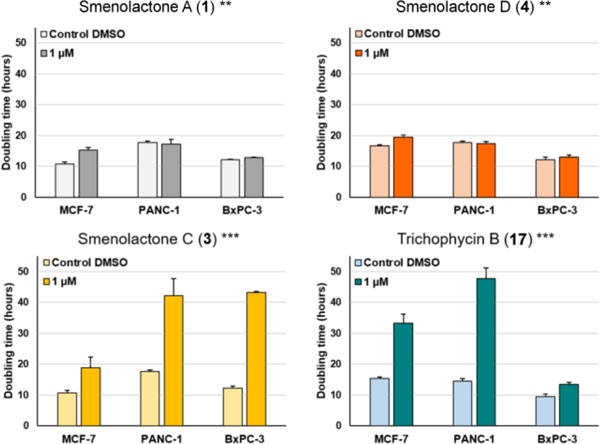
Doubling times of NCI of MCF7, PANC-1 and BxPC-3 cancer cells after 48 h treatment with 1 μM of trichophycin B, smenolactones A, C, and D, and 0.5% DMSO. Doubling time is the time required for a curve cell index value to double. Data are presented as mean ± SD; n=3. ** p < 0.001; *** p < 0.0001.
Chart 1.
Chart 1.
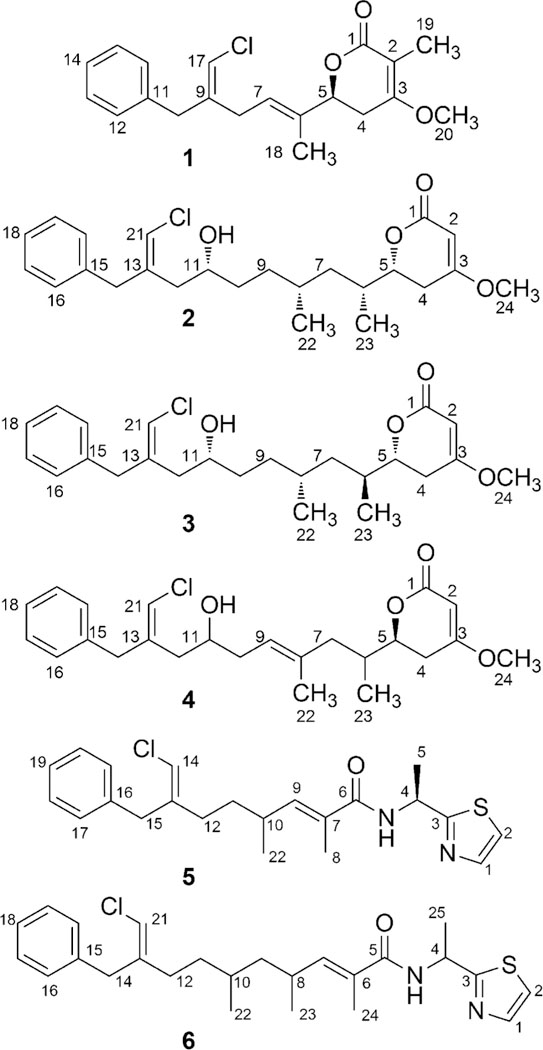
Structures of the new chlorinated polyketides, smenolactones A (1), B (2), C (3), and D (4) isolated from Smenospongia aurea and of the new isoconulothiazole B (5) and conulothiazole C (6) isolated from Trichodesmium sp.
Chart 2.
Chart 2.
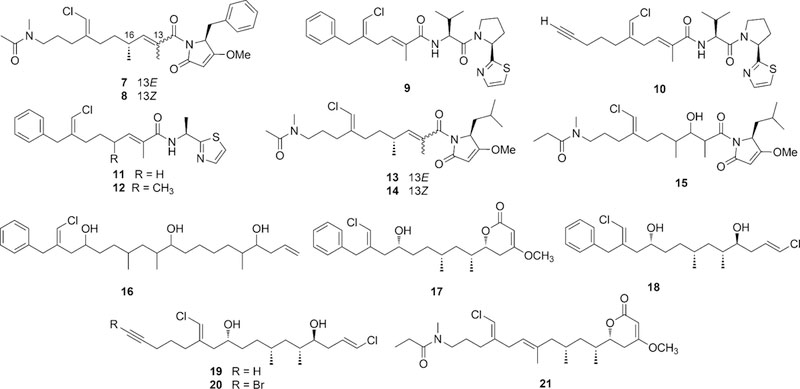
Structures of smenamides A (7) and B (8), smenothiazoles A (9) and B (10) and conulothiazoles A (11) and B (12) isolated from Smenospongia spp, and of smenamides C (13), D (14), and E (15) and trichophycins A-F (16–21) isolated from Trichodesmium sp.

References

    1. Hu Y, Chen J, Hu G, Yu J, Zhu X, Lin Y, Chen S and Yuan J, Mar. Drugs, 2015, 13, 202–221. - PMC - PubMed
    1. Esposito G, Bourguet-Kondracki M-L, Mai LH, Longeon A, Teta R, Meijer L, Van Soest R, Mangoni A and Costantino V, J. Nat. Prod, 2016, 79, 2953–2960. - PubMed
    1. Costantino V, Fattorusso E, Imperatore C and Mangoni A, European J. Org. Chem, 2003, 1433–1437.
    1. Costantino V, Fattorusso E, Imperatore C, Mangoni A and Teta R, European J. Org. Chem, 2009, 2112–2119.
    1. Saurav K, Bar-Shalom R, Haber M, Burgsdorf I, Oliviero G, Costantino V, Morgenstern D and Steindler L, Front. Microbiol, 2016, 7, 416. - PMC - PubMed

LinkOut - more resources