. 2019 Dec 1:2019:1907698.
doi: 10.1155/2019/1907698. eCollection 2019.

Kaempferol Promotes Apoptosis While Inhibiting Cell Proliferation via Androgen-Dependent Pathway and Suppressing Vasculogenic Mimicry and Invasion in Prostate Cancer

Affiliations

Kaempferol Promotes Apoptosis While Inhibiting Cell Proliferation via Androgen-Dependent Pathway and Suppressing Vasculogenic Mimicry and Invasion in Prostate Cancer

Jun Da et al. Anal Cell Pathol (Amst). .

Abstract

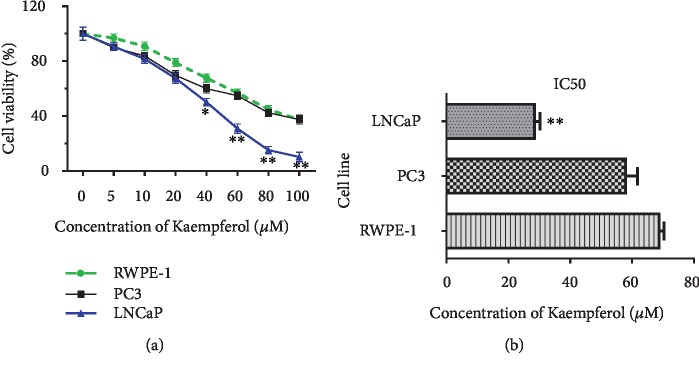
Kaempferol is a well-known natural flavonol reported to be a potential treatment for multiple cancers. In this study, we demonstrated that cell growth of androgen-sensitive LNCaP cells could be inhibited 33% by 5 μM kaempferol, around 60% by 10 μM kaempferol, and almost 100% by 15 μM kaempferol. Also, kaempferol showed relatively limited effect on PC-3 cells and nonmalignant RWPE-1 cells. In the presence of DHT, the IC50 for kaempferol was 28.8 ± 1.5 μM in LNCaP cells, 58.3 ± 3.5 μM in PC-3 cells, and 69.1 ± 1.2 μM in RWPE-1 cells, respectively. Kaempferol promotes apoptosis of LNCaP cells in a dose-dependent manner in the presence of dihydrotestosterone (DHT). Then, luciferase assay data showed that kaempferol could inhibit the activation of androgen receptors induced by DHT significantly. The downstream targets of androgen receptors, such as PSA, TMPRSS2, and TMEPA1, were found decreased in the presence of kaempferol in qPCR data. It was then confirmed that the protein level of PSA was decreased. Kaempferol inhibits AR protein expression and nuclear accumulation. Kaempferol suppressed vasculogenic mimicry of PC-3 cells in an in vitro study. In conclusion, kaempferol is a promising therapeutic candidate for treatment of prostate cancer, where the androgen signaling pathway as well as vasculogenic mimicry are involved.


Conflict of interest statement

All the authors declare that they have no competing interests.

Figures
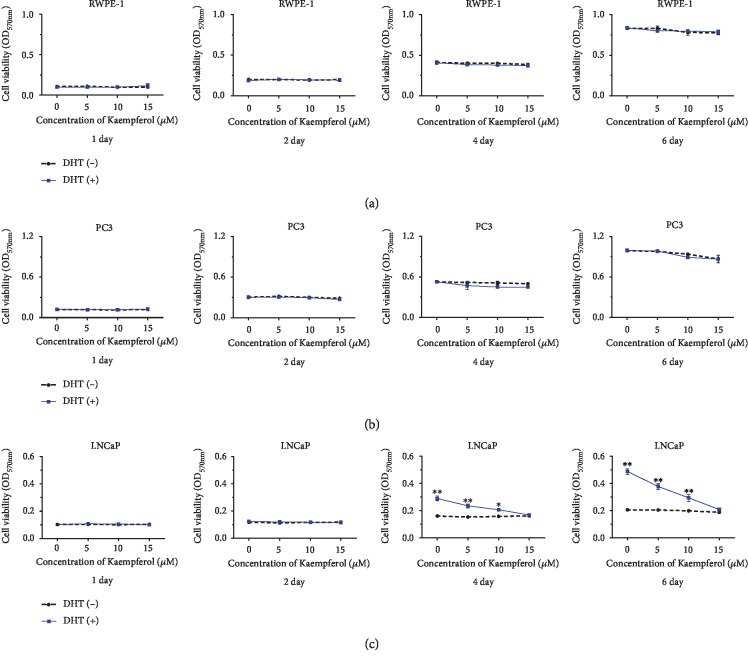
Figure 1
Figure 1
The effect of kaempferol on cell viability of prostate cancer cells. (a, b) Cell growth of RWPE-1 and PC-3 cells was slightly affected by DHT and kaempferol. (c) Kaempferol inhibited cell growth of LNCaP cells up to 33% at 5 μM, around 60% at 10 μM, and almost 100% at 15 μM (p < 0.05) in the presence of 1 nM DHT on days 4 and 6 (n = 3). p < 0.05, ∗∗p < 0.01 compared with cells without DHT.
Figure 2
Figure 2
(a, b) IC50 of kaempferol with DHT. IC50 of kaempferol was 28.8 ± 1.5 μM, 58.3 ± 3.5 μM, and 69.1 ± 1.2 μM in LNCaP, PC-3, and RWPE-1 cells with 1 nM DHT (n = 3). p < 0.05, ∗∗p < 0.01 compared with RWPE-1.
Figure 3
Figure 3
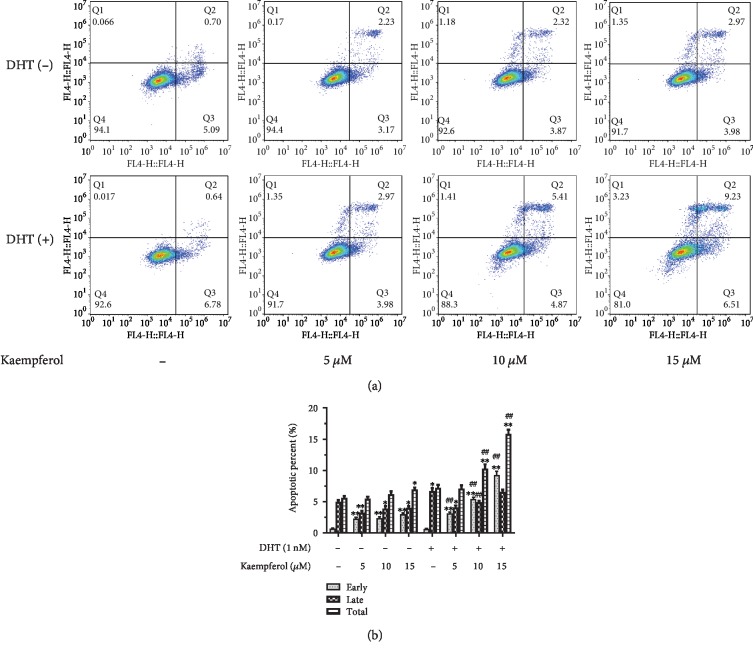
Kaempferol promotes the DHT-dependent apoptosis of AR-positive prostate cancer cells. (a) Apoptosis of LNCaP cells was analyzed using flow cytometry. (b) Kaempferol promotes early and total apoptosis in a dose-dependent manner in the presence of 1 nM DHT (n = 3). p < 0.05, ∗∗p < 0.01 compared with cells without DHT and kaempferol treatment. ##p < 0.01 compared with cells with DHT but without kaempferol treatment.
Figure 4
Figure 4
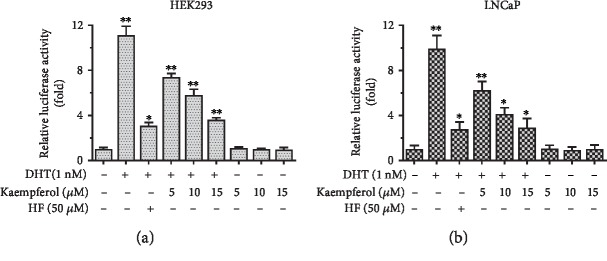
Kaempferol inhibited the AR activation in HEK293 and LNCaP cells. (a) In HEK293 cells, HF inhibited DHT-induced activation of AR by 72.46%. Kaempferol inhibited the AR activation by 33.53% at 5 μM, 47.90% at 10 μM, and 67.66% at 15 μM. (b) In LNCaP cells, HF inhibited DHT-induced activation of AR by 72.13%. Kaempferol inhibited the AR activation by 37.19% at 5 μM, 58.40% at 10 μM, and 70.64% at 15 μM (n = 3). p < 0.05, ∗∗p < 0.01 compared with cells without kaempferol, DHT, and HF.
Figure 5
Figure 5
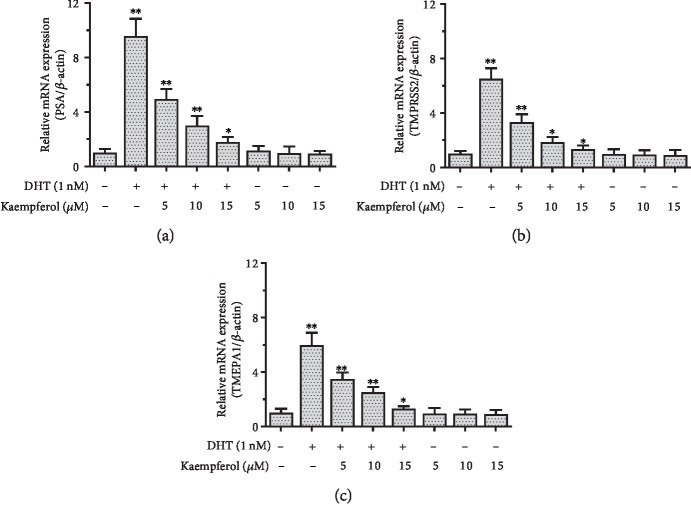
Kaempferol suppresses mRNA expression of AR target gene in LNCaP cells in the presence of DHT. (a) Kaempferol suppresses PSA mRNA expression by 48.25% at 5 μM, 68.62% at 10 μM, and 81.27% at 15 μM. (b) Kaempferol suppresses TMPRSS2 mRNA expression by 49.14% at 5 μM, 71.67% at 10 μM, and 79.48% at 15 μM. (c) Kaempferol suppresses TMEPA1 mRNA expression in qPCR by 41.45% at 5 μM, 58.06% at 10 μM, and 78.12% at 15 μM (n = 3). p < 0.05, ∗∗p < 0.01 compared with cells without kaempferol and DHT.
Figure 6
Figure 6
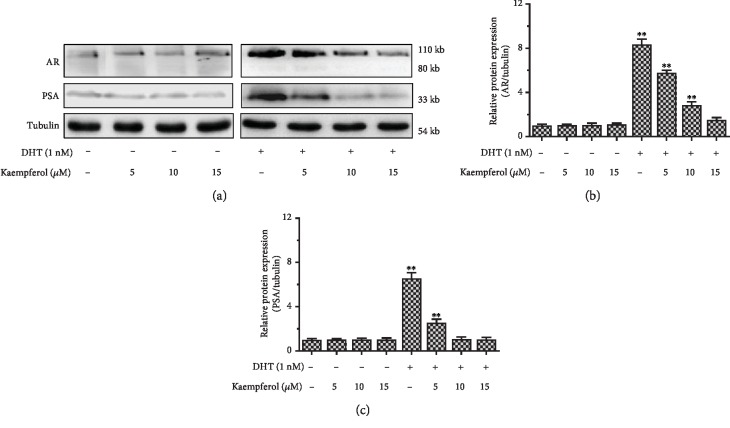
Kaempferol suppressed AR and PSA protein expression in LNCaP cells in the presence of 1 nM DHT. (a) The protein expression of AR and PSA was measured by western blotting. (b) The relative protein expression of AR was quantified by AR blots to Tubulin. (c) The relative protein expression of PSA was quantified by PSA blots to Tubulin (n = 3). ∗∗p < 0.01 compared with cells without DHT and kaempferol treatment.
Figure 7
Figure 7
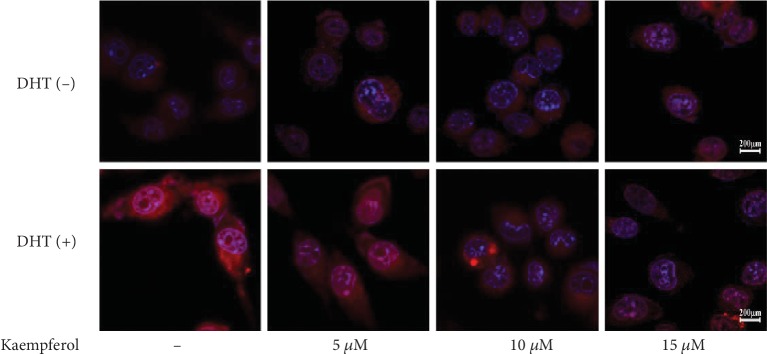
Kaempferol suppresses AR expression and nuclear accumulation in LNCaP cells in the presence of DHT measured using immunofluorescence method. AR protein expression and nuclear accumulation in LNCaP cells were inhibited by kaempferol in a dose-dependent manner in the presence of 1 nM DHT.
Figure 8
Figure 8
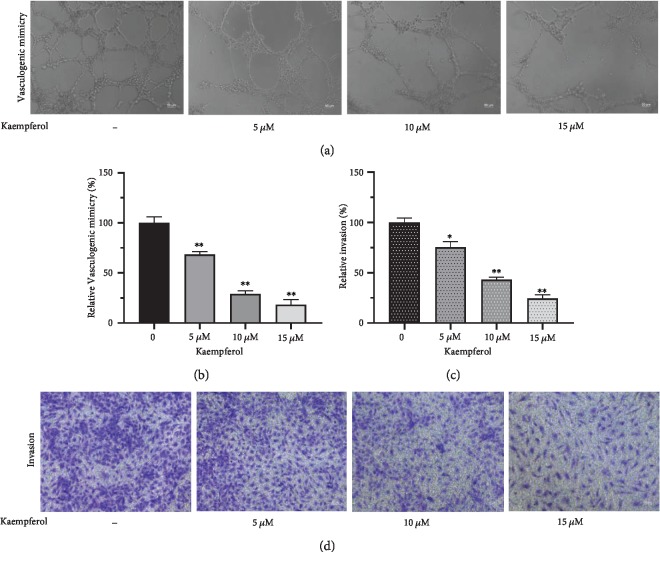
Kaempferol inhibits vasculogenic mimicry formation and invasion in PC-3. Kaempferol inhibited vasculogenic mimicry formation and invasion in PC-3 cells in a dose-dependent manner (5-15 μM) (n = 3). p < 0.05, ∗∗p < 0.01 compared with cells without kaempferol treatment.

References

    1. Daniyal M., Siddiqui Z. A., Akram M., Asif H. M., Sultana S., Khan A. Epidemiology, etiology, diagnosis and treatment of prostate cancer. Asian Pacific Journal of Cancer Prevention. 2014;15(22):9575–9578. doi: 10.7314/apjcp.2014.15.22.9575. - DOI - PubMed
    1. Riahi-Chebbi I., Souid S., Othman H., et al. The phenolic compound kaempferol overcomes 5-fluorouracil resistance in human resistant LS174 colon cancer cells. Scientific Reports. 2019;9(1):p. 195. doi: 10.1038/s41598-018-36808-z. - DOI - PMC - PubMed
    1. Kaur P., Robin, Mehta R. G., Singh B., Arora S. Development of aqueous-based multi-herbal combination using principal component analysis and its functional significance in HepG2 cells. BMC Complementary and Alternative Medicine. 2019;19(1):p. 18. doi: 10.1186/s12906-019-2432-9. - DOI - PMC - PubMed
    1. Wu P., Meng X., Zheng H., et al. Kaempferol attenuates ROS-induced hemolysis and the molecular mechanism of its induction of apoptosis on bladder cancer. Molecules. 2018;23(10):p. 2592. doi: 10.3390/molecules23102592. - DOI - PMC - PubMed
    1. Song W., Dang Q., Xu D., et al. Kaempferol induces cell cycle arrest and apoptosis in renal cell carcinoma through EGFR/p38 signaling. Oncology Reports. 2014;31(3):1350–1356. doi: 10.3892/or.2014.2965. - DOI - PubMed

MeSH terms