


Formative Usability Testing Reduces Severe Blood Product Ordering Errors
- PMID: 31875648
- PMCID: PMC6930842
- DOI: 10.1055/s-0039-3402714
Formative Usability Testing Reduces Severe Blood Product Ordering Errors
Abstract
Background: Medical errors in blood product orders and administration are common, especially for pediatric patients. A failure modes and effects analysis in our health care system indicated high risk from the electronic blood ordering process.
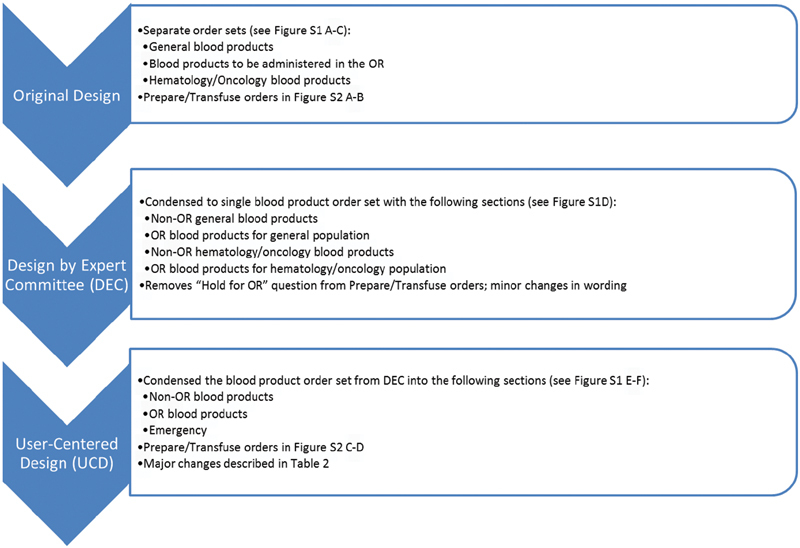
Objectives: There are two objectives of this study as follows:(1) To describe differences in the design of the original blood product orders and order sets in the system (original design), new orders and order sets designed by expert committee (DEC), and a third-version developed through user-centered design (UCD).(2) To compare the number and type of ordering errors, task completion rates, time on task, and user preferences between the original design and that developed via UCD.
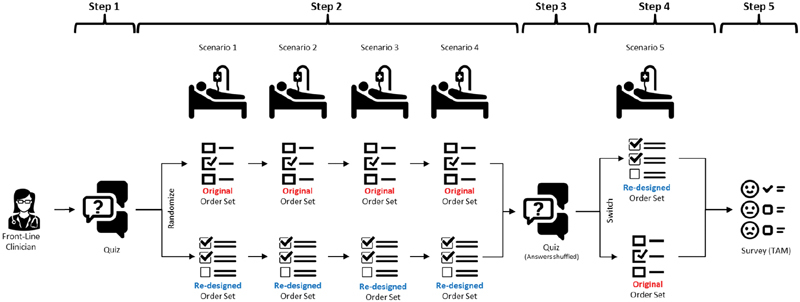
Methods: A multidisciplinary expert committee proposed adjustments to existing blood product order sets resulting in the DEC order set. When that order set was tested with front-line users, persistent failure modes were detected, so orders and order sets were redesigned again via formative usability testing. Front-line users in their native clinical workspaces were observed ordering blood in realistic simulated scenarios using a think-aloud protocol. Iterative adjustments were made between participants. In summative testing, participants were randomized to use the original design or UCD for five simulated scenarios. We evaluated differences in ordering errors, time on task, and users' design preference with two-sample t-tests.
Results: Formative usability testing with 27 providers from seven specialties led to 18 changes made to the DEC to produce the UCD. In summative testing, error-free task completion for the original design was 36%, which increased to 66% in UCD (30%, 95% confidence interval [CI]: 3.9-57%; p = 0.03). Time on task did not vary significantly.
Conclusion: UCD led to substantially different blood product orders and order sets than DEC. Users made fewer errors when ordering blood products for pediatric patients in simulated scenarios when using the UCD orders and order sets compared with the original design.
Georg Thieme Verlag KG Stuttgart · New York.
Conflict of interest statement
A.B.C. reports personal fees from American Medical Informatics Association, outside the submitted work. N.M. reports equity in Phrase Health, a clinical decision support analytics company. E.W.O. reports other from Phrase Health, outside the submitted work. J.B. has nothing to disclose. M.R. has nothing to disclose.
Figures
References
-
- Rowley M. 2018. Errors related to information technology (IT) pp. 104–105.
-
- New H V, Berryman J, Bolton-Maggs P H et al.Guidelines on transfusion for fetuses, neonates and older children. Br J Haematol. 2016;175(05):784–828. - PubMed
-
- Goel R, Cushing M M, Tobian A AR. Pediatric patient blood management programs: not just transfusing little adults. Transfus Med Rev. 2016;30(04):235–241. - PubMed
-
- Jones H, Reeve K. Transfusion guidelines in children: II. Anaesth Intensive Care Med. 2017;18:546–550.
MeSH terms
LinkOut - more resources
Full Text Sources
Medical
Research Materials
