. 2019 Dec 20;9(1):33.
doi: 10.3390/cells9010033.

Synergistic Effects of Nanomedicine Targeting TNFR2 and DNA Demethylation Inhibitor-An Opportunity for Cancer Treatment

Affiliations

Synergistic Effects of Nanomedicine Targeting TNFR2 and DNA Demethylation Inhibitor-An Opportunity for Cancer Treatment

Mohammad A I Al-Hatamleh et al. Cells. .

Abstract

Tumor necrosis factor receptor 2 (TNFR2) is expressed on some tumor cells, such as myeloma, Hodgkin lymphoma, colon cancer and ovarian cancer, as well as immunosuppressive cells. There is increasingly evidence that TNFR2 expression in cancer microenvironment has significant implications in cancer progression, metastasis and immune evasion. Although nanomedicine has been extensively studied as a carrier of cancer immunotherapeutic agents, no study to date has investigated TNFR2-targeting nanomedicine in cancer treatment. From an epigenetic perspective, previous studies indicate that DNA demethylation might be responsible for high expressions of TNFR2 in cancer models. This perspective review discusses a novel therapeutic strategy based on nanomedicine that has the capacity to target TNFR2 along with inhibition of DNA demethylation. This approach may maximize the anti-cancer potential of nanomedicine-based immunotherapy and, consequently, markedly improve the outcomes of the management of patients with malignancy.

Keywords: TNF; immunosuppressive; immunotherapy; nanoparticles; regulatory T cells.


Conflict of interest statement

The authors declare that there is no conflict of interest regarding the publication of this paper.

Figures
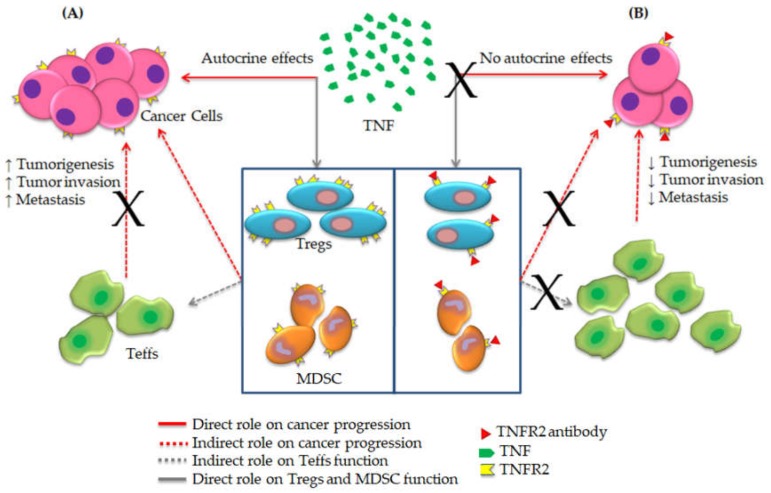
Figure 1
Figure 1
The blockade mechanism of TNF-TNFR2 axis towards effective cancer immunotherapy. (A) TNFR2 is expressed on cancer cells and suppressive immune cells, including regulatory T cells (Tregs) and myeloid-derived suppressor cells (MDSCs). Binding of TNF to TNFR2 enhances cancer proliferation and immune evasion by expansion of Tregs and MDSCs along with the suppression of the immune response of effector T cells (Teffs). (B) Antibody blockade of TNFR2 inverts this mechanism and promotes effector functions against cancer (Amended from Al-Hatamleh et al., 2019 [16]).
Figure 2
Figure 2
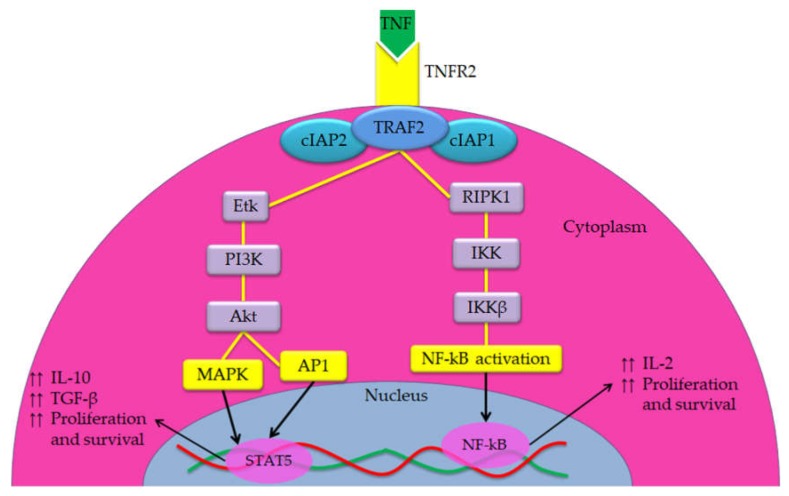
Overview of the TNF-TNFR2 signaling pathway. In both cancer cell and immunosuppressive cells, TNFR2 is activated by both soluble TNF (sTNF) and membrane-bound TNF (mTNF) but it is fully activated by mTNF. TNFR2 does not interact with an intracellular DD, while it interacts with complex I that consists of TRAF2 with cIAP1 and cIAP2 and induction of homeostatic signals. The signals travel from complex I either via receptor-interacting serine/threonine-protein kinase 1 (RIPK1) or Etk (a member of the Btk tyrosine kinase family). RIPK1 trigger NF-κB via the IkB kinase (IKK) complex, which results in increasing the transcription of several genes associated positively with cell survival and proliferation. However, the Etk, through the PI3K/Akt pathway, is able to activate both AP1 and MAPK signaling pathways, which activate the promoter of proliferation, survival and other transcription factors. Further, it is associated with enhancing the phosphorylation of STAT5 that play a crucial role in immunosuppression.
Figure 3
Figure 3
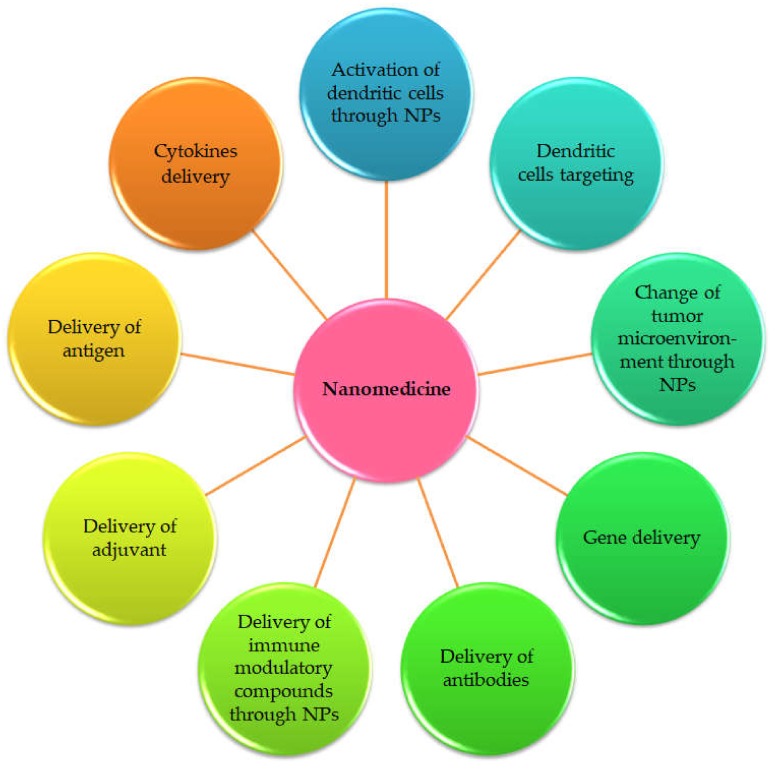
Nanomedicine strategies to improve cancer immunotherapy as suggested by Qiu et al., 2017 [12].
Figure 4
Figure 4
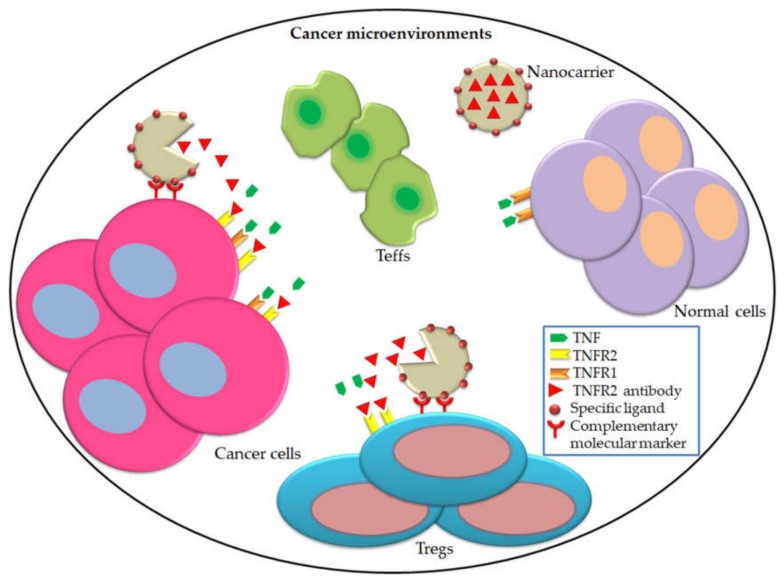
Nanoparticles-targeting TNFR2 exhibit their effects on cancer cells and Tregs. We hypothesized that based on the ability of nanoparticles with specific ligands to targeting cancer cells, it is possible to incorporate TNFR2 antibodies with this kind of nanoparticles. Consequently, TNFR2 antibodies will be released at the cancer microenvironment, which is in turn, will blockade TNFR2 on cancer cells and Tregs. This modulation will result in suppressing Tregs and activate Teffs, thus less tumorigenesis, tumor invasion and metastasis.
Figure 5
Figure 5
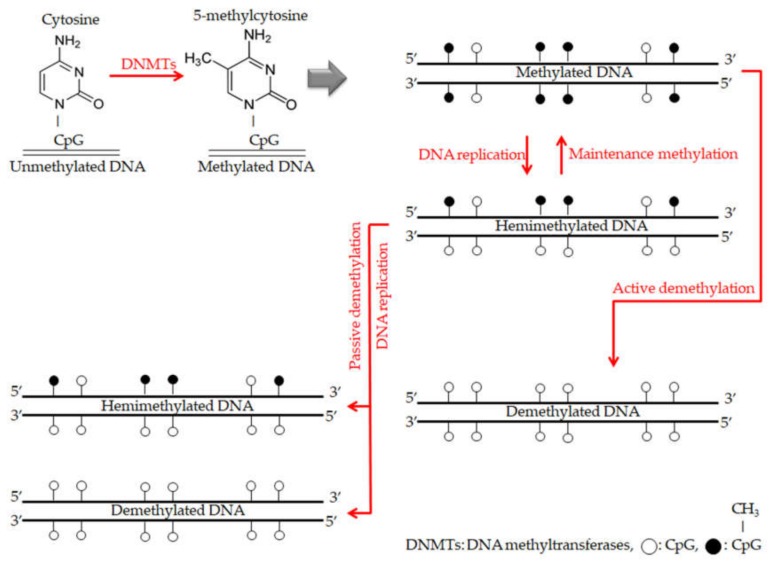
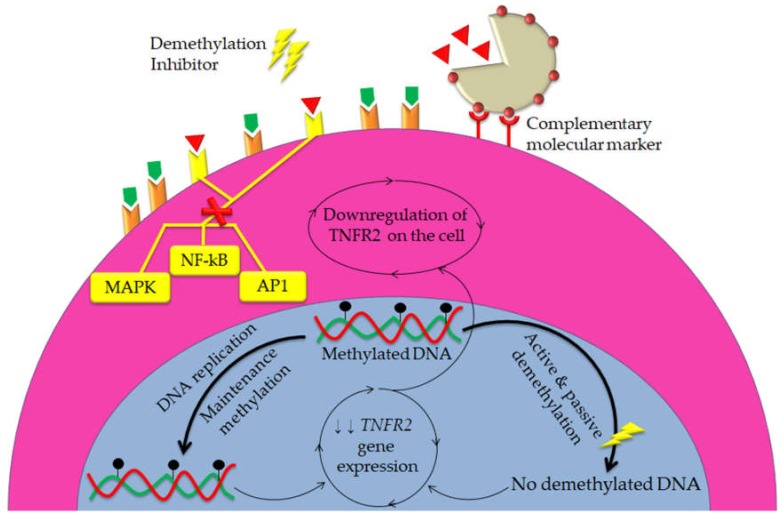
The overall description for mechanisms of DNA methylation and demethylation. During DNA methylation, DNA methyltransferases (DNMTs) enzymes are responsible for adding methyl groups to specific CpG islands and establishing DNA methylation patterns. With each DNA replication round, there is a new strand of unmethylated DNA. Thus the new double strand DNA becomes hemimethylated. Furthermore, maintenance methylation process by DNMT1 enzyme leads to copy that DNA methylation pattern from the old strand onto the new strand. On the other hand, during DNA demethylation, maintenance methylation process finishing with remarkably failing, which leads to stopping DNA methylation patterns (passive demethylation). While, active demethylation achieving by specific enzymes have not been explicitly explored and results in modifying methylated cytosines to only cytosines without methyl groups and independently of DNA replication [75].
Figure 6
Figure 6
NPs are hypothesized to be utilized synergistically with DNA demethylation inhibitors to stronger blockade of TNFR2 signals in both cancer cells and immunosuppressive cells. Owning to their ability to target specific cellular sites, NPs with specific ligands can deliver TNFR2 antibodies to cancer cells and immunosuppressive cells only, which in turn stop TNFR2 intracellular signal pathways. Meanwhile, using DNA demethylation inhibitors might lead to epigenetic alteration results in decrease the expression of TNFR2 gene, thus downregulation of TNFR2. Consequently, combination of these two strategies might extend the anti-tumor effects of TNFR2 antibodies with more precision in immunotherapy.

References

    1. Aggarwal B.B., Gupta S.C., Kim J.H. Historical perspectives on tumor necrosis factor and its superfamily: 25 years later, a golden journey. Blood. 2012;119:651–665. doi: 10.1182/blood-2011-04-325225. - DOI - PMC - PubMed
    1. Sedger L.M., McDermott M.F. TNF and TNF-receptors: From mediators of cell death and inflammation to therapeutic giants–past, present and future. Cytokine Growth Factor Rev. 2014;25:453–472. doi: 10.1016/j.cytogfr.2014.07.016. - DOI - PubMed
    1. Ahmad S., Azid N.A., Boer J.C., Lim J., Chen X., Plebanski M., Mohamud R. The Key Role of TNF-TNFR2 Interactions in the Modulation of Allergic Inflammation: A Review. Front. Immunol. 2018;9:2572. doi: 10.3389/fimmu.2018.02572. - DOI - PMC - PubMed
    1. Coussens L.M., Werb Z. Inflammation and cancer. Nature. 2002;420:860–867. doi: 10.1038/nature01322. - DOI - PMC - PubMed
    1. Ham B., Fernandez M.C., D’Costa Z., Brodt P. The diverse roles of the TNF axis in cancer progression and metastasis. Trends Cancer Res. 2016;11:1–27. - PMC - PubMed

Publication types

MeSH terms

Substances

LinkOut - more resources