. 2019 Dec 24;12(1):55.
doi: 10.3390/cancers12010055.

Single Nucleotide Polymorphism rs6942067 Is a Risk Factor in Young and in Non-Smoking Patients with HPV Negative Head and Neck Squamous Cell Carcinoma

Affiliations

Single Nucleotide Polymorphism rs6942067 Is a Risk Factor in Young and in Non-Smoking Patients with HPV Negative Head and Neck Squamous Cell Carcinoma

Guillaume B Cardin et al. Cancers (Basel). .

Abstract

Genetic factors behind the increasing incidence of human papillomavirus (HPV) negative head and neck squamous cell carcinoma (HNSCC) in young non-smokers are suspected, but have not been identified. Recently, rs6942067, a single nucleotide polymorphism (SNP) located upstream of the DCBLD1 gene, was found associated with non-smoking lung adenocarcinoma. To validate if this SNP is also implicated in HNSCC, participants of The Cancer Genome Atlas HNSCC cohort were investigated for rs6942067 status, associated DCBLD1 expression, and clinical characteristics. Occurrence of the rs6942067 GG genotype is significantly higher in young and in HPV negative non-smoking HNSCC than in other HNSCC. Additionally, rs6942067 GG is associated with higher DCBLD1 expression in HNSCC and patients with high DCBLD1 expression have a worse overall survival at three years, both in univariate and multivariate analysis. Furthermore, high DCBLD1 expression is associated with activation of the integrin signaling pathway and its phosphorylation with EGFR and MET. Collectively, these findings suggest that DCBLD1 plays a critical role in HNSCC and demonstrate an association between rs6942067 and clinical characteristics of young age and HPV negative non-smoking status in HNSCC patients.

Keywords: DCBLD1; cancer susceptibility genes; head and neck squamous cell carcinoma; human papillomavirus; rs6942067; tobacco.


Conflict of interest statement

The authors declare no conflicts of interest.

Figures
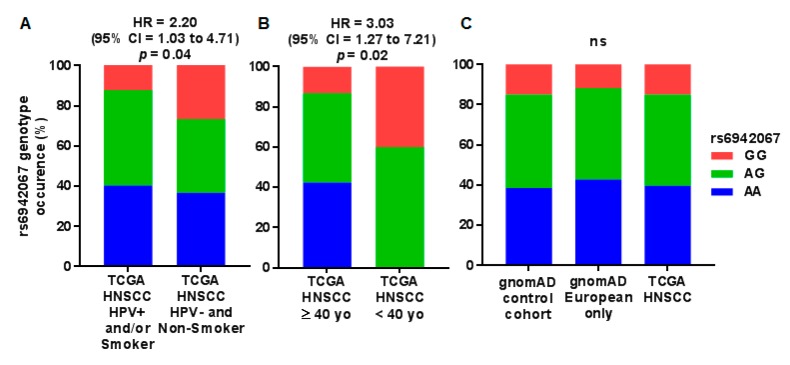
Figure 1
Figure 1
rs6942067 genotype status in the Cancer TCGA HNSCC cohort and the gnomAD cohort. Comparison of rs6942067 genotype for (A) HPV positive and/or smoking patients (n = 124) and non-smoker and HPV negative patients (n = 30) of the TCGA HNSCC cohort; (B) ≥40 years old (n = 144) and <40 years old (n = 10) patients of the TCGA HNSCC cohort; and (C) all participants of the gnomAD cohort (n = 15,654), European participant of the gnomAD cohort (n = 9431), and patients of the TCGA HNSCC cohort. Only 154 patients had whole genome sequencing data for the TCGA HNSCC cohort. Relative risk and p values are for a Pearson’s chi-square test and a recessive model of penetrance.
Figure 2
Figure 2
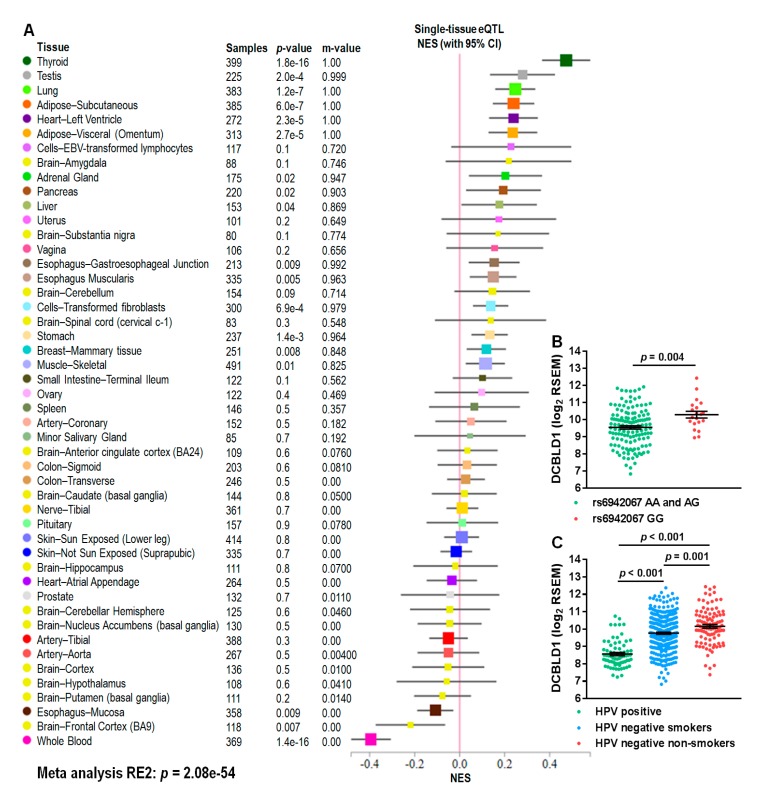
DCBLD1 gene expression, rs6942067, and HNSCC risk factors. (A) Multi-tissue expression quantitative trait locus analysis of rs6942067 and DCBLD1 using the GTEx project and the Han and Eskin’s random effects model (RE2). (B,C) Comparison of DCBLD1 gene expression for (B) rs6942067 AA and AG (n = 135) or rs6940267 GG (n = 20) and (C) HPV positive (green, n = 71), HPV negative smokers (blue, n = 334), or HPV negative non-smokers (red, n = 101) patients of the TCGA HNSCC cohort. Mean and standard error are shown.
Figure 3
Figure 3
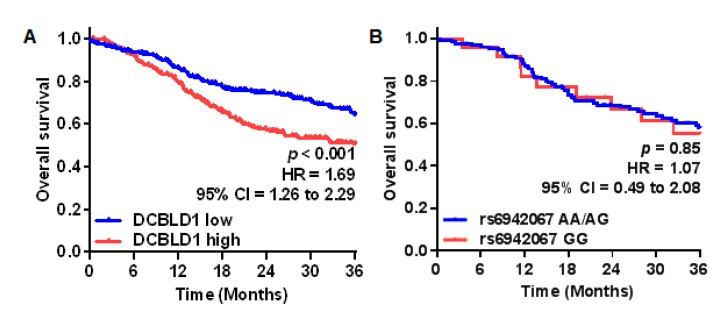
DCBLD1 gene expression, rs6942067, and HNSCC overall survival comparison for HNSCC patients of the TCGA cohort using the Kaplan–Meier curve estimation for (A) tumor low (blue, n = 258) and high (red, n = 259) DCBLD1 gene expression; and for (B) rs6942067 AA and AG (blue, n = 131) versus rs6942067 GG (red, n = 23). p values were calculated using a two-sided log-rank test.
Figure 4
Figure 4
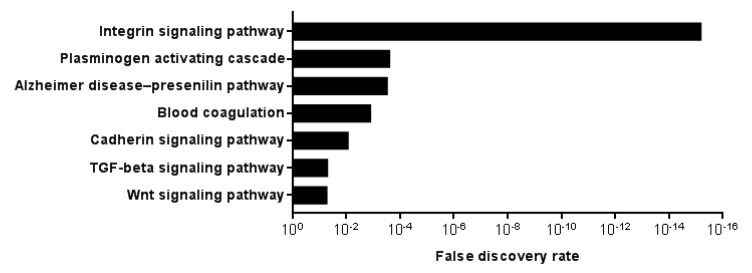
Significantly enriched PANTHER pathways in the higher (n = 25) versus lower (n = 25) DCBLD1 expressing participants from the HNSCC TCGA cohort. p values for significance cut-off was calculated using Bonferroni correction. No pathway was significantly enriched in the lower DCBLD1 participants.
Figure 5
Figure 5
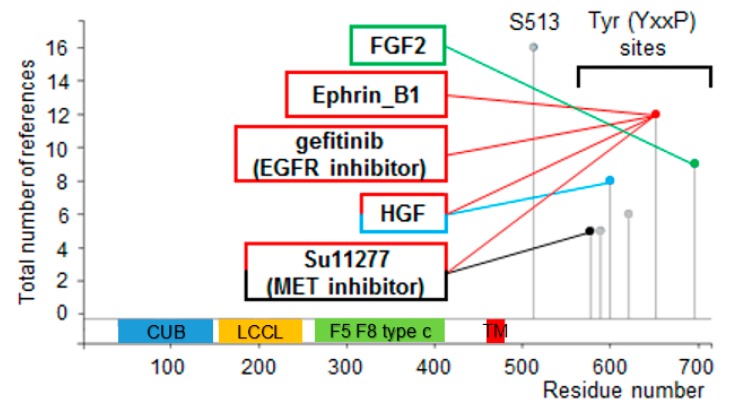
Phosphoproteomic bioinformatical analysis of the DCBLD1 protein. PhosphoSitePlus® analysis shows one frequently detected S513 phosphorylation site of unknown function and six YxxP sites. Four of the six sites are linked with three different receptor tyrosine kinases.

References

    1. Bray F., Ferlay J., Soerjomataram I., Siegel R.L., Torre L.A., Jemal A. Global cancer statistics 2018: GLOBOCAN estimates of incidence and mortality worldwide for 36 cancers in 185 countries. CA Cancer J. Clin. 2018;68:394–424. doi: 10.3322/caac.21492. - DOI - PubMed
    1. Maier H., Dietz A., Gewelke U., Heller W.D., Weidauer H. Tobacco and alcohol and the risk of head and neck cancer. Clin. Investig. 1992;70:320–327. doi: 10.1007/BF00184668. - DOI - PubMed
    1. Ragin C.C., Modugno F., Gollin S.M. The epidemiology and risk factors of head and neck cancer: A focus on human papillomavirus. J. Dent. Res. 2007;86:104–114. doi: 10.1177/154405910708600202. - DOI - PubMed
    1. Goldenberg D., Lee J., Koch W.M., Kim M.M., Trink B., Sidransky D., Moon C.S. Habitual risk factors for head and neck cancer. Otolaryngol. Head Neck Surg. 2004;131:986–993. doi: 10.1016/j.otohns.2004.02.035. - DOI - PubMed
    1. Jin Y.T., Myers J., Tsai S.T., Goepfert H., Batsakis J.G., el-Naggar A.K. Genetic alterations in oral squamous cell carcinoma of young adults. Oral Oncol. 1999;35:251–256. doi: 10.1016/S1368-8375(98)00112-2. - DOI - PubMed