


Hadrontherapy Interactions in Molecular and Cellular Biology
- PMID: 31878191
- PMCID: PMC6981652
- DOI: 10.3390/ijms21010133
Hadrontherapy Interactions in Molecular and Cellular Biology
Abstract
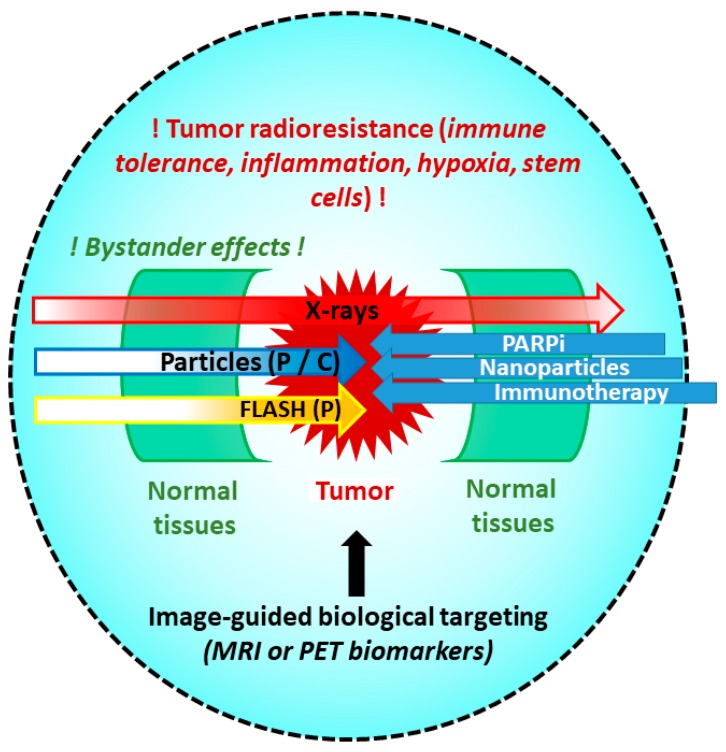
The resistance of cancer cells to radiotherapy is a major issue in the curative treatment of cancer patients. This resistance can be intrinsic or acquired after irradiation and has various definitions, depending on the endpoint that is chosen in assessing the response to radiation. This phenomenon might be strengthened by the radiosensitivity of surrounding healthy tissues. Sensitive organs near the tumor that is to be treated can be affected by direct irradiation or experience nontargeted reactions, leading to early or late effects that disrupt the quality of life of patients. For several decades, new modalities of irradiation that involve accelerated particles have been available, such as proton therapy and carbon therapy, raising the possibility of specifically targeting the tumor volume. The goal of this review is to examine the up-to-date radiobiological and clinical aspects of hadrontherapy, a discipline that is maturing, with promising applications. We first describe the physical and biological advantages of particles and their application in cancer treatment. The contribution of the microenvironment and surrounding healthy tissues to tumor radioresistance is then discussed, in relation to imaging and accurate visualization of potentially resistant hypoxic areas using dedicated markers, to identify patients and tumors that could benefit from hadrontherapy over conventional irradiation. Finally, we consider combined treatment strategies to improve the particle therapy of radioresistant cancers.
Keywords: cancer; hadrontherapy; hypoxia; particle therapy; radioresistance.
Conflict of interest statement
The authors declare no conflict of interest.
Figures
References
-
- Munzenrider J.E., Verhey L.J., Gragoudas E.S., Seddon J.M., Urie M., Gentry R., Birnbaum S., Ruotolo D.M., Crowell C., McManus P. Conservative treatment of uveal melanoma: Local recurrence after proton beam therapy. Int. J. Radiat. Oncol. Biol. Phys. 1989;17:493–498. doi: 10.1016/0360-3016(89)90099-0. - DOI - PubMed
Publication types
MeSH terms
LinkOut - more resources
Full Text Sources
Medical
