


Development of Systems for the Production of Plant-Derived Biopharmaceuticals
- PMID: 31878277
- PMCID: PMC7020158
- DOI: 10.3390/plants9010030
Development of Systems for the Production of Plant-Derived Biopharmaceuticals
Abstract
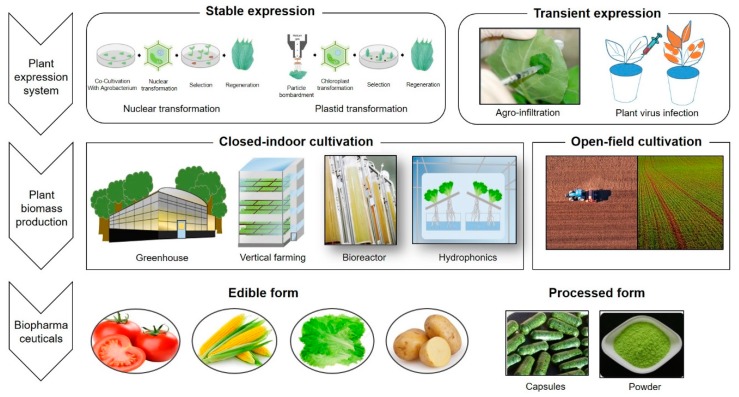
Over the last several decades, plants have been developed as a platform for the production of useful recombinant proteins due to a number of advantages, including rapid production and scalability, the ability to produce unique glycoforms, and the intrinsic safety of food crops. The expression methods used to produce target proteins are divided into stable and transient systems depending on applications that use whole plants or minimally processed forms. In the early stages of research, stable expression systems were mostly used; however, in recent years, transient expression systems have been preferred. The production of the plant itself, which produces recombinant proteins, is currently divided into two major approaches, open-field cultivation and closed-indoor systems. The latter encompasses such regimes as greenhouses, vertical farming units, cell bioreactors, and hydroponic systems. Various aspects of each system will be discussed in this review, which focuses mainly on practical examples and commercially feasible approaches.
Keywords: expression system; molecular farming; plant-derived protein; production system; recombinant protein.
Conflict of interest statement
The authors have no conflicts of interest to declare.
Figures
References
-
- Fischer R., Drossard J., Commandeur U., Schillberg S., Emans N. Towards molecular farming in the future: Moving from diagnostic protein and antibody production in microbes to plants. Biotechnol. Appl. Biochem. 1999;30:101–108. - PubMed
-
- Fischer R., Schillberg S. Molecular Farming: Plant-Made Pharmaceuticals and Technical Proteins. John Wiley & Sons; Hoboken, NJ, USA: 2004.
Publication types
LinkOut - more resources
Full Text Sources
