Review
. 2019 Dec 26;17(1):110.
doi: 10.1186/s12958-019-0550-3.

Tracking research trends and hotspots in sperm DNA fragmentation testing for the evaluation of male infertility: a scientometric analysis

Affiliations
Review

Tracking research trends and hotspots in sperm DNA fragmentation testing for the evaluation of male infertility: a scientometric analysis

Saradha Baskaran et al. Reprod Biol Endocrinol. .

Abstract

Background: This article describes the research trends in sperm DNA fragmentation (SDF) over the past 20 years (1999-2018) using a scientometric approach.

Methods: A stepwise approach was adopted to retrieve scientometric data (articles per year, authors, affiliations, journals, countries) from Scopus and analyze the publication pattern of SDF with reference to key areas of research in the field of Andrology.

Results: A total of 2121 articles were retrieved related to SDF. Our data revealed an increasing research trend in SDF (n = 33 to n = 173) over the past 20 years (R2 = 0.894). Most productive country in publications was the USA (n = 450), while Agarwal A. (n = 129) being the most productive author. Most of the articles in SDF were primarily focused on lifestyle (n = 157), asthenozoospermia (n = 135) and varicocele (130). Mechanistic studies on SDF were published twice as much as prognostic/diagnostic studies, with significant emphasis on oxidative stress. Terminal deoxynucleotidyl transferase dUTP nick end labeling (TUNEL) was the most widely used technique to evaluate SDF. Publications on SDF related to assisted reproductive techniques also showed a linear increasing trend (R2 = 0.933).

Conclusions: Our analysis revealed an increasing trend in SDF publications predominantly investigating lifestyle, asthenozoospermia and varicocele conditions with TUNEL being the most widely used technique. A substantial increase in research is warranted to establish SDF as prognostic/diagnostic parameter to evaluate clinical scenarios and ART outcomes.

Keywords: DNA fragmentation; Diagnosis; Infertility, male; Prognosis; Publications; Scientometric analysis.


Conflict of interest statement

The authors declare that they have no competing interests.

Figures
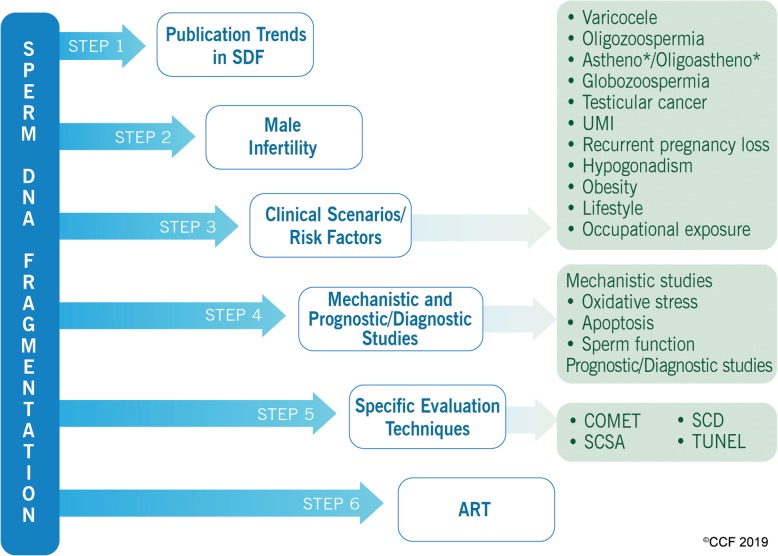
Fig. 1
Fig. 1
Flow diagram depicting the stepwise analysis of publication trends in SDF. Subcategory “Astheno*/Oligoastheno*” includes articles on asthenozoospermia, asthenoteratozoospermia, oligoasthenozoospermia, and oligoasthenoteratozoospermia. UMI: unexplained male infertility, SCSA: sperm chromatin structure assay, SCD: sperm chromatin dispersion test, TUNEL: terminal deoxynucleotidyl transferase dUTP nick end labeling, ART: artificial reproductive techniques
Fig. 2
Fig. 2
a Publication trends in SDF-based research over the past 20 years. b Analysis of the research trends based on types of publication. c Top 10 institutions based on the publications in SDF (1999–2018). d Contour/Heat map showing the publications in SDF (1999–2018). e International collaborations in SDF research. f Analysis of the research trends based on the origin of publications across the globe. g Contour/Heat map showing the top scientist working in the area of SDF. Heat map 2d and 2g shows gradient heat pattern (red, orange, yellow, green and blue) based on the number of publications from journal and author, respectively. The font size of the journal and author names are presented in an ascending manner with respect to an increasing number of publications. Only the names of journals and authors having higher number of publications are visible
Fig. 3
Fig. 3
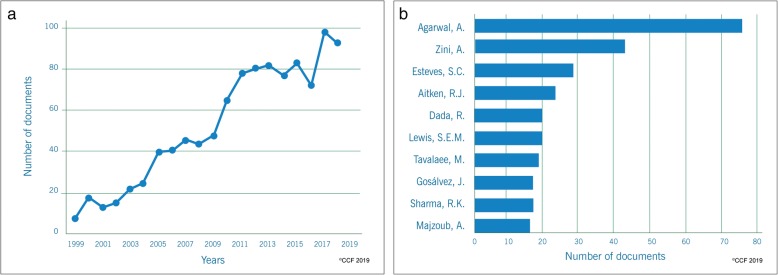
a Research trends on SDF-associated male infertility studies. b Top scientist investigating the role of SDF in male infertility
Fig. 4
Fig. 4
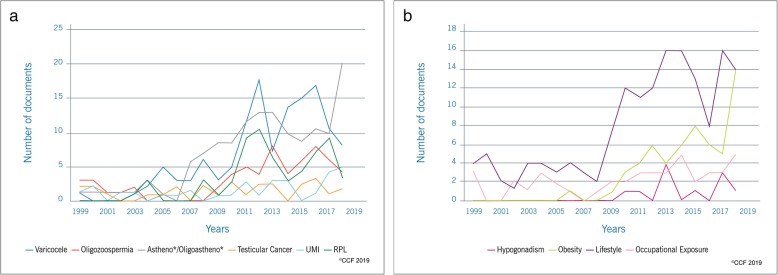
a Publication trends on SDF based research on varicocele, oligozoospermia, Astheno*/Oligoastheno*, testicular cancer, unexplained male infertility (UMI), recurrent pregnancy loss (RPL). Astheno*/Oligoastheno* includes articles on asthenozoospermia, asthenoteratozoospermia, oligoasthenozoospermia, and oligoasthenoteratozoospermia. b Publication trends on SDF-based research on hypogonadism, obesity, lifestyle and occupational exposure
Fig. 5
Fig. 5
Publication trends in mechanistic studies and prognostic/diagnostic studies on SDF
Fig. 6
Fig. 6
Publication trend in SDF using TUNEL/SCSA/Comet/SCD between1999–2018
Fig. 7
Fig. 7
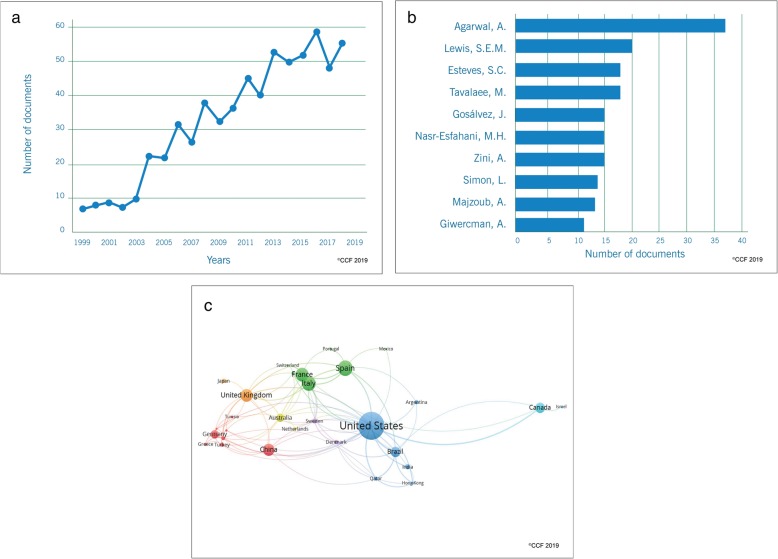
a Publication trend in SDF-based ART studies between1999–2018. b Top scientist involved in SDF-based ART studies. c SDF-based ART studies: Collaboration network

References

    1. Agarwal A, et al. A unique view on male infertility around the globe. Reprod Biol Endocrinol. 2015;13(1):37. doi: 10.1186/s12958-015-0032-1. - DOI - PMC - PubMed
    1. Sharlip ID, et al. Best practice policies for male infertility. Fertil Steril. 2002;77(5):873–882. doi: 10.1016/S0015-0282(02)03105-9. - DOI - PubMed
    1. Wang C, Swerdloff RS. Limitations of semen analysis as a test of male fertility and anticipated needs from newer tests. Fertil Steril. 2014;102(6):1502–1507. doi: 10.1016/j.fertnstert.2014.10.021. - DOI - PMC - PubMed
    1. Braude P, Bolton V, Moore S. Human gene expression first occurs between the four- and eight-cell stages of preimplantation development. Nature. 1988;332:459–461. doi: 10.1038/332459a0. - DOI - PubMed
    1. Evenson DP, Darzynkiewicz Z, Melamed MR. Comparison of human and mouse sperm chromatin structure by flow cytometry. Chromosoma. 1980;78(2):225–238. doi: 10.1007/BF00328394. - DOI - PubMed