Review
. 2020 Mar;26(3):229-239.
doi: 10.1261/rna.073601.119. Epub 2019 Dec 26.

The landscape of eukaryotic mRNPs

Affiliations
Review

The landscape of eukaryotic mRNPs

Anthony Khong et al. RNA. 2020 Mar.

Abstract

The proper regulation of mRNA processing, localization, translation, and degradation occurs on mRNPs. However, the global principles of mRNP organization are poorly understood. We utilize the limited, but existing, information available to present a speculative synthesis of mRNP organization with the following key points. First, mRNPs form a compacted structure due to the inherent folding of RNA. Second, the ribosome is the principal mechanism by which mRNA regions are partially decompacted. Third, mRNPs are 50%-80% protein by weight, consistent with proteins modulating mRNP organization, but also suggesting the majority of mRNA sequences are not directly interacting with RNA-binding proteins. Finally, the ratio of mRNA-binding proteins to mRNAs is higher in the nucleus to allow effective RNA processing and limit the potential for nuclear RNA based aggregation. This synthesis of mRNP understanding provides a model for mRNP biogenesis, structure, and regulation with multiple implications.


Figures

FIGURE 1.
FIGURE 1.
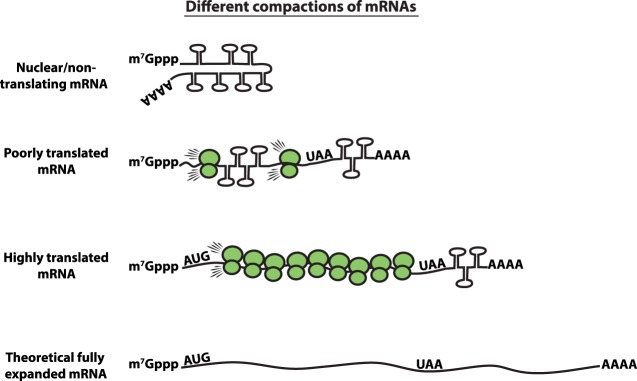
Schematic of the different levels of compaction of mRNAs. (i) Nuclear and nontranslating mRNAs represent the most compact form. (ii) Ribosomes decompact the mRNA by unfolding the mRNA. (iii) mRNAs that are more engaged in translation (more ribosomes loaded) are more decompact than mRNAs that are not as well translated. (iv) Finally, the theoretical fully expanded mRNA.
FIGURE 2.
FIGURE 2.
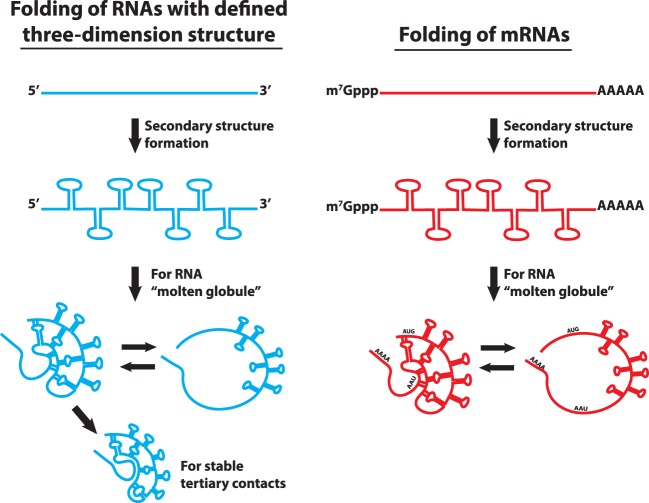
Stepwise ncRNA folding versus mRNA folding. RNA has a propensity to fold into secondary structures rapidly forming a “molten globule” state. Functional ncRNAs which have defined tertiary interactions, enable further compaction into specific structures. In contrast, mRNA lacking defined tertiary interactions stays in a “molten globule” state.
FIGURE 3.
FIGURE 3.
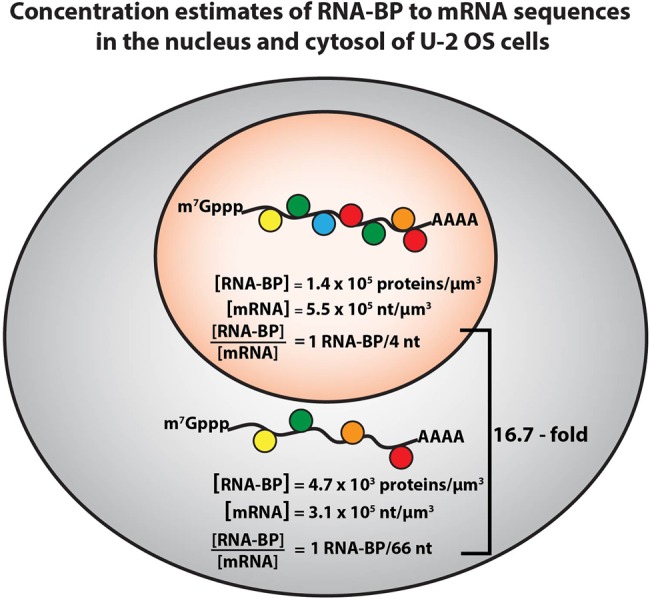
Estimates of mRNA and RNA-BP concentrations in the nucleus and the cytoplasm. The estimates are derived from analyzing a number of data sets (Alberts 2002; Beck et al. 2011; Wühr et al. 2015; Piovesan et al. 2016; Khong et al. 2017) (see Supplemental Calculation #1). RNA-BPs are estimated to be ∼30-fold more concentrated in the nucleus than in the cytosol in U-2 OS cells. mRNA (in terms of RNA nucleotides) is ∼1.8-fold more concentrated in the nucleus than in the cytosol. Therefore, the ratio of RNA-BPs to mRNA sequences is higher in the nucleus than the cytoplasm (∼16.7-fold more RNA-BPs per nucleotide).
FIGURE 4.
FIGURE 4.
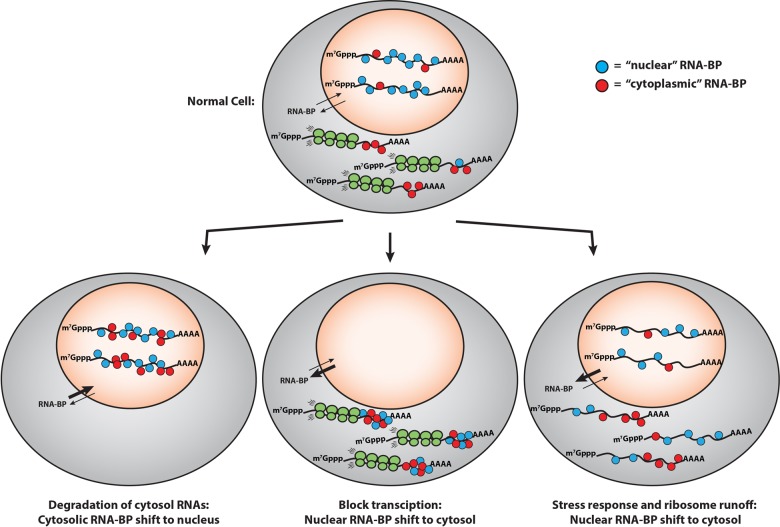
The shuttling of RNA-BPs between the nucleus and the cytoplasm is highly dependent on mRNA concentration in the nucleus and the cytoplasm. (i) When mRNAs in the cytoplasm are degraded by viral ribonucleases or RNase L, a rapid accumulation of cytoplasmic RNA-BPs in the nucleus has been observed (Clyde and Glaunsinger 2010; Gilbertson et al. 2018; Burke et al. 2019). (ii) Similarly, when transcription is blocked, many nuclear RNA-BPs accumulate in the cytoplasm (Hamilton et al. 1997). (iii) Finally, when ribosomes run-off mRNAs due to cellular stress and expose the ORF, several nuclear RNA-BPs move to the cytosol (Kedersha et al. 1999).

References

    1. Adivarahan S, Livingston N, Nicholson B, Rahman S, Wu B, Rissland OS, Zenklusen D. 2018. Spatial organization of single mRNPs at different stages of the gene expression pathway. Mol Cell 72: 727–738.e725. 10.1016/j.molcel.2018.10.010 - DOI - PMC - PubMed
    1. Alberts B. 2002. Molecular biology of the cell. Garland Science, New York.
    1. Arava Y, Wang Y, Storey JD, Liu CL, Brown PO, Herschlag D. 2003. Genome-wide analysis of mRNA translation profiles in Saccharomyces cerevisiae. Proc Natl Acad Sci 100: 3889–3894. 10.1073/pnas.0635171100 - DOI - PMC - PubMed
    1. Arava Y, Boas FE, Brown PO, Herschlag D. 2005. Dissecting eukaryotic translation and its control by ribosome density mapping. Nucleic Acids Res 33: 2421–2432. 10.1093/nar/gki331 - DOI - PMC - PubMed
    1. Aw JG, Shen Y, Wilm A, Sun M, Lim XN, Boon KL, Tapsin S, Chan YS, Tan CP, Sim AY, et al. 2016. In vivo mapping of eukaryotic RNA interactomes reveals principles of higher-order organization and regulation. Mol Cell 62: 603–617. 10.1016/j.molcel.2016.04.028 - DOI - PubMed

Publication types

MeSH terms

LinkOut - more resources