


Structured Chart Review: Assessment of a Structured Chart Review Methodology
- PMID: 31879317
- PMCID: PMC6931034
- DOI: 10.1542/hpeds.2019-0225
Structured Chart Review: Assessment of a Structured Chart Review Methodology
Abstract
Background and objectives: Chart reviews are frequently used for research, care assessments, and quality improvement activities despite an absence of data on reliability and validity. We aim to describe a structured chart review methodology and to establish its validity and reliability.
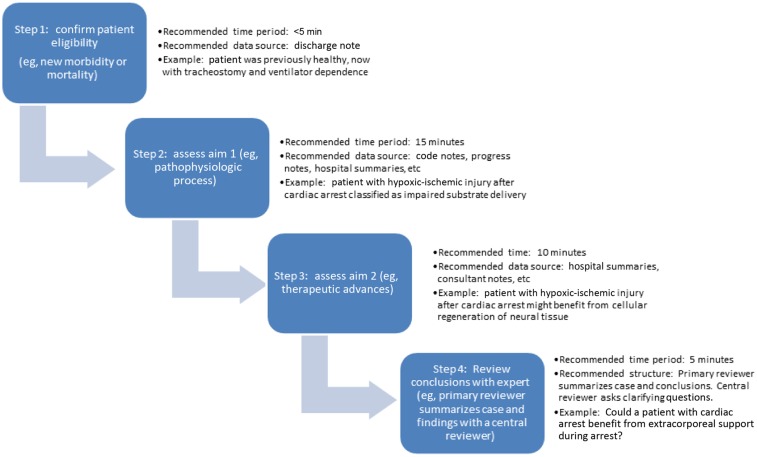
Methods: A generalizable structured chart review methodology was designed to evaluate causes of morbidity or mortality and to identify potential therapeutic advances. The review process consisted of a 2-tiered approach with a primary review completed by a site physician and a short secondary review completed by a central physician. A total of 327 randomly selected cases of known mortality or new morbidities were reviewed. Validity was assessed by using postreview surveys with a Likert scale. Reliability was assessed by percent agreement and interrater reliability.
Results: The primary reviewers agreed or strongly agreed in 94.9% of reviews that the information to form a conclusion about pathophysiological processes and therapeutic advances could be adequately found. They agreed or strongly agreed in 93.2% of the reviews that conclusions were easy to make, and confidence in the process was 94.2%. Secondary reviewers made modifications to 36.6% of cases. Duplicate reviews (n = 41) revealed excellent percent agreement for the causes (80.5%-100%) and therapeutic advances (68.3%-100%). κ statistics were strong for the pathophysiological categories but weaker for the therapeutic categories.
Conclusions: A structured chart review by knowledgeable primary reviewers, followed by a brief secondary review, can be valid and reliable.
Copyright © 2020 by the American Academy of Pediatrics.
Conflict of interest statement
POTENTIAL CONFLICT OF INTEREST: The authors have indicated they have no potential conflicts of interest to disclose.
Figures
References
-
- de Vries EN, Eikens-Jansen MP, Hamersma AM, Smorenburg SM, Gouma DJ, Boermeester MA. Prevention of surgical malpractice claims by use of a surgical safety checklist. Ann Surg. 2011;253(3):624–628 - PubMed
-
- Klasco RS, Wolfe RE, Lee T, et al. Can medical record reviewers reliably identify errors and adverse events in the ED? Am J Emerg Med. 2016;34(6):1043–1048 - PubMed
-
- Brennan TA, Localio AR, Leape LL, et al. Identification of adverse events occurring during hospitalization. A cross-sectional study of litigation, quality assurance, and medical records at two teaching hospitals. Ann Intern Med. 1990;112(3):221–226 - PubMed
-
- Allison JJ, Wall TC, Spettell CM, et al. The art and science of chart review. Jt Comm J Qual Improv. 2000;26(3):115–136 - PubMed
-
- Gilbert EH, Lowenstein SR, KozioI-McLain J, Barta DC, Steiner J. Chart reviews in emergency medicine research: where are the methods? Ann Emerg Med. 1996;27(3):305–308 - PubMed
Publication types
MeSH terms
Grants and funding
- P2C HD047879/HD/NICHD NIH HHS/United States
- UG1 HD083166/HD/NICHD NIH HHS/United States
- U10 HD049981/HD/NICHD NIH HHS/United States
- UG1 HD083170/HD/NICHD NIH HHS/United States
- U01 HD049934/HD/NICHD NIH HHS/United States
- U10 HD050096/HD/NICHD NIH HHS/United States
- U10 HD063114/HD/NICHD NIH HHS/United States
- UG1 HD050096/HD/NICHD NIH HHS/United States
- U10 HD050012/HD/NICHD NIH HHS/United States
- UG1 HD083171/HD/NICHD NIH HHS/United States
- U10 HD049983/HD/NICHD NIH HHS/United States
- RL1 HD107773/HD/NICHD NIH HHS/United States
- U10 HD063108/HD/NICHD NIH HHS/United States
LinkOut - more resources
Full Text Sources
