The Trend in Incidence and Case-fatality of Hospitalized Acute Myocardial Infarction Patients in Korea, 2007 to 2016
- PMID: 31880418
- PMCID: PMC6935556
- DOI: 10.3346/jkms.2019.34.e322
The Trend in Incidence and Case-fatality of Hospitalized Acute Myocardial Infarction Patients in Korea, 2007 to 2016
Abstract
Background: The trend in the incidence of hospitalized acute myocardial infarction (AMI) and the difference between regions has not been reported in Korea since 2010. Thus, we aimed to inspect recent trends and regional differences in the incidence of AMI and case-fatality between 2007 and 2016.
Methods: Data from the medical utilization cohort from 2002 to 2016 were analyzed. New incidence of AMI was identified by checking the diagnosis code, duration of admission, type of test, treatment, and medication. Age-standardized incidence rate by gender, age group, and resident region was calculated from 2007 to 2016. Cumulative case-fatality rate was calculated until 3 years.
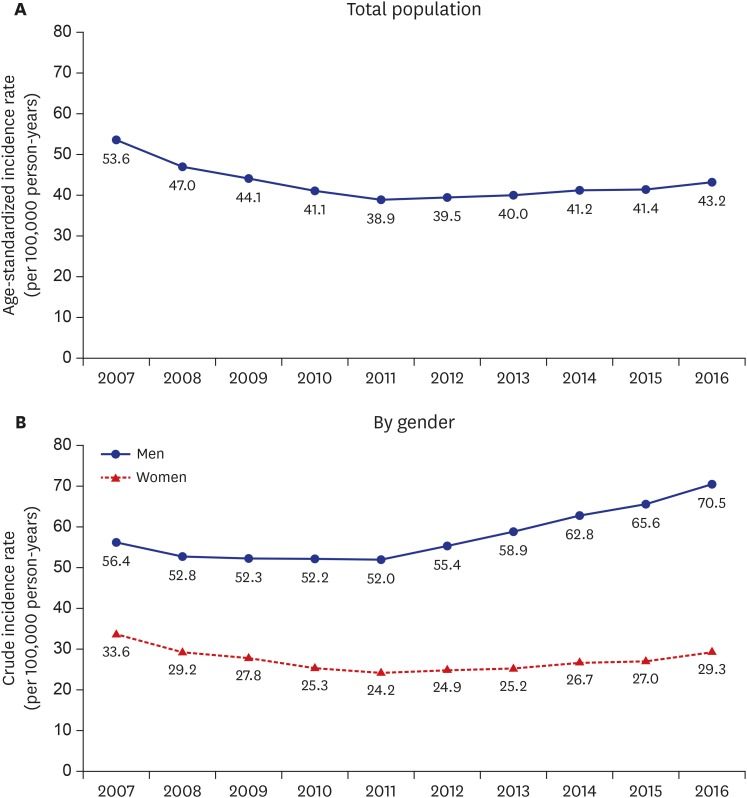
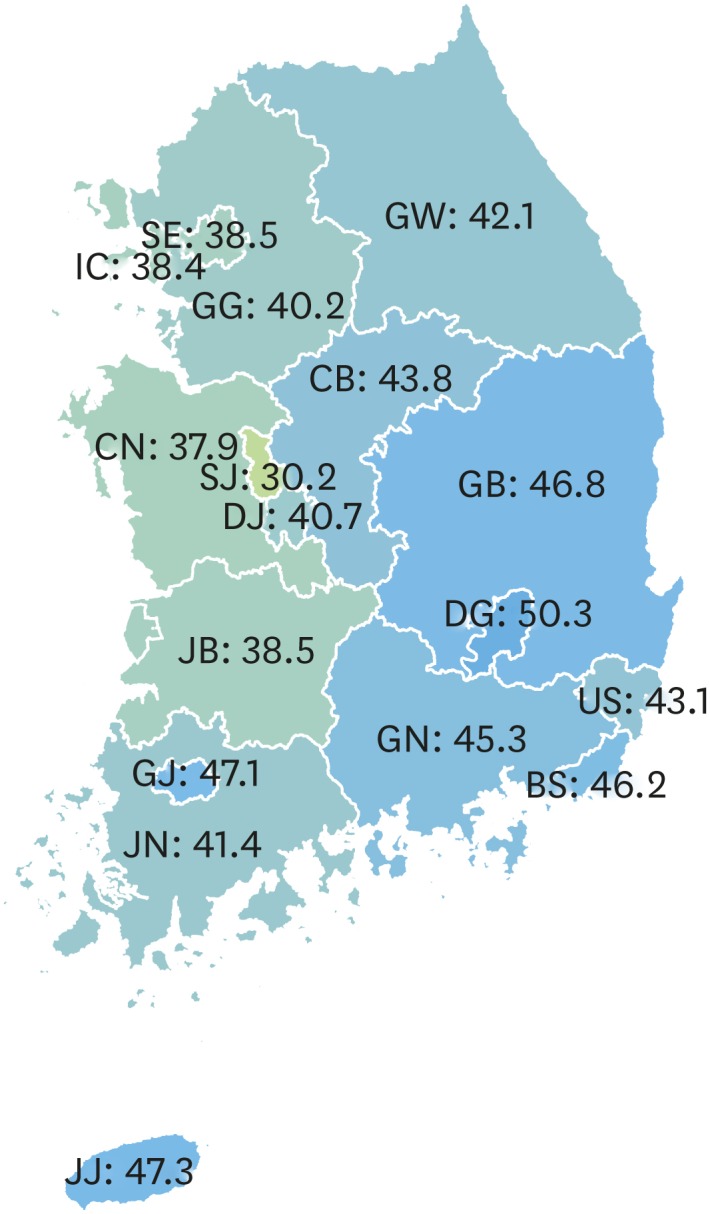
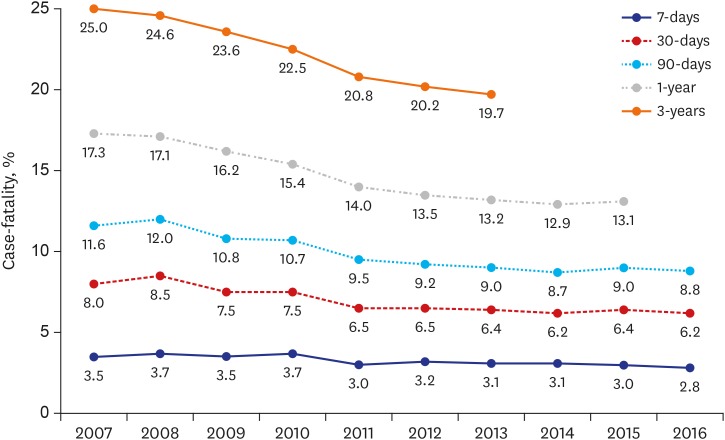
Results: Age-standardized incidence of hospitalized AMI decreased from 53.6 cases per 100,000 person-years in 2007 to 38.9 cases in 2011. Thereafter, the incidence gradually increased to 43.2 cases in 2016. The trend by gender and age groups was also similar to the total trend. The regional age-standardized incidence was the highest in Daegu (50.3 cases per 100,000 person-years) and the lowest in Sejong (30.2 cases), which were similar to the ischemic heart disease mortality in these regions. The 7-, 30-, and 90-days and 1- and 3-years average case-fatality over 10 years were 3.2%, 6.9%, 9.9%, 14.7%, and 22.4%, respectively.
Conclusion: Although case-fatality continuously decreased from 2007 to 2016, hospitalized AMI incidence decreased from 2007 to 2011 and gradually increased from 2011 to 2016, with marked disparity between regions. Effective preventive strategies to decrease AMI incidence are required to decrease cardiovascular disease mortality in Korea.
Keywords: Acute Myocardial Infarction; Case-Fatality; Incidence Rate; Regional Differences.
© 2019 The Korean Academy of Medical Sciences.
Conflict of interest statement
The authors have no potential conflicts of interest to disclose.
Figures
References
-
- World Health Organization. The top 10 causes of death. [Updated 2018]. [Accessed June 21, 2019]. https://www.who.int/news-room/fact-sheets/detail/the-top-10-causes-of-death.
-
- Korea National Statistical Office. 2017 The annual report on the cause of death statistics. [Updated 2018]. [Accessed June 21, 2019]. http://kostat.go.kr/portal/korea/kor_nw/1/1/index.board?bmode=read&bSeq=....
-
- Read SH, Fischbacher CM, Colhoun HM, Gasevic D, Kerssens JJ, McAllister DA, et al. Trends in incidence and case fatality of acute myocardial infarction, angina and coronary revascularisation in people with and without type 2 diabetes in Scotland between 2006 and 2015. Diabetologia. 2019;62(3):418–425. - PMC - PubMed
-
- Sulo G, Igland J, Vollset SE, Ebbing M, Egeland GM, Ariansen I, et al. Trends in incident acute myocardial infarction in Norway: an updated analysis to 2014 using national data from the CVDNOR project. Eur J Prev Cardiol. 2018;25(10):1031–1039. - PubMed
MeSH terms
Grants and funding
LinkOut - more resources
Full Text Sources
Medical