


Sex associations and computed tomography coronary angiography-guided management in patients with stable chest pain
- PMID: 31883330
- PMCID: PMC7109601
- DOI: 10.1093/eurheartj/ehz903
Sex associations and computed tomography coronary angiography-guided management in patients with stable chest pain
Abstract
Aims: The relative benefits of computed tomography coronary angiography (CTCA)-guided management in women and men with suspected angina due to coronary heart disease (CHD) are uncertain.
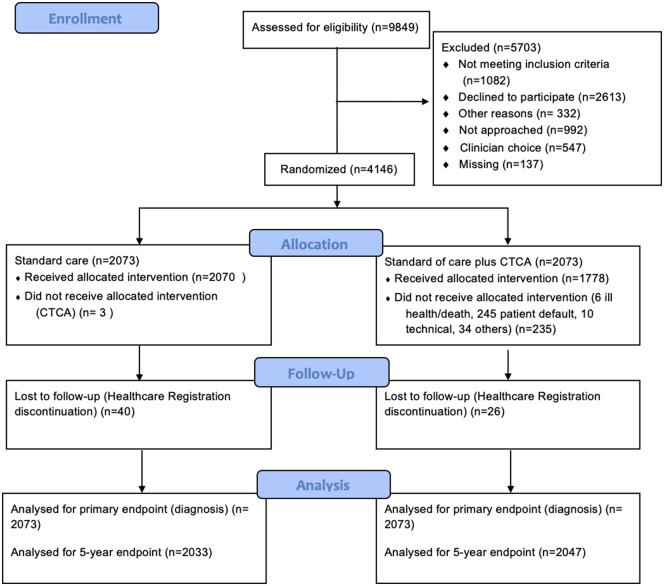
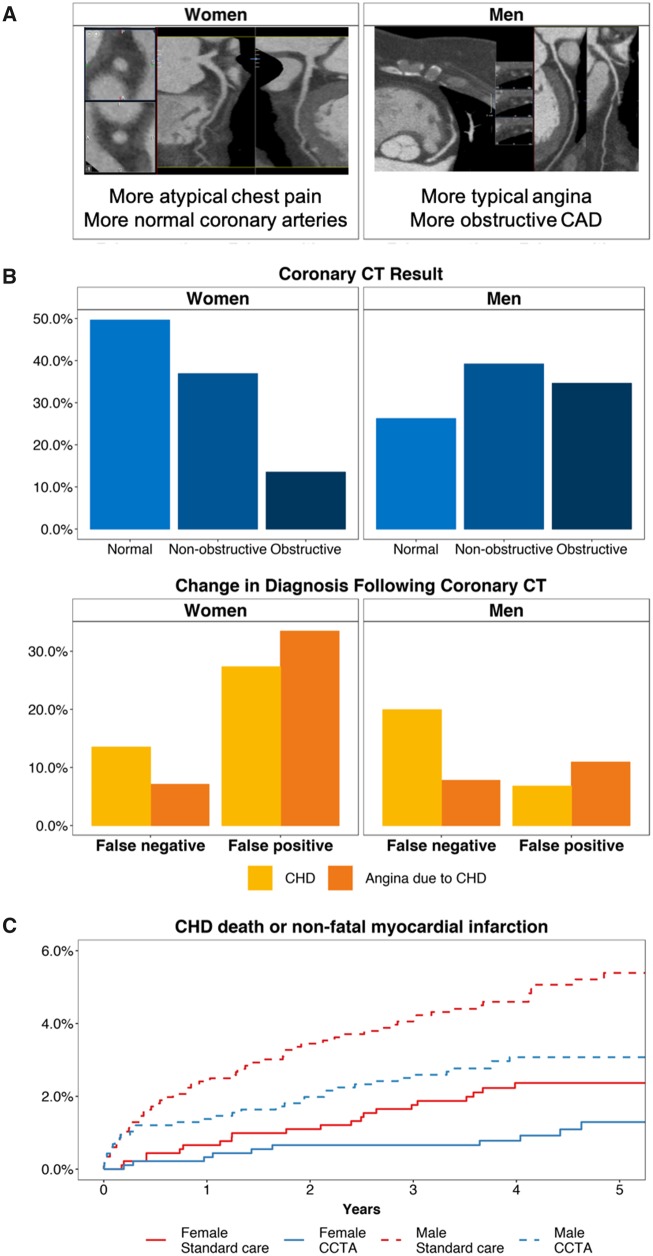
Methods and results: In this post hoc analysis of an open-label parallel-group multicentre trial, we recruited 4146 patients referred for assessment of suspected angina from 12 cardiology clinics across the UK. We randomly assigned (1:1) participants to standard care alone or standard care plus CTCA. Fewer women had typical chest pain symptoms (n = 582, 32.0%) when compared with men (n = 880, 37.9%; P < 0.001). Amongst the CTCA-guided group, more women had normal coronary arteries [386 (49.6%) vs. 263 (26.2%)] and less obstructive CHD [105 (11.5%) vs. 347 (29.8%)]. A CTCA-guided strategy resulted in more women than men being reclassified as not having CHD {19.2% vs. 13.1%; absolute risk difference, 5.7 [95% confidence interval (CI): 2.7-8.7, P < 0.001]} or having angina due to CHD [15.0% vs. 9.0%; absolute risk difference, 5.6 (2.3-8.9, P = 0.001)]. After a median of 4.8 years follow-up, CTCA-guided management was associated with similar reductions in the risk of CHD death or non-fatal myocardial infarction in women [hazard ratio (HR) 0.50, 95% CI 0.24-1.04], and men (HR 0.63, 95% CI 0.42-0.95; Pinteraction = 0.572).
Conclusion: Following the addition of CTCA, women were more likely to be found to have normal coronary arteries than men. This led to more women being reclassified as not having CHD, resulting in more downstream tests and treatments being cancelled. There were similar prognostic benefits of CTCA for women and men.
Keywords: Angina; CT coronary angiography; CTCA; Coronary heart disease; Gender.
© The Author(s) 2019. Published by Oxford University Press on behalf of the European Society of Cardiology.
Figures
References
-
- Caroline D, Felicity C, Lopez Sendon JL, Luigi T, Eric B, Nicholas D, Francois D, Anselm G, Desmond J, David M, Witold R, Kristian T, Freek V, Fox Kim M.. Gender differences in the management and clinical outcome of stable angina. Circulation 2006;113:490–498. - PubMed
-
- Hemingway H, Langenberg C, Damant J, Frost C, PyöRäLä K, Barrett-Connor E.. Prevalence of angina in women versus men: a systematic review and meta-analysis of international variations across 31 countries. Circulation 2008;117:1526–1536. - PubMed
-
- Mosca L, Jones WK, King KB, Ouyang P, Redberg RF, Hill MN.. Awareness, perception, and knowledge of heart disease risk and prevention among women in the United States. American Heart Association Women’s Heart Disease and Stroke Campaign Task Force. Arch Fam Med 2000;9:506–515. - PubMed
-
- King KM, Ghali WA, Faris PD, Curtis MJ, Galbraith PD, Graham MM, Knudtson ML.. Sex differences in outcomes after cardiac catheterization: effect modification by treatment strategy and time. JAMA 2004;291:1220–1225. - PubMed
Publication types
MeSH terms
Grants and funding
LinkOut - more resources
Full Text Sources
Medical
