. 2019 Dec 28;16(1):279.
doi: 10.1186/s12974-019-1675-1.

Complement factor H contributes to mortality in humans and mice with bacterial meningitis

Affiliations

Complement factor H contributes to mortality in humans and mice with bacterial meningitis

E Soemirien Kasanmoentalib et al. J Neuroinflammation. .

Abstract

Background: The complement system is a vital component of the inflammatory response occurring during bacterial meningitis. Blocking the complement system was shown to improve the outcome of experimental pneumococcal meningitis. Complement factor H (FH) is a complement regulatory protein inhibiting alternative pathway activation but is also exploited by the pneumococcus to prevent complement activation on its surface conferring serum resistance.

Methods: In a nationwide prospective cohort study of 1009 episodes with community-acquired bacterial meningitis, we analyzed whether genetic variations in CFH influenced FH cerebrospinal fluid levels and/or disease severity. Subsequently, we analyzed the role of FH in our pneumococcal meningitis mouse model using FH knock-out (Cfh-/-) mice and wild-type (wt) mice. Finally, we tested whether adjuvant treatment with human FH (hFH) improved outcome in a randomized investigator blinded trial in a pneumococcal meningitis mouse model.

Results: We found the major allele (G) of single nucleotide polymorphism in CFH (rs6677604) to be associated with low FH cerebrospinal fluid concentration and increased mortality. In patients and mice with bacterial meningitis, FH concentrations were elevated during disease and Cfh-/- mice with pneumococcal meningitis had increased mortality compared to wild-type mice due to C3 depletion. Adjuvant treatment of wild-type mice with purified human FH led to complement inhibition but also increased bacterial outgrowth which resulted in similar disease outcomes.

Conclusion: Low FH levels contribute to mortality in pneumococcal meningitis but adjuvant treatment with FH at a clinically relevant time point is not beneficial.

Keywords: Animal models; Anti-inflammatory therapy; Bacterial meningitis; Complement factor H; Complement system; Pneumococcal meningitis.


Conflict of interest statement

RBP, DW, and TWK are co-inventors of a patent describing potentiating anti-FH antibodies and uses thereof. All other authors declare that they have no competing interests.

Figures
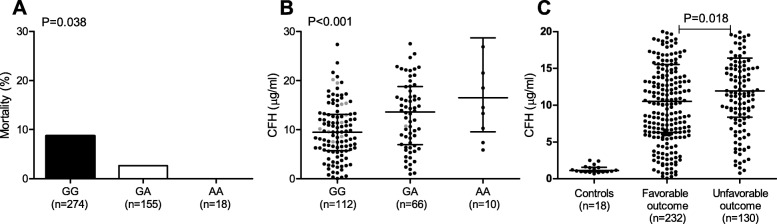
Fig. 1
Fig. 1
Association of SNP rs6677604 with mortality and cerebrospinal fluid FH concentration in patients with bacterial meningitis. In immunocompetent bacterial meningitis patients of Caucasian descent, the rs6677604 major allele G (minor allele frequency A EUR 0.187) was associated with an increased mortality under an additive model (a). P value was determined with the Pearson chi-square test. The rs6677604 major allele G was also associated with lower FH CSF levels under an additive model (b). P value was determined with the Kruskal-Wallis test. In bacterial meningitis patients the CSF FH concentration was significant higher compared to controls (c). Bacterial meningitis patients with an unfavorable outcome had slightly increased FH levels compared to patients with a favorable outcome. After correction for CSF total protein CSF FH levels were similar in bacterial meningitis patients with a unfavourable and a favourable outcome. P value was determined with the Mann-Whitney U test. Each dot represents an individual patient, gray dots represent deceased patients, lines represent median values and error bars are interquartile ranges
Fig. 2
Fig. 2
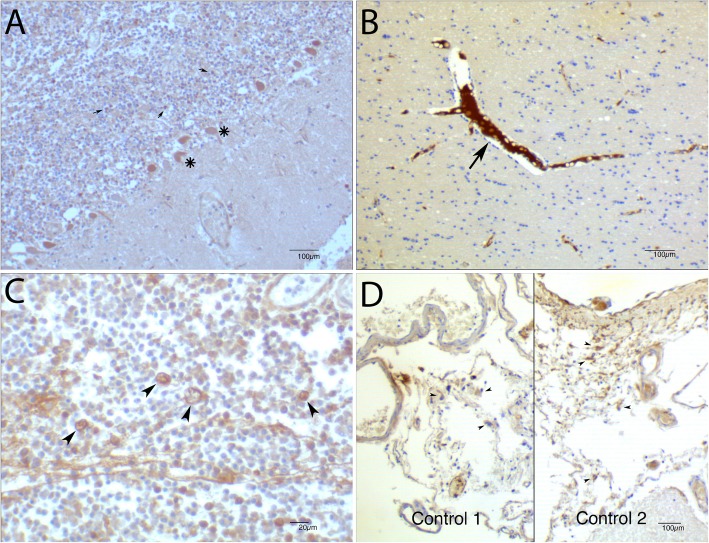
Immunohistochemical staining of brain tissue of a pneumococcal meningitis patient. In the pneumococcal meningitis FH was expressed in the brain parenchymal cells (a), with strong expression in Purkinje cells (a, asterisk) and in cells in the granular layer (a, arrows). In the control case the parenchyma was negative (b) and FH expression was confined in the blood within blood vessels (b, arrow). Inflammatory cells in the meninges of the pneumococcal meningitis case showed strong expression of FH (c) and macrophages show stronger positivity than granulocytes (c, arrowheads). In the control case, meningeal cells showed variable intensity FH expression (d, arrowheads)
Fig. 3
Fig. 3
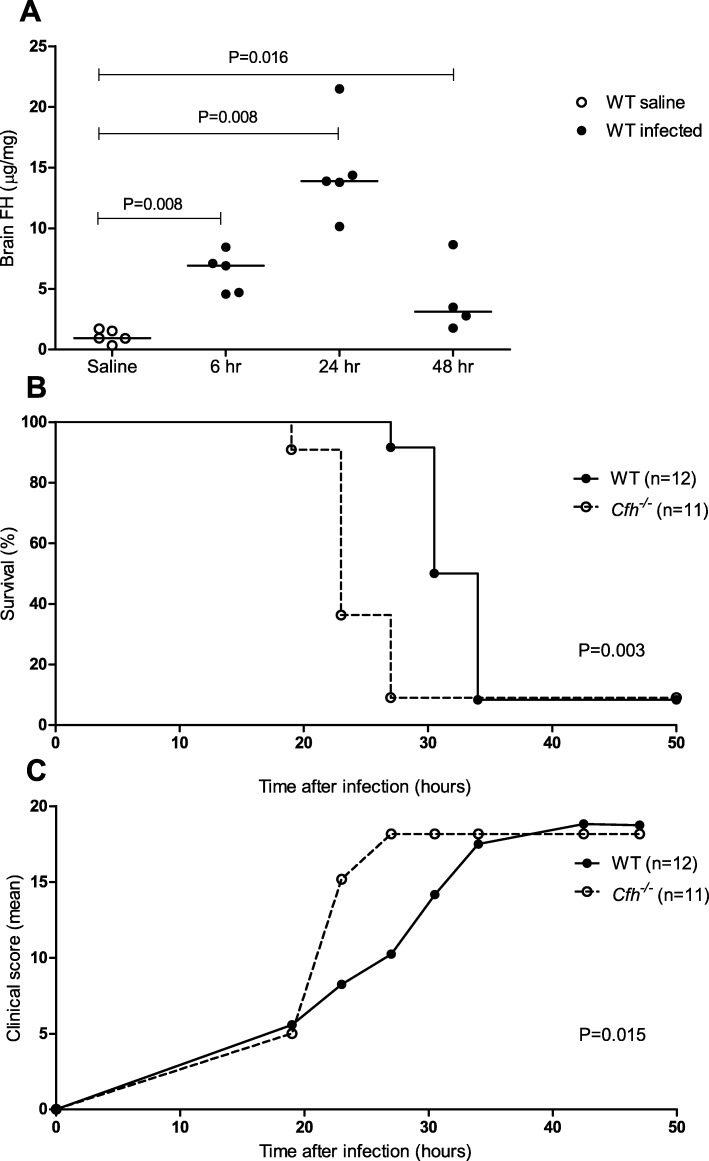
Expression of FH during experimental pneuomococcal meningitis and the effect of FH deficiency on clinical severity and survival. FH brain levels are increased during experimental pneumococcal meningitis at 6, 24, and 48 h after infection compared to saline inoculated mice (a). Lines represent median values, P values were determined with the Mann-Whitney U test. Kaplan-Meier curve of wt and Cfh−/− mice with pneumococcal meningitis. P value was determined with the log-rank test (b). Clinical severity scores for Cfh−/− mice increased faster as compared to wt mice (0.112 vs. 0.088 points/h). P value was determined using exponential regression (c)
Fig. 4.
Fig. 4.
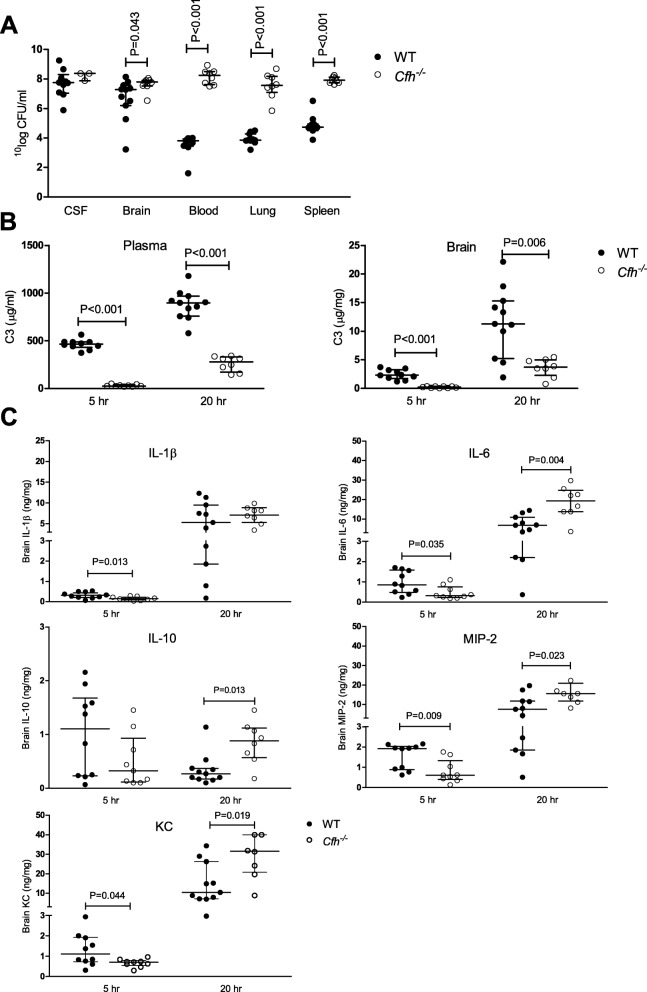
Effect of FH deficiency on bacterial outgrowth, complement, and inflammatory response during experimental pneumococcal meningitis. Bacterial outgrowth in CSF, brain, blood, lung, and spleen of Cfh−/− and wt mice at 20 h after infection (a). Plasma and brain C3 levels were decreased in Cfh−/− mice compared to wt mice at 5 and 20 h after infection (b). Cfh−/− mice had significantly lower cytokine and chemokine brain levels at 5 h after infection and significant higher cytokine and chemokine brain levels at 20 h after infection (c). Data are given as medians and interquartile ranges, P values were determined with the Mann-Whitney U test
Fig. 5
Fig. 5
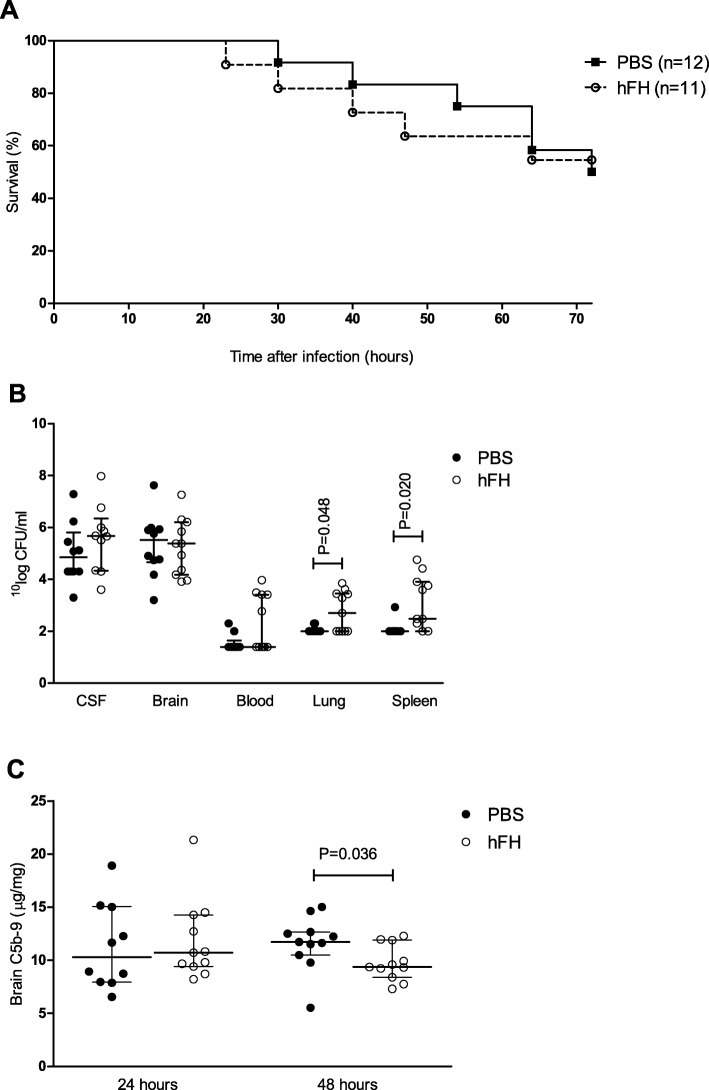
Adjuvant treatment with human FH in experimental pneumococcal meningitis. Mortality rates were similar between hFH- and PBS-treated mice (45% vs. 50%) (a). Bacterial outgrowth was increased in hFH-treated mice compared to PBS-treated mice in lung and spleen at 24 h after infection (b). Activation of the terminal complement pathway indicated by C5b-9 level was significant lower in mice treated with hFH compared to mice treated with PBS in the brain at 48 h after infection, median 9.37 μg/mg tissue vs. 11.71 μg/mg tissue (c). Lines represent median values and error bars are interquartile ranges, P values were determined with the Mann-Whitney U test

References

    1. Bijlsma MW, Brouwer MC, Kasanmoentalib ES, Kloek AT, Lucas MJ, Tanck MW, et al. Community-acquired bacterial meningitis in adults in the Netherlands, 2006-14: a prospective cohort study. Lancet Infect Dis. 2016;16(3):339–347. doi: 10.1016/S1473-3099(15)00430-2. - DOI - PubMed
    1. van de Beek D, de Gans J, Tunkel AR, Wijdicks EF. Community-acquired bacterial meningitis in adults. N Engl J Med. 2006;354(1):44–53. doi: 10.1056/NEJMra052116. - DOI - PubMed
    1. van de Beek D, de Gans J, Spanjaard L, Weisfelt M, Reitsma JB, Vermeulen M. Clinical features and prognostic factors in adults with bacterial meningitis. N Engl J Med. 2004;351(18):1849–1859. doi: 10.1056/NEJMoa040845. - DOI - PubMed
    1. Scarborough M, Thwaites GE. The diagnosis and management of acute bacterial meningitis in resource-poor settings. Lancet Neurol. 2008;7(7):637–648. doi: 10.1016/S1474-4422(08)70139-X. - DOI - PubMed
    1. Wall EC, Cartwright K, Scarborough M, Ajdukiewicz KM, Goodson P, Mwambene J, et al. High mortality amongst adolescents and adults with bacterial meningitis in sub-Saharan Africa: an analysis of 715 cases from Malawi. PLoS One. 2013;8(7):e69783. doi: 10.1371/journal.pone.0069783. - DOI - PMC - PubMed

Substances

LinkOut - more resources